
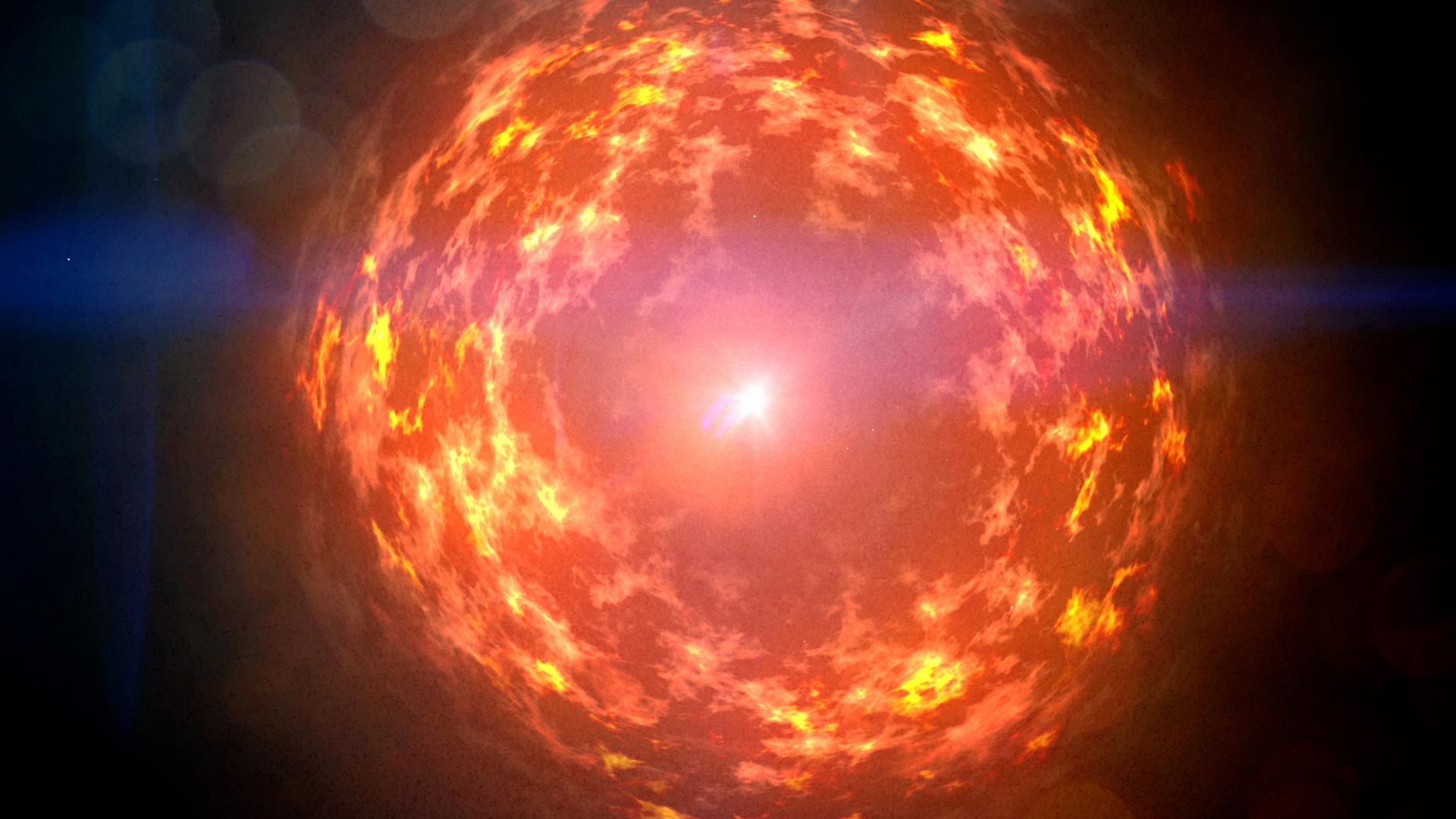
Observations of SN 2023ixf in 2023 led to surprising findings regarding cosmic ray production by supernovae, with potential implications for understanding cosmic ray origins and acceleration mechanisms.
In 2023, a nearby supernova offered astrophysicists an excellent opportunity to test ideas about how these types of explosions boost particles, called cosmic rays, to near light-speed. But surprisingly, NASA’s Fermi Gamma-ray Space Telescope detected none of the high-energy gamma-ray light those particles should produce.
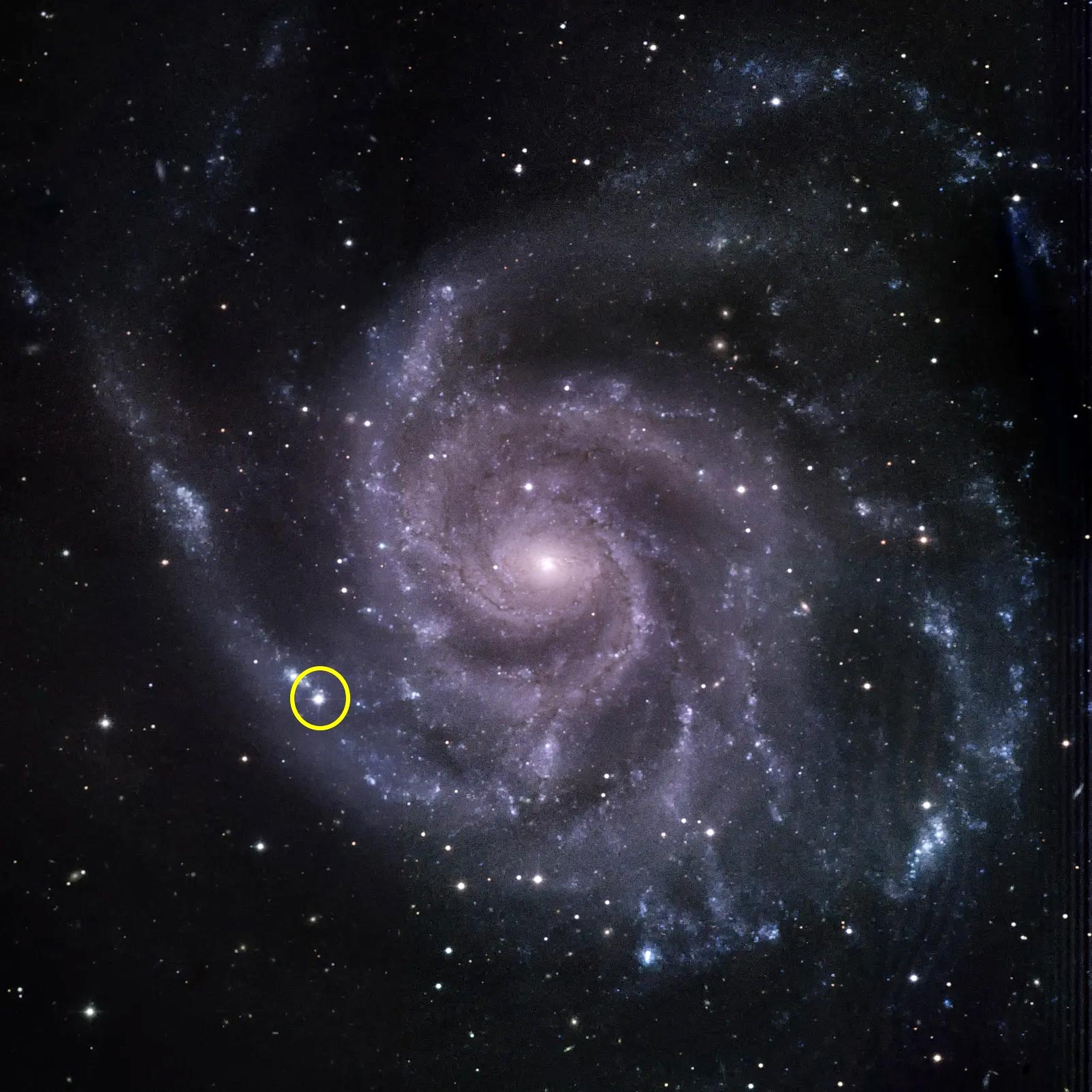
On May 18, 2023, a supernova erupted in the nearby Pinwheel galaxy (Messier 101), located about 22 million light-years away in the constellation Ursa Major. The event, named SN 2023ixf, is the most luminous nearby supernova discovered since Fermi launched in 2008.
Unanticipated Results From Fermi Telescope
“Astrophysicists previously estimated that supernovae convert about 10% of their total energy into cosmic ray acceleration,” said Guillem Martí-Devesa, a researcher at the University of Trieste in Italy. “But we have never observed this process directly. With the new observations of SN 2023ixf, our calculations result in an energy conversion as low as 1% within a few days after the explosion. This doesn’t rule out supernovae as cosmic ray factories, but it does mean we have more to learn about their production.”
The paper, led by Martí-Devesa while at the University of Innsbruck in Austria, will appear in a future edition of Astronomy and Astrophysics.
Even when it doesn’t detect gamma rays, NASA’s Fermi Gamma-ray Space Telescope helps astronomers learn more about the universe. Credit: NASA’s Goddard Space Flight Center
Cosmic Rays and Their Origins
Trillions of trillions of cosmic rays collide with Earth’s atmosphere every day. Roughly 90% of them are hydrogen nuclei – or protons – and the remainder are electrons or the nuclei of heavier elements.
Scientists have been investigating cosmic ray origins since the early 1900s, but the particles can’t be traced back to their sources. Because they’re electrically charged, cosmic rays change course as they travel to Earth thanks to magnetic fields they encounter.
“Gamma rays, however, travel directly to us,” said Elizabeth Hays, the Fermi project scientist at NASA’s Goddard Space Flight Center in Greenbelt, Maryland. “Cosmic rays produce gamma rays when they interact with matter in their environment. Fermi is the most sensitive gamma-ray telescope in orbit, so when it doesn’t detect an expected signal, scientists must explain the absence. Solving that mystery will build a more accurate picture of cosmic ray origins.”
Supernovae As Cosmic Ray Accelerators
Astrophysicists have long suspected supernovae of being top cosmic ray contributors.
These explosions occur when a star at least eight times the Sun’s mass runs out of fuel. The core collapses and then rebounds, propelling a shock wave outward through the star. The shock wave accelerates particles, creating cosmic rays. When cosmic rays collide with other matter and light surrounding the star, they generate gamma rays.
Supernovae greatly impact a galaxy’s interstellar environment. Their blast waves and expanding cloud of debris may persist for more than 50,000 years. In 2013, Fermi measurements showed that supernova remnants in our own Milky Way galaxy were accelerating cosmic rays, which generated gamma-ray light when they struck interstellar matter. But astronomers say the remnants aren’t producing enough high-energy particles to match scientists’ measurements on Earth.
One theory proposes that supernovae may accelerate the most energetic cosmic rays in our galaxy in the first few days and weeks after the initial explosion.
But supernovae are rare, occurring only a few times a century in a galaxy like the Milky Way. Out to distances of around 32 million light-years, a supernova occurs, on average, just once a year.
After a month of observations, starting when visible light telescopes first saw SN 2023ixf, Fermi had not detected gamma rays.
Challenges and Future Research
“Unfortunately, seeing no gamma rays doesn’t mean there are no cosmic rays,” said co-author Matthieu Renaud, an astrophysicist at the Montpellier Universe and Particles Laboratory, part of the National Center for Scientific Research in France. “We have to go through all the underlying hypotheses regarding acceleration mechanisms and environmental conditions in order to convert the absence of gamma rays into an upper limit for cosmic ray production.”
The researchers propose a few scenarios that may have affected Fermi’s ability to see gamma rays from the event, like the way the explosion distributed debris and the density of material surrounding the star.
Fermi’s observations provide the first opportunity to study conditions right after the supernova explosion. Additional observations of SN 2023ixf at other wavelengths, new simulations and models based on this event, and future studies of other young supernovae will help astronomers home in on the mysterious sources of the universe’s cosmic rays.
Fermi is an astrophysics and particle physics partnership managed by Goddard. Fermi was developed in collaboration with the U.S. Department of Energy, with important contributions from academic institutions and partners in France, Germany, Italy, Japan, Sweden, and the United States.
Never miss a breakthrough: Join the SciTechDaily newsletter.
Follow us on Google and Google News.
1 Comment
“We can measure that we get bursts of cosmic rays when the sun flares, so some of them come from the sun. But many of them seem to come from further away. The majority probably come from somewhere in our galaxy, but a few appear to come from beyond our galaxy!
Scientists believe cosmic rays get spit out by faraway stars exploding (called supernovas). Others could be produced when matter falls into supermassive black holes, from highly magnetized neutron stars, or when galaxies collide.”
– “Cosmic rays, explained”, uchicago news
“Subsequently, Sekido et al. (1951) identified the Crab Nebula as a source of cosmic rays.”
“In 2017, the Pierre Auger Collaboration published the observation of a weak anisotropy in the arrival directions of the highest energy cosmic rays.[58] Since the Galactic Center is in the deficit region, this anisotropy can be interpreted as evidence for the extragalactic origin of cosmic rays at the highest energies. This implies that there must be a transition energy from galactic to extragalactic sources, and there may be different types of cosmic-ray sources contributing to different energy ranges.”
– “Cosmic ray”, Wikipedia