
Close Menu
    Facebook X (Twitter) Instagram
    SciTechDaily
    • Biology
    • Chemistry
    • Earth
    • Health
    • Physics
    • Science
    • Space
    • Technology
    Facebook X (Twitter) Pinterest YouTube RSS
    SciTechDaily
    Home»Space»Cosmic Chaos and the Clues in Fast Radio Bursts
    Space

    Cosmic Chaos and the Clues in Fast Radio Bursts

    By Science China PressApril 19, 2024No Comments4 Mins Read
    Facebook Twitter Pinterest Telegram LinkedIn WhatsApp Email Reddit
    Share
    Facebook Twitter LinkedIn Pinterest Telegram Email Reddit
    Compact Object Generating FRBs
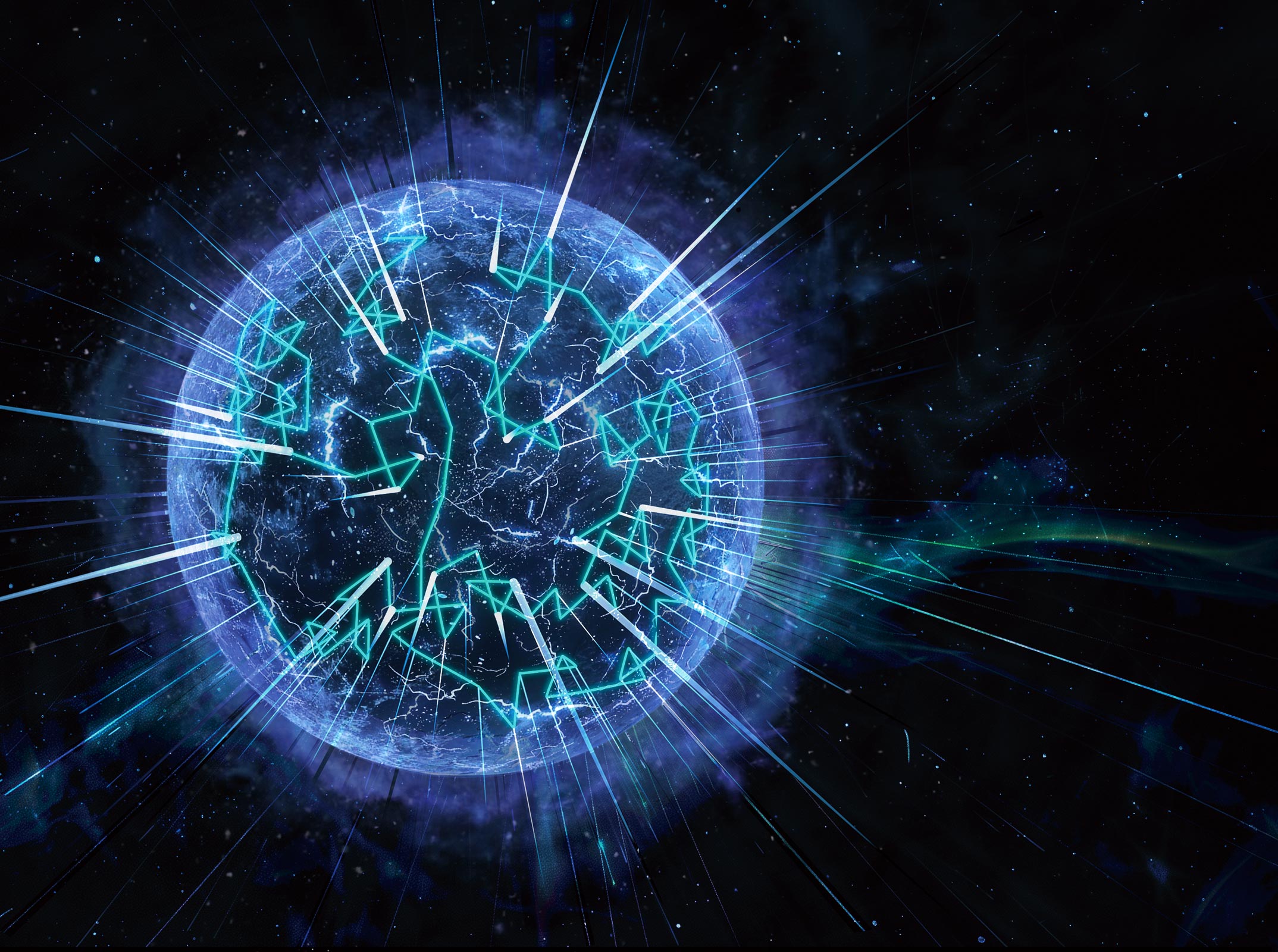
    White fissures on the magnetar’s surface symbolizing starquake activity, and conical spikes extending from the surface representing multiple bursts of FRBs. The spikes vary in size, mirroring the variability in burst energy. Green lines connecting the bursts indicate a random walk path, symbolizing the stochastic nature of fast radio burst activity. There’s no direct link between the green zigzag lines and the starquake fissures, highlighting the distinction between the nature of FRBs and earthquakes. Credit: ©Science China Press

    Research on fast radio bursts (FRBs) highlights their extreme energy output and enigmatic nature. Recent studies using innovative methods to analyze FRBs suggest they are caused by multiple emission mechanisms, adding complexity to understanding their origins.

    Fast radio bursts (FRBs) represent the most intense radio explosions in the Universe, releasing sufficient energy, within just a thousandth of a second, to power the global human society for a trillion years. Since the first discovery in 2007, FRBs have garnered significant attention, culminating in the 2023 Shaw Prize in Astronomy. With yet unknown origin, these extreme cosmic bursts are among the most enigmatic phenomena in astronomy as well as physics.

    Causality dictates that FRB sources should be smaller than c·dt in size, where c is the speed of light and dt is the duration of the events. For a typical 1 millisecond burst, this implies a region smaller than 300 kilometers, implying compact objects such as neutron stars or black holes to be the FRBs’ engines. Fast spin has been observed in most compact objects, giving rise to the expectation of periodicity in repeating FRBs’ bursts. However, extensive searches for periodicity from millisecond to second scales have all failed, prompting a re-evaluation of FRB emission mechanisms.
    Pincus Index vs Lyapunov Exponent of Sine Function
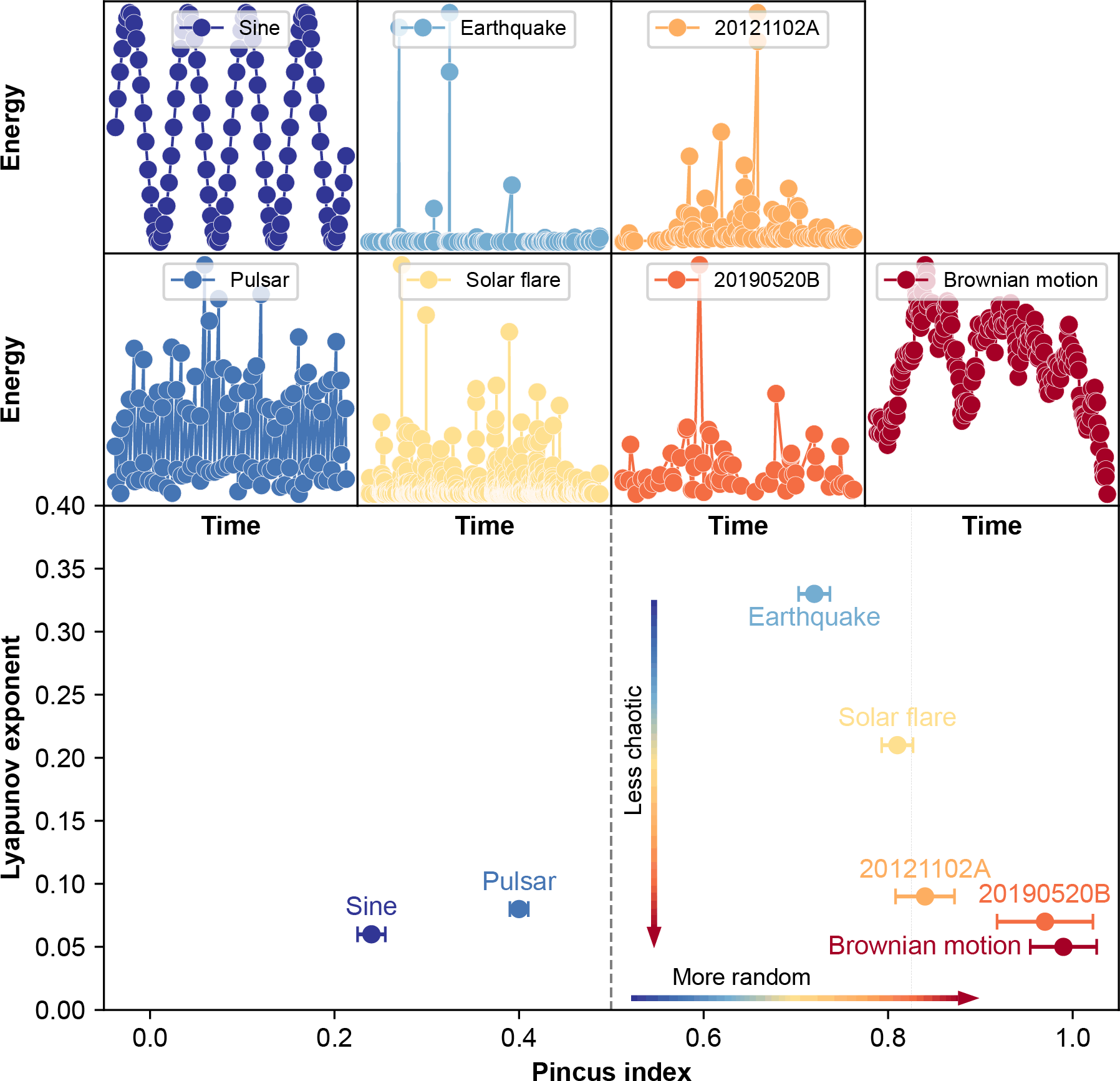
    The top and middle panels present event series in the time-energy space of these sources. The color changes from blue to red, implying increased stochasticity. In the bottom panel, fast radio bursts congregate with Brownian motion toward highly random, yet less chaotic regions in the stochasticity-chaos phase space, which is distinct from earthquakes and solar flares, both of which are more chaotic but less random than FRBs. Credit: ©Science China Press

    A team led by Professor Di Li from the National Astronomical Observatories of the Chinese Academy of Sciences has introduced a novel approach to characterize the FRBs’ behavior in the time-energy bivariate phase space. Quantifying the randomness and chaos using generalized “Pincus Index” and “Lyapunov Exponent,” respectively, they manage to place FRBs in the context of other common physical events like pulsars, earthquakes, and solar flares, systematically.

    Both randomness and chaos cause unpredictability, but they are distinct. The unpredictability of a random sequence stays constant over time, picturing rolling dice—the outcome of each roll bears no link to the previous one. In chaotic systems, unpredictability increases exponentially over time. For example, anyone can predict the weather in the coming seconds by looking up and around, while it is still challenging for mankind to predict weather for the longer term accurately.

    The team found FRBs to roam around the energy-time phase space, with a lower level of chaos but a higher degree of randomness than those of earthquakes and solar flares. The pronounced randomness of FRB emissions suggests a combination of multiple emission mechanisms or locations. This study establishes a new frame of quantifying FRBs and gets us closer to finally revealing the origin of these violent cosmic explosions: who is rolling the cosmic dice?

    Reference: “The arrival time and energy of FRBs traverse the time-energy bivariate space like a Brownian motion” by Yong-Kun Zhang, Di Li, Yi Feng, Pei Wang, Chen-Hui Niu, Shi Dai, Ju-Mei Yao and Chao-Wei Tsai, 9 February 2024, Science Bulletin.
    DOI: 10.1016/j.scib.2024.02.010

    Never miss a breakthrough: Join the SciTechDaily newsletter.
    Follow us on Google and Google News.

    Astronomy Astrophysics Fast Radio Bursts
    Share. Facebook Twitter Pinterest LinkedIn Email Reddit

    Related Articles

    Mysterious Source of Fast Radio Bursts – “We Could Not Believe It”

    Mysterious Cosmic Flashes Pinpointed to a Surprising Location in Space – “Closest Ever”

    Something Really Wants Our Attention: One Cosmic Object Emitted 1,652 Fast Radio Bursts in 47 Days

    Origin Unknown: Over a Thousand Powerful Cosmic Explosions Detected by FAST Telescope in 47 Days

    Puzzling Periodicity of a Fast Radio Burst Probed by Two of the Biggest Radio Telescopes in the World

    CHIME Telescope Detects More Than 500 Mysterious Fast Radio Bursts From Outer Space

    Magnetic Monsters: Hubble Tracks Down Location of Mysterious Radio Signals From Intergalactic Space

    Enhanced X-ray Emissions Coincide With Giant Radio Pulses From Crab Pulsar

    Mysterious Fast Radio Bursts Include Lower Frequency Radio Waves Than Previously Detected

    Leave A Reply Cancel Reply

    • Facebook
    • Twitter
    • Pinterest
    • YouTube

    Don't Miss a Discovery

    Subscribe for the Latest in Science & Tech!

    Trending News

    Monster Storms on Jupiter Unleash Lightning Beyond Anything on Earth

    Scientists Create “Liquid Gears” That Spin Without Touching

    The Simple Habit That Could Help Prevent Cancer

    Millions Take These IBS Drugs, But a New Study Finds Serious Risks

    Scientists Unlock Hidden Secrets of 2,300-Year-Old Mummies Using Cutting-Edge CT Scanner

    Bread Might Be Making You Gain Weight Even Without Eating More Calories

    Scientists Discover Massive Magma Reservoir Beneath Tuscany

    Europe’s Most Active Volcano Just Got Stranger – Here’s Why Scientists Are Rethinking It

    Follow SciTechDaily
    • Facebook
    • Twitter
    • YouTube
    • Pinterest
    • Newsletter
    • RSS
    SciTech News
    • Biology News
    • Chemistry News
    • Earth News
    • Health News
    • Physics News
    • Science News
    • Space News
    • Technology News
    Recent Posts
    • Scientists Were Wrong About This Strange “Rule-Breaking” Particle
    • Webb Space Telescope Uncovers Unexpected Ice Clouds on a Jupiter-Like World
    • 289-Million-Year-Old Reptile Mummy Reveals Origin of Human Breathing System
    • New Brain Discovery Challenges Long-Held Theory of Teenage Brain Development
    • Sharks Are Overheating as Warming Oceans Push Them to the Edge
    Copyright © 1998 - 2026 SciTechDaily. All Rights Reserved.
    • Science News
    • About
    • Contact
    • Editorial Board
    • Privacy Policy
    • Terms of Use

    Type above and press Enter to search. Press Esc to cancel.