
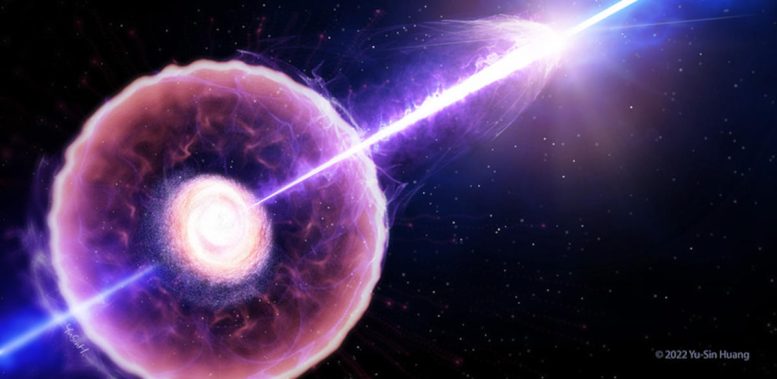
By studying polarization, researchers uncovered hidden energy in GRB191221B, advancing insights into star masses and early universe history.
Gamma-ray bursts are the brightest explosions in the cosmos, emitting intense gamma rays for brief periods of time. These bursts are categorized as either short or long, with long gamma-ray bursts being produced by the death of massive stars. Hence why they provide hidden clues about the evolution of the universe.
Gamma-ray bursts release not only gamma rays, but also radio waves, optical light, and X-rays. When the efficiency of converting explosion energy to emitted energy is high, the total energy of the explosion can be determined by summing up all the emitted energy. However, when the conversion efficiency is low or uncertain, measuring only the emitted energy is not sufficient to calculate the total explosion energy.
Polarization: Unlocking Hidden Energies
Now, a team of astrophysicists has succeeded in measuring a gamma-ray burst’s hidden energy by utilizing light polarization. The team was led by Dr. Yuji Urata from the National Central University in Taiwan and MITOS Science CO., LTD, and Professor Kenji Toma from Tohoku University’s Frontier Research Institute for Interdisciplinary Sciences (FRIS).
Details of their findings were recently published in the journal Nature Astronomy.
When an electromagnetic wave is polarized, it means that the oscillation of that wave flows in one direction. While light emitted from stars is not polarized, the reflection of that light is. Many everyday items such as sunglasses and light shields utilize polarization to block out the glare of lights traveling in a uniform direction.
Measuring the degree of polarization is referred to as polarimetry. In astrophysical observations, measuring a celestial object’s polarimetry is not as easy as measuring its brightness. But it offers valuable information on the physical conditions of objects.
The team looked at a gamma-ray burst that occurred on December 21, 2019 (GRB191221B). Using the Very Large Telescope of the European Southern Observatory and Atacama Large Millimeter/submillimeter Array – some of the world’s most advanced optical and radio telescopes – they calculated the polarimetry of fast-fading emissions from GRB191221B. They then successfully measured the optical and radio polarizations simultaneously, finding the radio polarization degree to be significantly lower than the optical one.
Discovering the Hidden Energy
“This difference in polarization at the two wavelengths reveals detailed physical conditions of the gamma-ray burst’s emission region,” said Toma. “In particular, it allowed us to measure the previously unmeasurable hidden energy.”
When accounting for the hidden energy, the team revealed that the total energy was about 3.5 times bigger than previous estimates.
With the explosion energy representing the gravitational energy of the progenitor star, being able to measure this figure has important ramifications for determining stars’ masses.
“Knowing the measurements of the progenitor star’s true masses will help in understanding the evolutionary history of the universe,” added Toma. “The first stars in the universe could be discovered if we can detect their long gamma-ray bursts.”
Reference: “Simultaneous radio and optical polarimetry of GRB 191221B afterglow” by Yuji Urata, Kenji Toma, Stefano Covino, Klaas Wiersema, Kuiyun Huang, Jiro Shimoda, Asuka Kuwata, Sota Nagao, Keiichi Asada, Hiroshi Nagai, Satoko Takahashi, Chao-En Chung, Glen Petitpas, Kazutaka Yamaoka, Luca Izzo, Johan Fynbo, Antonio de Ugarte Postigo, Maryam Arabsalmani, and Makoto Tashiro, 8 December 2022, Nature Astronomy.
DOI: 10.1038/s41550-022-01832-7
Never miss a breakthrough: Join the SciTechDaily newsletter.
Follow us on Google and Google News.