

Researchers discovered that insulin-producing cells are inhibited during activity, promoting energy use, and reactivated afterward, aiding recovery.
Insulin is a vital hormone that plays a crucial role in regulating sugar metabolism in humans and other organisms. The mechanisms by which it performs this task are well understood. However, less is known about the control of insulin-secreting cells and the resulting insulin secretion.
Researchers from the Biocenter of Julius-Maximilians-Universität (JMU) Würzburg in Germany have made new discoveries about the control of insulin secretion in their recent study published in Current Biology. The team, led by Dr. Jan Ache, used the fruit fly Drosophila melanogaster as a model organism. Interestingly, this fly also releases insulin after eating, but unlike humans, the hormone is not produced by pancreas cells, but rather by nerve cells in the brain.
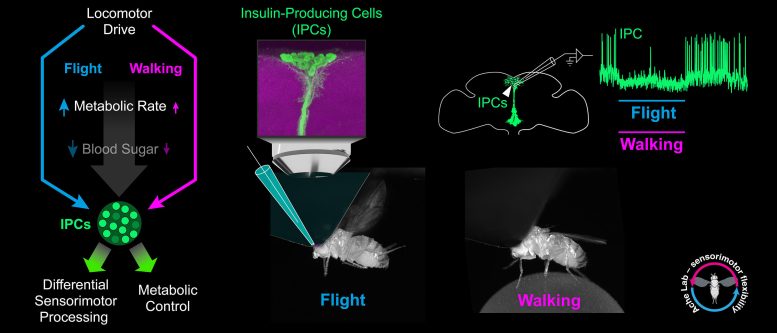
Electrophysiological Measurements in Active Flies
The JMU group figured out that the physical activity of the fly has a strong effect on its insulin-producing cells. For the first time, the researchers measured the activity of these cells electrophysiologically in walking and flying Drosophila.
The result: when Drosophila starts to walk or fly, its insulin-producing cells are immediately inhibited y. When the fly stops moving, the activity of the cells rapidly increases again and shoots up above normal levels.
“We hypothesize that the low activity of insulin-producing cells during walking and flight contributes to the provision of sugars to meet the increased energy demand,” says Dr. Sander Liessem, first author of the publication. “We suspect that the increased activity after exercise helps to replenish the fly’s energy stores, for example in the muscles.”
Blood Sugar Plays No Role in Regulation
The JMU team was also able to demonstrate that the fast, behavior-dependent inhibition of insulin-producing cells is actively controlled by neural pathways. “It is largely independent of changes in the sugar concentration in the fly’s blood,” explains co-author Dr. Martina Held.
It makes a lot of sense for the organism to anticipate an increased energy demand in this way to prevent extreme fluctuations in blood sugar levels.
Insulin Has Hardly Changed in Evolution
Do the results allow conclusions to be drawn about humans? Probably.
“Although the release of insulin in fruit flies is mediated by different cells than in humans, the insulin molecule and its function have hardly changed in the course of evolution,” says Jan Ache. In the past 20 years, using Drosophila as a model organism, many fundamental questions have already been answered that could also contribute to a better understanding of metabolic defects in humans and associated diseases, such as diabetes or obesity.
Less Insulin Means Longevity
“One exciting point is that reduced insulin activity contributes to healthy aging and longevity,” Sander Liessem tells us. This has already been shown in flies, mice, humans, and other species. The same applies to an active lifestyle. “Our work shows a possible link explaining how physical activity could positively affect insulin regulation via neuronal signaling pathways.”
Further Steps in the Research
Next, Jan Ache’s team plans to investigate which neurotransmitters and neuronal circuits are responsible for the activity changes observed in insulin-producing cells in the fly. This is likely going to be challenging: A plethora of messenger substances and hormones are involved in neuromodulatory processes, and individual substances can have opposite or complementary effects in combination.
The group is now analyzing the many ways in which insulin-producing cells process input from the outside. They are also investigating other factors that could have an influence on the activity of these cells, for example, the age of the fly or their nutritional state.
“In parallel, we are investigating the neuronal control of walking and flight behavior,” explains Jan Ache. The long-term goal of his group, he says, is to bring these two research questions together: How does the brain control walking and other behaviors, and how does the nervous system ensure that the energy balance is regulated accordingly?
Reference: “Behavioral state-dependent modulation of insulin-producing cells in Drosophila” by Sander Liessem, Martina Held, Rituja S. Bisen, Hannah Haberkern, Haluk Lacin, Till Bockemühl and Jan M. Ache, 28 December 2022, Current Biology.
DOI: 10.1016/j.cub.2022.12.005
Never miss a breakthrough: Join the SciTechDaily newsletter.
Follow us on Google and Google News.
3 Comments
For people with Diabetes is curbing insulin production a good or bad thing?
Exercise is a good thing.
There is a more productive way to control 🛂 an health wise that màkes more sense period. Exercise 💪 is very realistic completely.