
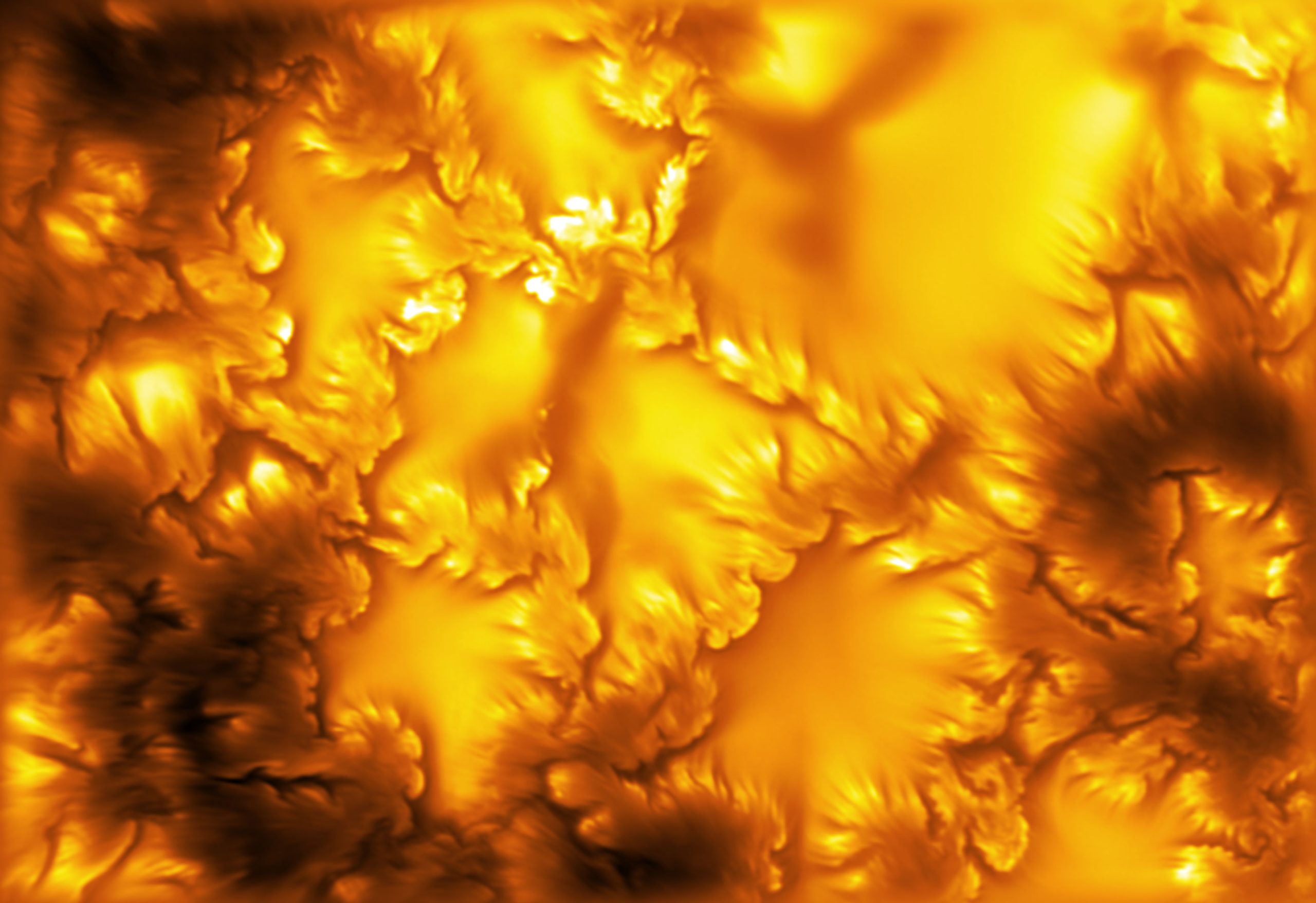
The world’s largest solar telescope and advanced computer simulations revealed vortices that are reshaping our understanding of the Sun.
Across the Sun’s visible surface, hot plasma is constantly rising, cooling, and sinking. At the edges of these churning regions, researchers have now resolved tiny swirling structures that may help explain how the Sun twists, stores, and transports magnetic energy.
The plasma vortices were revealed through observations from the NSF Daniel K. Inouye Solar Telescope in Hawaii, the world’s largest solar telescope, combined with advanced computer simulations. The work involved researchers from the U.S. National Science Foundation National Solar Observatory (NSF NSO), the Max Planck Institute for Solar System Research (MPS) in Germany, and the High Altitude Observatory (HAO) in the USA.
Seeing the structures required resolving features only about 20 kilometers across. Researchers used a broadband imaging camera supplied by MPS, while MPS scientist and coauthor Michiel van Noort contributed to the observations as well as the processing and restoration of the images.
“To detect the vortices, we needed to resolve structures on the solar surface about 20 kilometers in size. That is at the limit of what even the world’s largest solar telescope and state-of-the-art simulations can achieve,” said MPS scientist and co-author of the new publication Michiel van Noort, who, among other things, contributed to the observations and conducted the data reduction and image restoration.
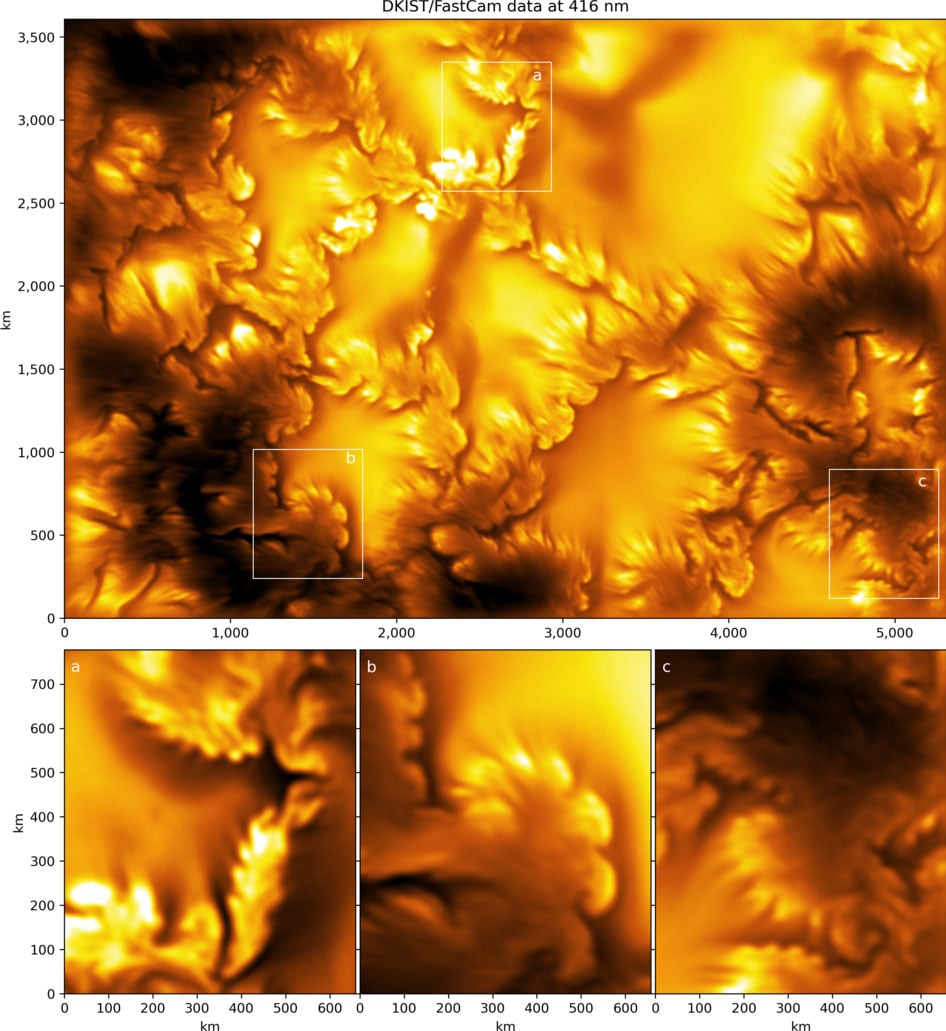
Tiny vortices emerge at granule edges
The newly visible structures form along the boundaries of granules, features that densely cover the Sun’s surface and measure roughly 500 to 2,000 kilometers across. Collectively, these granules create the pattern known as solar granulation.
Granulation is produced by the continual movement of plasma from the Sun’s hot interior. Material rises toward the surface, loses heat, and then descends again. Along the edges of these granules, the researchers identified delicate fringes that repeatedly curl into motions resembling ocean waves as they break.
Some fringes measure barely more than 20 kilometers across. From Earth, resolving a solar feature at that scale is comparable to identifying a one-euro coin from 180 kilometers away.
The researchers interpret the swirling patterns as evidence of Kelvin-Helmholtz instabilities, a familiar phenomenon in fluid dynamics. These instabilities develop when neighboring fluids move at different speeds, creating shear forces along their boundary. Small disturbances can then grow into waves or vortices.
The same process appears in many environments, including lake surfaces, ocean waves, cloud formation, the atmospheres of Jupiter and Saturn, and regions where the solar wind interacts with planetary magnetospheres. At the Sun’s granule boundaries, neighboring layers of plasma also appear to move at different speeds, providing the conditions needed to generate Kelvin-Helmholtz instabilities.
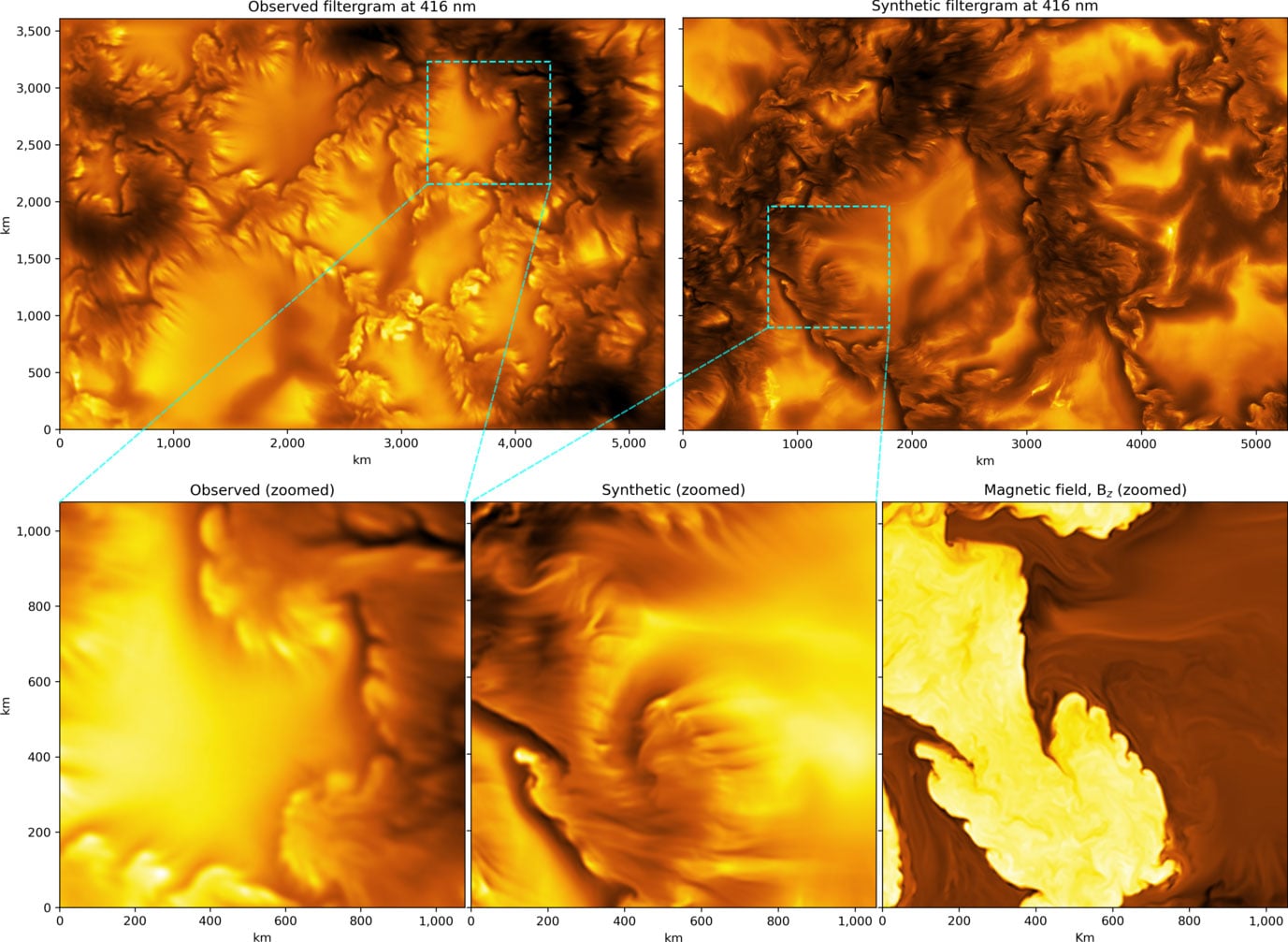
Vortices may twist magnetic fields
The tiny vortices could help resolve a longstanding question about how the Sun stores energy in its magnetic field and later releases it, sometimes through small bursts of radiation called nanoflares.
Current theory holds that magnetic energy accumulates as magnetic field lines become twisted and coiled, much like mechanical energy building in a tightly wound metal spring. As more energy is stored, the magnetic configuration becomes increasingly unstable.
That energy can eventually escape through magnetic reconnection, a process in which twisted magnetic field lines break apart and reconnect in a different arrangement.
What has remained uncertain is what repeatedly causes those magnetic field lines to twist. The newly observed vortices may provide part of the explanation. Because they seem to occur continually in locations where the magnetic field is sufficiently strong, the swirling plasma could routinely drive the twisting process.
Magnetic flux could spread faster
The analysis also indicates that these small vortices efficiently mix magnetized plasma with plasma that is not magnetized at the Sun’s surface. That mixing could help magnetic fields move rapidly upward into the solar atmosphere.
This matters because the Sun’s magnetic activity changes on an eleven-year cycle, an unusually fast transformation on cosmic timescales. For its magnetic structure to change that quickly, magnetic flux must be transported efficiently through the atmosphere.
Existing models have struggled to account for such rapid diffusion. The newly observed vortices provide a possible mechanism that could help explain how magnetic flux moves away from the surface fast enough to support those changes.
“The newly discovered plasma vortices impressively demonstrate how minute processes — at the limit of what we can resolve using all available techniques — significantly determine the nature of our star,” said Sami K. Solanki, director of the MPS and co-author of the new publication.
Reference: “Ubiquitous Kelvin–Helmholtz instabilities driving plasma mixing on the Sun” by David Kuridze, Friedrich Wöger, Michiel van Noort, Matthias Rempel, Robert Cameron, Thomas Rimmele, Sami K. Solanki, Sarah A. Jaeggli, Alexandra Tritschler, Han Uitenbroek, Damien Przybylski and David A. Boboltz, 5 August 2026, Nature.
DOI: 10.1038/s41586-026-10871-3
This project has received funding from the European Research Council under the European Union’s Horizon 2020 research and innovation program (Grant Agreement No. 101097844 for Project WINSUN). This material is based upon work supported by the NSF National Center for Atmospheric Research, which is a main facility sponsored by the US National Science Foundation (Cooperative Agreement No. 1852977).
Never miss a breakthrough: Join the SciTechDaily newsletter.
Follow us on Google and Google News.
1 Comment
Fractals