
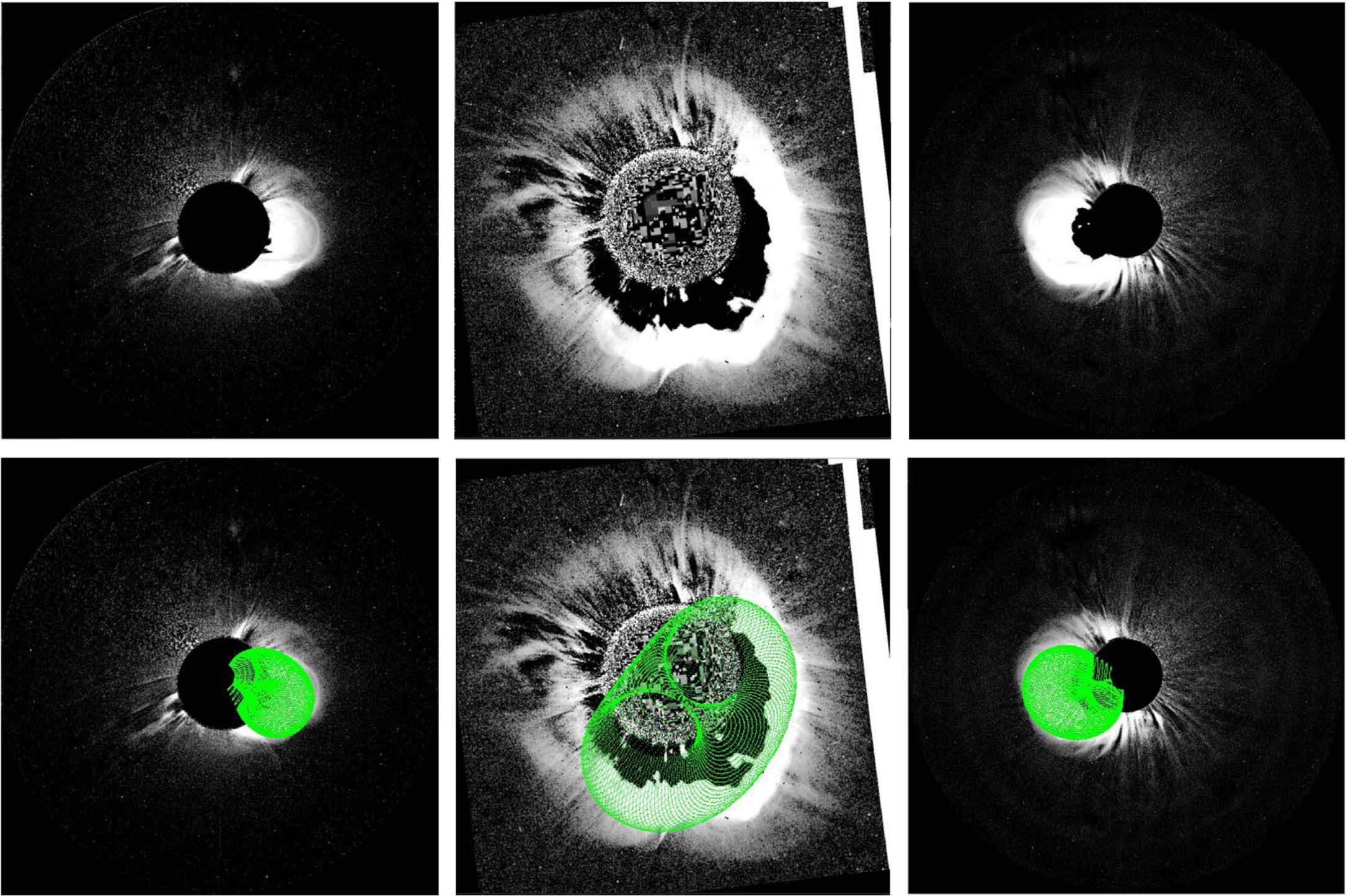
Using supercomputers, researchers develop new software for improved space weather prediction.
The surface of the sun churns with energy and frequently ejects masses of highly-magnetized plasma towards Earth. Sometimes these ejections are strong enough to crash through the magnetosphere — the natural magnetic shield that protects the Earth — damaging satellites or electrical grids. Such space weather events can be catastrophic.
Astronomers have studied the sun’s activity for centuries with greater and greater understanding. Today, computers are central to the quest to understand the sun’s behavior and its role in space weather events.
The bipartisan PROSWIFT (Promoting Research and Observations of Space Weather to Improve the Forecasting of Tomorrow) Act, passed into law in October 2020, is formalizing the need to develop better space weather forecasting tools.
“Space weather requires a real-time product so we can predict impacts before an event, not just afterward,” explained Nikolai Pogorelov, distinguished professor of Space Science at The University of Alabama in Huntsville, who has been using computers to study space weather for decades. “This subject – related to national space programs, environmental, and other issues – was recently escalated to a higher level.”
To many, space weather may seem like a distant concern, but like a pandemic — something we knew was possible and catastrophic — we may not realize its dangers until it’s too late.
“We don’t think about it, but electrical communication, GPS, and everyday gadgets can be affected by extreme space weather effects,” Pogorelov said.
Furthermore, the U.S. is planning missions to other planets and the moon. All will require very accurate predictions of space weather – for the design of spacecraft and to alert astronauts to extreme events.
With funding from the National Science Foundation (NSF) and NASA, Pogorelov leads a team working to improve the state-of-the-art in space weather forecasting.
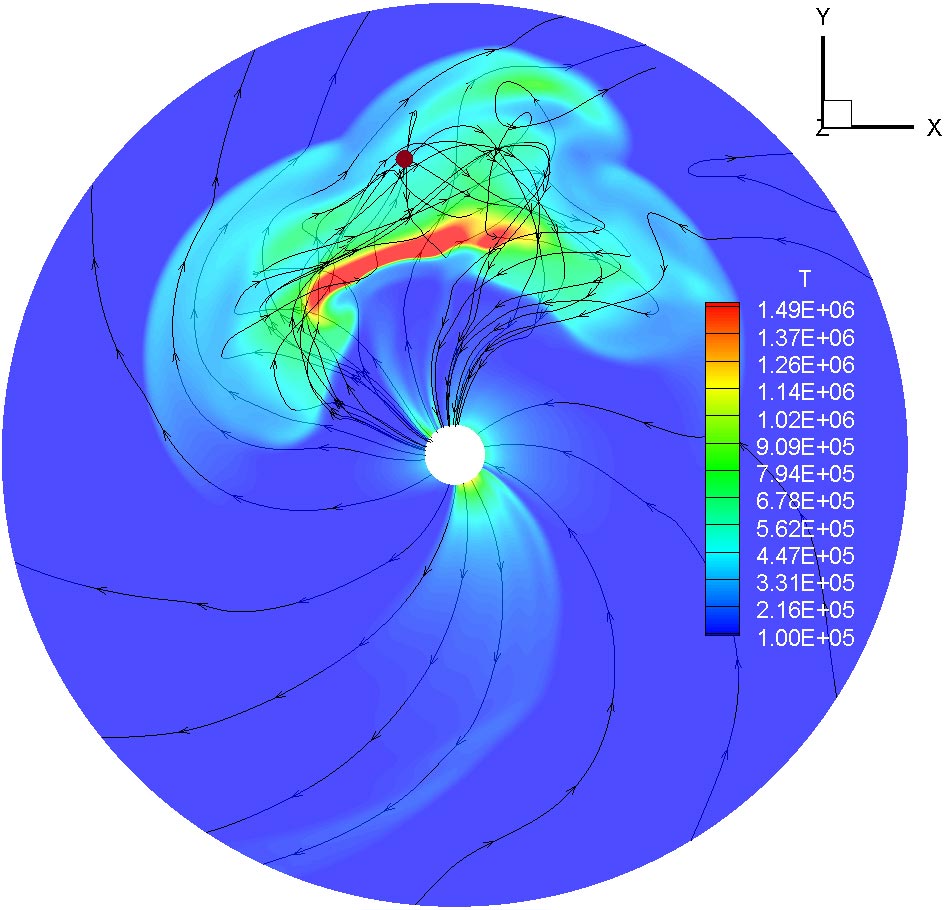
“This research, blending intricate science, advanced computing, and exciting observations, will advance our understanding of how the Sun drives space weather and its effects on Earth,” said Mangala Sharma, Program Director for Space Weather in the Division of Atmospheric and Geospace Sciences at NSF. “The work will help scientists predict space weather events and build our nation’s resilience against these potential natural hazards.”
The multi-institutional effort involves the NASA Goddard and Marshall Space Flight Centers, Lawrence Berkeley National Laboratory, and two private companies, Predictive Science Inc. and Space Systems Research Corporation.
Pogorelov uses the Frontera supercomputer at the Texas Advanced Computing Center (TACC) — the ninth fastest in the world — as well as at both the NASA Advanced Supercomputing (NAS) Facility at NASA’s Ames Research Center, and the San Diego Supercomputing Center, to improve the models and methods at the heart of space weather forecasting.
Turbulence and Ion Acceleration
Turbulence plays a key role in the dynamics of the solar wind and coronal mass ejections. This complex phenomenon has many facets, including the role of shock-turbulence interaction and ion acceleration.
“Solar plasma is not in thermal equilibrium. This creates interesting features,” Pogorelov said.
Writing in the Astrophysical Journal in April 2021, Pogorelov, along with Michael Gedalin (Ben Gurion University of the Negev, Israel), and Vadim Roytershteyn (Space Science Institute) described the role of backstreaming pickup ions in the acceleration of charged particles in the universe. Backstreaming ions, either of interstellar or local origin, are picked up by the magnetized solar wind plasma and move radially outwards from the Sun.
“Some non-thermal particles can be further accelerated to create solar energetic particles that are particularly important for space weather conditions on Earth and for people in space,” he said.
Pogorelov performed simulations on Frontera to better understand this phenomenon and compare it with observations from Voyager 1 and 2, the spacecraft that explored the outer reaches of the heliosphere and are now providing unique data from the local interstellar medium.
Predicting Coronal Mass Ejections with Advanced Models
One of the major focuses of space weather prediction is correctly forecasting the arrival of coronal mass ejections — the release of plasma and accompanying magnetic field from the solar corona — and determining the direction of the magnetic field it carries with it. Pogorelov’s team’s study of backstreaming ions help to do so, as does work published in the Astrophysical Journal in 2020 that used a flux rope-based magnetohydrodynamic model to predict the arrival time to Earth and magnetic field configuration of the July 12, 2012, coronal mass ejection. (Magnetohydrodynamics refers to the magnetic properties and behavior of electrically conducting fluids like plasma, which plays a key role in the dynamics of space weather).
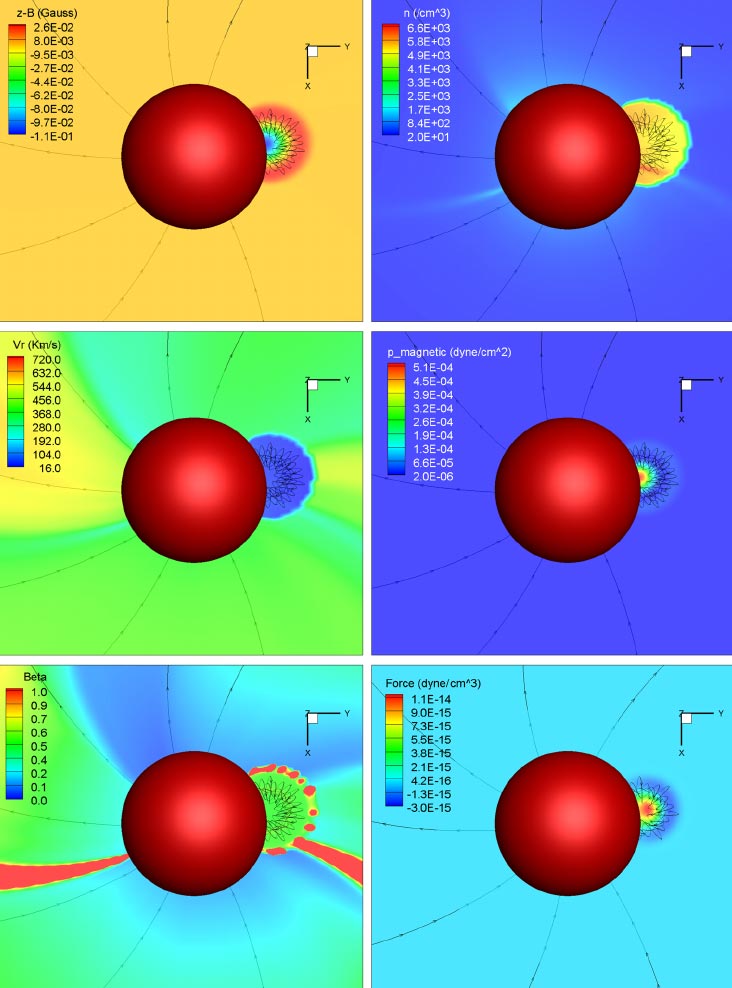
“Fifteen years ago, we didn’t know that much about the interstellar medium or solar wind properties,” Pogorelov said. “We have so many observations available today, which allow us to validate our codes and make them much more reliable.”
Parker Solar Probe and a New Frontier
Pogorelov is a co-investigator on an on-board component of the Parker Solar Probe called SWEAP (Solar Wind Electrons, Protons, and Alphas instrument). With each orbit, the probe approaches the sun, providing new information about the characteristics of the solar wind.
“Soon it will penetrate beyond the critical sphere where the solar wind becomes superfast magnetosonic, and we’ll have information on the physics of solar wind acceleration and transport that we never had before,” he said.
As the probe and other new observational tools become available, Pogorelov anticipates a wealth of new data that can inform and drive the development of new models relevant to space weather forecasting. For that reason, alongside his basic research, Pogorelov is developing a software framework that is flexible, useable by different research groups around the world, and can integrate new observational data.
“No doubt, in years to come, the quality of data from the photosphere and solar corona will be improved dramatically, both because of new data available and new, more sophisticated ways to work with data,” he said. “We’re trying to build software in a way that if a user comes up with better boundary conditions from new science missions, it will be easier for them to integrate that information.”
References:
“Backstreaming Pickup Ions” by Michael Gedalin, Nikolai V. Pogorelov and Vadim Roytershteyn, 2 April 2021, The Astrophysical Journal.
DOI: 10.3847/1538-4357/abe62c
“A Modified Spheromak Model Suitable for Coronal Mass Ejection Simulations” by Talwinder Singh, Mehmet S. Yalim, Nikolai V. Pogorelov and Nat Gopalswamy, 5 May 2020, The Astrophysical Journal.
DOI: 10.3847/1538-4357/ab845f
“Application of a Modified Spheromak Model to Simulations of Coronal Mass Ejection in the Inner Heliosphere” by Talwinder Singh, Tae K. Kim, Nikolai V. Pogorelov and Charles N. Arge, 23 April 2020, Space Weather.
DOI: 10.1029/2019SW002405
Never miss a breakthrough: Join the SciTechDaily newsletter.
Follow us on Google and Google News.