
Close Menu
    Facebook X (Twitter) Instagram
    SciTechDaily
    • Biology
    • Chemistry
    • Earth
    • Health
    • Physics
    • Science
    • Space
    • Technology
    Facebook X (Twitter) Pinterest YouTube RSS
    SciTechDaily
    Home»Space»ESA’s Hershel Space Telescope Captures Incredible Views of Eagle Nebula
    Space

    ESA’s Hershel Space Telescope Captures Incredible Views of Eagle Nebula

    By SciTechDailyJanuary 18, 2012No Comments2 Mins Read
    Facebook Twitter Pinterest Telegram LinkedIn WhatsApp Email Reddit
    Share
    Facebook Twitter LinkedIn Pinterest Telegram Email Reddit
    hershel-eagle-nebula-esa
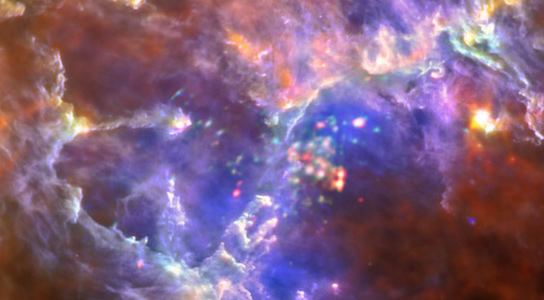
    The Eagle Nebula is situated 6,500 light-years away in the Serpens constellation.

    The European Space Agency’s Hershel space telescope has captured new, gorgeous views of the Eagle Nebula, located 6,500 light-years away in the Serpens constellation.

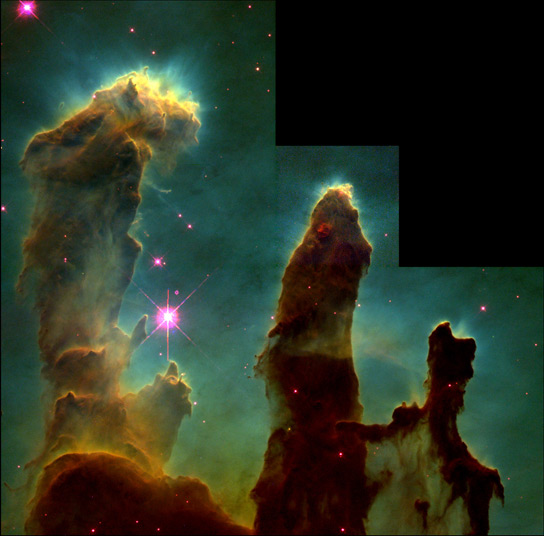
    The Eagle Nebula is well known thanks to NASA’s Hubble Space Telescope’s iconic Pillars of Creation images from 1995. The image shows a region within the Eagle nebula which holds a star-forming cluster named NGC6611. Light and heat emanating from young stars carved out the distinctive pillars, which are several trillion miles in length.
    eagle-nebula-pillars-of-creation

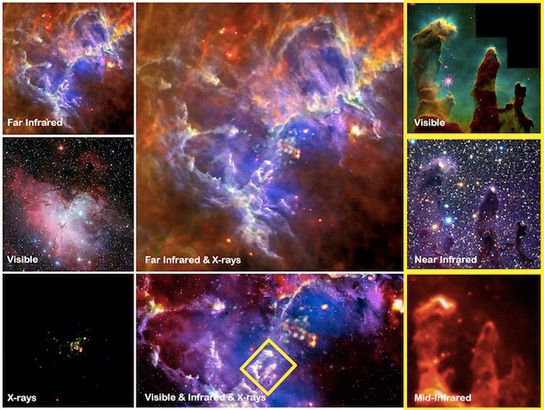
    Hershel’s new images aren’t just mesmerizing, but they also update the photos taken by Hubble and reveal new details about the region. Hubble images, taken in optical wavelengths, suggested that the area was a stellar nursery. Obscuring dust prevented astronomers from proving this.

    The new images, taken in far-IR wavelengths, were able to penetrate the dust, and allowed astronomers to view the inside of the actual pillars. Cocoons of gas and dust can now be seen, surrounding young stars as they form. These casings will blow away once the star’s light becomes visible.
    eagle-hershel-visible-ir-spectrum

    The new data has been combined with the ESA’s XMM-Newton space telescope, which sees the powerful x-ray radiation that the hot, young stars generate. The data also suggests that one of the massive stars in NGC6611 may have gone supernova about 6,000 years ago, releasing a shockwave that destroyed the pillars. Since the Eagle Nebula is 6,500 light-years away, the destruction won’t be visible on Earth for hundreds of years.


    Never miss a breakthrough: Join the SciTechDaily newsletter.
    Follow us on Google and Google News.

    European Space Agency Hershel Hubble Space Telescope NASA Nebula Popular Stellar Nursery XMM-Newton
    Share. Facebook Twitter Pinterest LinkedIn Email Reddit

    Related Articles

    Astronomers Build Incredible 3D Visualization of Exploded Star Using NASA’s Great Observatories [Video]

    Hubble Views an Ongoing Cosmic Collision

    Hubble Views Newborn Stars in Galaxy IC 5052

    New XDF Image, The Deepest-Ever View of the Universe

    Hubble Views Glowing Gas and Dark Dust in Spiral Galaxy NGC 4634

    Hubble Zooms in on the Center of M4

    Hubble Image of Peculiar Galaxy Pair Arp 116

    Panoramic View of 30 Doradus – The Brightest Star-Forming Region in Our Galactic Neighborhood

    Researchers Discover First Intermediate-Mass Black Hole

    Leave A Reply Cancel Reply

    • Facebook
    • Twitter
    • Pinterest
    • YouTube

    Don't Miss a Discovery

    Subscribe for the Latest in Science & Tech!

    Trending News

    Popular Sugar-Free Sweetener Linked to Liver Disease, Study Warns

    What Is Hantavirus? The Deadly Disease Raising Alarm Worldwide

    Scientists Just Discovered How the Universe Builds Monster Black Holes

    Scientists Unveil New Treatment Strategy That Could Outsmart Cancer

    A Simple Vitamin May Hold the Key to Treating Rare Genetic Diseases

    Scientists Think the Real Fountain of Youth May Be Hiding in Your Gut

    Ravens Don’t Follow Wolves, They Predict Them

    This Common Knee Surgery May Be Doing More Harm Than Good

    Follow SciTechDaily
    • Facebook
    • Twitter
    • YouTube
    • Pinterest
    • Newsletter
    • RSS
    SciTech News
    • Biology News
    • Chemistry News
    • Earth News
    • Health News
    • Physics News
    • Science News
    • Space News
    • Technology News
    Recent Posts
    • Why Are So Many New Fathers Dying? Scientists Say the U.S. Has a Dangerous Blind Spot
    • Scientists Identify Simple Supplement That Greatly Reduces Alzheimer’s Damage
    • You May Have a Dangerous Type of Cholesterol Even if Your Tests Look Normal
    • Study Reveals Dangerous Flaw in AI Symptom Checkers
    • New MRI Breakthrough Captures Stunningly Clear Images of the Eye and Brain
    Copyright © 1998 - 2026 SciTechDaily. All Rights Reserved.
    • Science News
    • About
    • Contact
    • Editorial Board
    • Privacy Policy
    • Terms of Use

    Type above and press Enter to search. Press Esc to cancel.