
Close Menu
    Facebook X (Twitter) Instagram
    SciTechDaily
    • Biology
    • Chemistry
    • Earth
    • Health
    • Physics
    • Science
    • Space
    • Technology
    Facebook X (Twitter) Pinterest YouTube RSS
    SciTechDaily
    Home»Biology»Evolutionary Biologists Make Multicellular Life Evolve in the Lab
    Biology

    Evolutionary Biologists Make Multicellular Life Evolve in the Lab

    By SciTechDailyJanuary 18, 2012No Comments2 Mins Read
    Facebook Twitter Pinterest Telegram LinkedIn WhatsApp Email Reddit
    Share
    Facebook Twitter LinkedIn Pinterest Telegram Email Reddit
    multicellular-yeast-developing
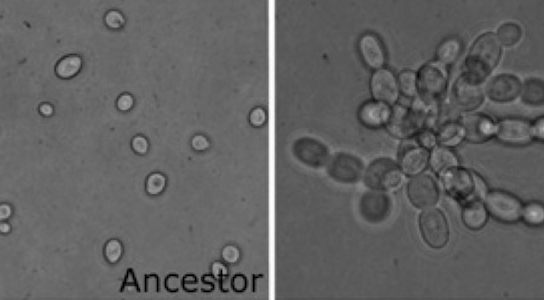
    Evolutionary biologists cultivated brewer’s yeast in nutrient-rich broth, transforming single-celled yeast into multicellular organisms in 60 days. Credit: Ratcliff et al./PNAS

    The evolutionary transition between single-celled organisms and multicellular life as we know it took several billion years to occur in nature, but under artificial pressure, evolutionary biologists have been able to make it happen in 60 days.
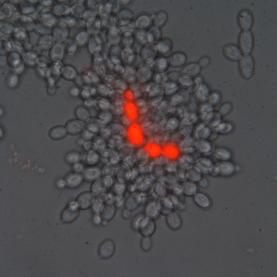
    Credit: Ratcliff et al./PNAS

    Single-celled yeast became multicellular creatures, a crucial step for life’s progression, from algae and bacteria to more complex forms of life. While this doesn’t duplicate what happened in the prehistoric transitions, it could help evolutionary biologists reveal the principles that guided them.

    In the new study, published on January 17th in the Proceedings of the National Academy of Sciences, researchers led by evolutionary biologists Michael Travisano and William Ratcliff from the University of Minnesota grew brewer’s yeasts in flasks of nutrient-rich broth.

    The experimental protocol was quite simple: once per day, they shook the flasks, removed the yeast that settled at the bottom, and used it to start new cultures. Free-floating yeast was left behind, while yeast gathered in heavy, falling clumps survived to reproduce. Within a few weeks, the individual yeast cells were still single-celled, but clumped together. After two months, they came to a permanent arrangement. Each strain evolved to become multicellular, displaying all of the characteristics of complex forms of life.
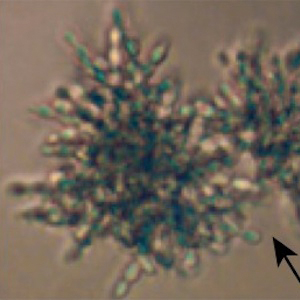
    multicellular-yeast
    Credit: Ratcliff et al./PNAS

    The cells cooperate, and this cooperation benefits all of the cells involved. They gave a single-celled organism a reason to become multicellular, and proved that this was what happened experimentally. Rapid evolution could occur in nature, it just needs to be discovered.

    The multicellularity was engineered via artificial selection, but there is no reason why this couldn’t have happened in nature.

    Never miss a breakthrough: Join the SciTechDaily newsletter.
    Follow us on Google and Google News.

    Evolution Evolutionary Life University of Minnesota
    Share. Facebook Twitter Pinterest LinkedIn Email Reddit

    Related Articles

    Exceptionally Preserved Fossil Sheds Light on the Evolution of How Dinosaurs Breathed

    Scientists Built an Underwater Theater and Attached 3D Glasses to Cuttlefish – Here’s What They Learned

    New Study Presents “Water World” Theory for the Emergence of Life

    New Research Tests Theory that Life Originated at Deep Sea Vents

    Rudimentary Form of Life Sidesteps Normal Replication Processes

    New Findings Challenge Assumptions about the Origins of Life

    Origin of Ion-Pumping Proteins Could Explain How Life Began

    DNA Could Predate Existence of Life As We Know It

    Amino Acids in Meteorites Provide a Clue to How Life Turned Left

    Leave A Reply Cancel Reply

    • Facebook
    • Twitter
    • Pinterest
    • YouTube

    Don't Miss a Discovery

    Subscribe for the Latest in Science & Tech!

    Trending News

    AI Could Detect Early Signs of Alzheimer’s in Under a Minute – Far Before Traditional Tests

    What if Dark Matter Has Two Forms? Bold New Hypothesis Could Explain a Cosmic Mystery

    This Metal Melts in Your Hand – and Scientists Just Discovered Something Strange

    Beef vs. Chicken: Surprising Results From New Prediabetes Study

    Alzheimer’s Breakthrough: Scientists Discover Key Protein May Prevent Toxic Protein Clumps in the Brain

    Quantum Reality Gets Stranger: Physicists Put a Lump of Metal in Two Places at Once

    Scientists May Have Found the Key to Jupiter and Saturn’s Moon Mystery

    Scientists Uncover Brain Changes That Link Pain to Depression

    Follow SciTechDaily
    • Facebook
    • Twitter
    • YouTube
    • Pinterest
    • Newsletter
    • RSS
    SciTech News
    • Biology News
    • Chemistry News
    • Earth News
    • Health News
    • Physics News
    • Science News
    • Space News
    • Technology News
    Recent Posts
    • Asthma and Depression Don’t Mix the Way Scientists Expected
    • Why Promising Cancer Drugs Failed: Scientists Uncover the Missing Piece
    • Popular Sweetener Linked to DNA Damage – “It’s Something You Should Not Be Eating”
    • Ancient “Rock” Microbes May Reveal How Complex Life Began
    • Hidden “Trade Winds” Inside Cells Could Explain Cancer Spread
    Copyright © 1998 - 2026 SciTechDaily. All Rights Reserved.
    • Science News
    • About
    • Contact
    • Editorial Board
    • Privacy Policy
    • Terms of Use

    Type above and press Enter to search. Press Esc to cancel.