
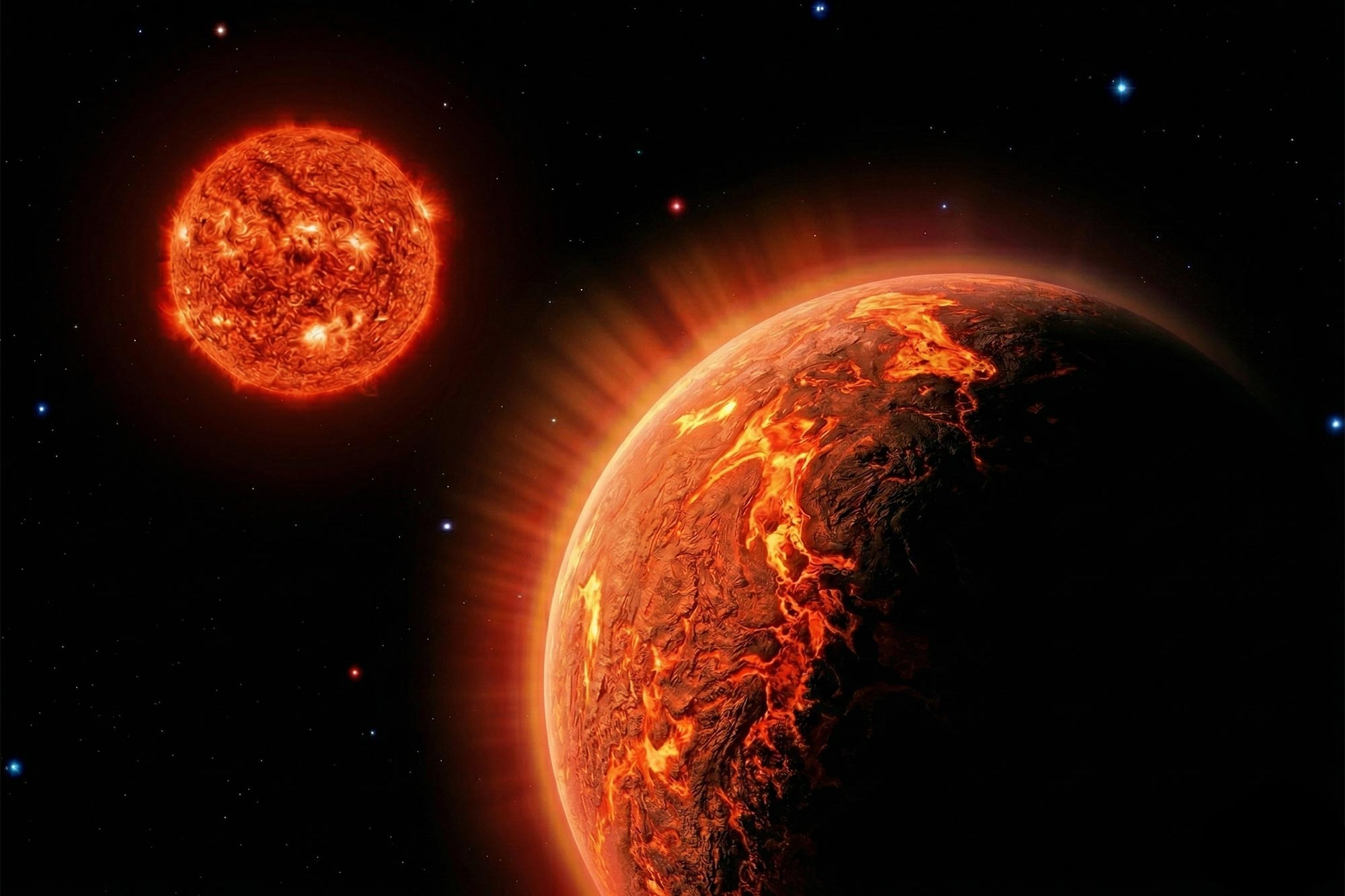
A new study suggests that even the most extreme exoplanets might not be entirely inhospitable.
Slightly larger than Earth, the exoplanet LHS 3844b circles a small red dwarf star called LHS 3884, about 48.5 light-years away. Unlike Earth, it does not experience sunrise or sunset. The planet is tidally locked, so one hemisphere always faces its star while the other remains in permanent darkness. This creates an extreme split: one side is relentlessly heated, while the other plunges toward temperatures where molecular motion nearly stops, a condition known as absolute zero (zero Kelvin).
At first glance, such a world seems completely inhospitable. Yet scientists are beginning to question that assumption.
Daisuke Noto, a postdoctoral researcher in Hugo Ulloa’s Penn GEFLOW Lab at the University of Pennsylvania, has been investigating whether these stark conditions truly rule out life. “Just looking at the extreme temperatures on the day and night sides like 1,000-2,000 Kelvin on the day side and absolute zero on the night side might lead one to conclude these exoplanets are too harsh for life. But,” says Noto, “life might find a way.”
Rethinking Habitability on Extreme Worlds
To explore this possibility, Noto and collaborators from the Japan Agency for Marine-Earth Science and Technology and Hokkaido University reported in Nature Communications that “such exoplanets may be more tolerant of sustaining life as tidal locking can contribute to maintaining moderate thermal environments locally by distributing heat flux laterally.”
Noto explains that this work challenges traditional assumptions about where life can exist. He also highlights how similar experimental approaches are being used to better understand processes occurring deep within Earth.
According to Noto, planets with permanent day and night sides are far more common than worlds like Earth, which experience regular cycles.
“Many celestial bodies like moons and planets that are very close to their parent stars are what we call tidally locked,” he explains. “Meaning, as they spin around on their axes and orbit around their parents, those rates or frequencies match, leading to the phenomena like us only seeing one side of our moon.”
Simulating Alien Interiors in the Lab
This constant alignment creates a stark temperature contrast across the planet. Noto’s research focuses on what happens below the surface, particularly how this imbalance shapes the mantle, the thick rocky layer between the crust and core.
“Building an actual exoplanet in the lab wasn’t in the budget,” Noto says. Instead, his team used a well-established method involving a small rectangular tank filled with viscous glycerol and seeded with thermochromic liquid crystals that change color with temperature.
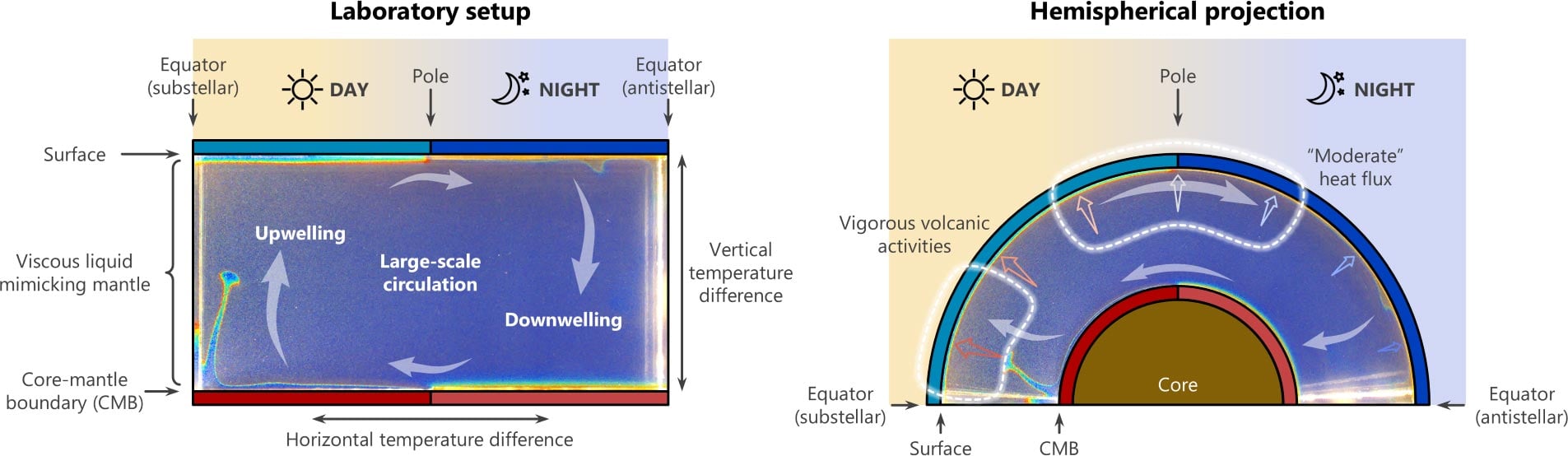
This setup builds on a long tradition of laboratory models used to study how heat and structure influence convection in slow-moving systems, from Earth’s interior to theoretical alien worlds.
Unlike weather or ocean circulation, which are strongly influenced by rotation and gravity, mantle convection is mainly driven by differences in temperature and density. To recreate these conditions, the team used four thermostats to control heating and cooling along the edges of the tank. This produced temperature gradients similar to those between a planet’s day side, night side, surface, and deep interior.
A Planetary “Heartbeat”
The experiments revealed a stable and repeating pattern of flow. Hot material rises on the day side, moves across the top, cools, and sinks on the night side, then returns along the bottom. This creates a continuous circulation loop, similar to a steady planetary heartbeat.
“It’s not chaotic like Earth’s mantle,” Noto says. “It’s slow and steady. Predictable. Kind of boring but in a good way.”
At times, the flow produced plume-like structures rising from the heated base. Unlike Earth’s hotspots in places like Hawaii or Iceland, which shift over time, these plumes remained fixed in the same location.
The model also produced Nusselt numbers, a measure of heat transfer, comparable to those on Earth. This finding suggests that some exoplanets could have localized geothermal environments, particularly in mid-latitude regions where conditions may be less extreme.
Implications Beyond the Surface
Noto suggests that this large-scale mantle circulation could also influence the planet’s liquid core. In turn, it might generate magnetic fields that differ from Earth’s dipole structure.
“That’s something we couldn’t test in this experiment,” he says, “but it’s an exciting direction for future work.”
Noto and Ulloa are continuing to expand their research using similar laboratory models to study a variety of geophysical systems. Earlier work has examined how mass and heat move in confined environments, offering insight into the role of fluids in hydrothermal systems.
“We are planning on further extending the experimental methods to delve deeper into different systems on our planet in different contexts, the possibilities are, quite literally, out of this world,” says Noto.
Reference: “Convective dynamics in mantle of tidally-locked exoplanets” by Daisuke Noto, Takehiro Miyagoshi, Tomomi Terada, Takatoshi Yanagisawa and Yuji Tasaka, 25 July 2025, Nature Communications.
DOI: 10.1038/s41467-025-62026-z
Never miss a breakthrough: Join the SciTechDaily newsletter.
Follow us on Google and Google News.