
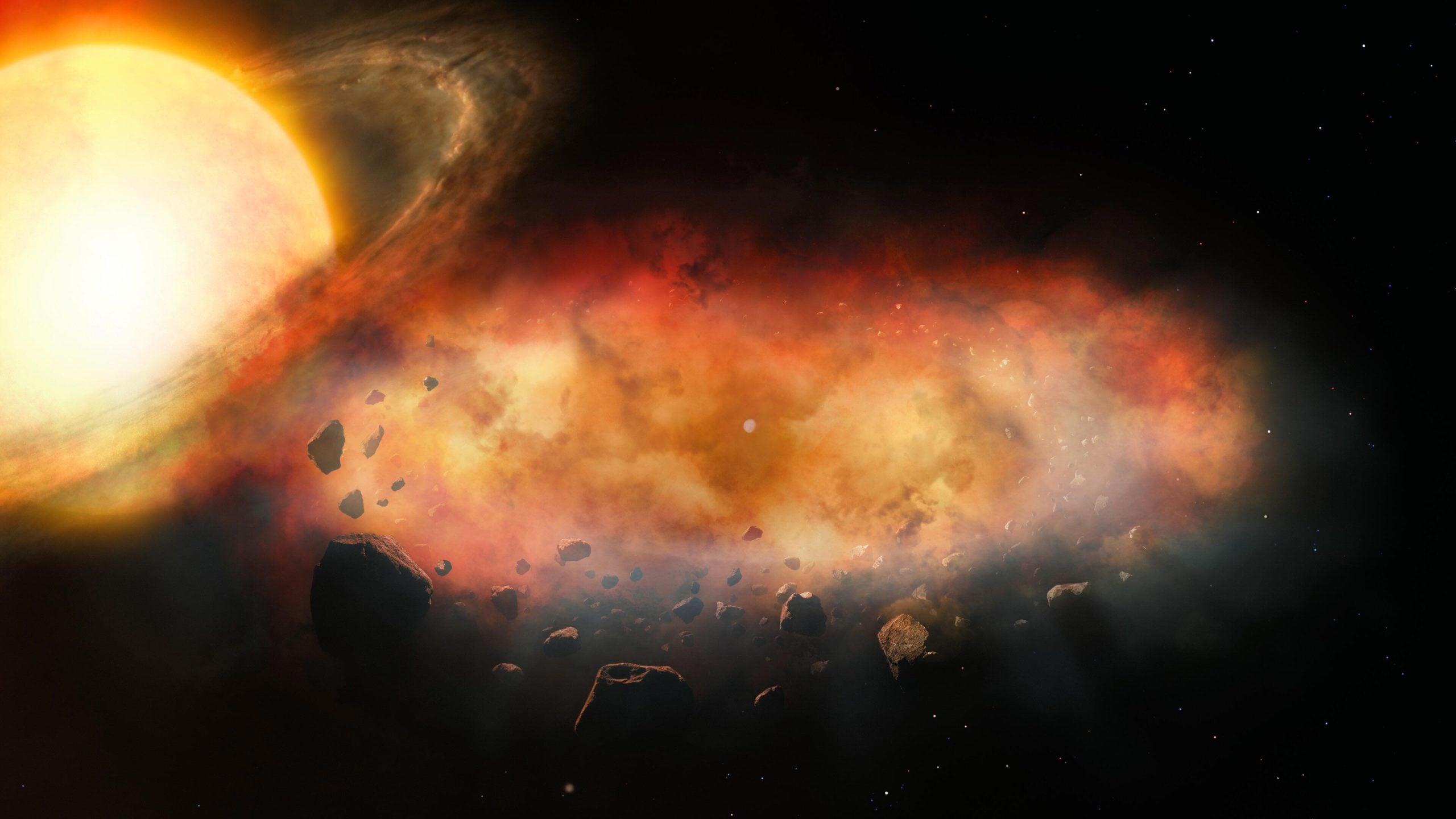
Astronomers have observed a Sun-like star dim dramatically for nearly nine months after being obscured by a vast cloud of gas and dust.
A huge cloud filled with vaporized metals has been spotted blowing powerful winds, and it temporarily blocked a star’s light for almost nine months. The observations were made with the Gemini South telescope in Chile, one half of the International Gemini Observatory, partly funded by the U.S. National Science Foundation and operated by NSF NOIRLab. Researchers say the event provides an unusual look at the restless, messy activity that can keep reshaping planetary systems long after they first form.
The story began in September 2024, when a star about 3000 light-years away abruptly faded to about 1/40 of its normal brightness. It stayed that dim until May 2025. The star, J0705+0612, resembles our Sun, which is why its sudden drop stood out to Johns Hopkins University astrophysicist Nadia Zakamska. “Stars like the Sun don’t just stop shining for no reason,” she says, “so dramatic dimming events like this are very rare.”
Because the dimming lasted for months, Zakamska’s team organized follow-up observations across several major facilities. They used the Gemini South telescope on Cerro Pachón in Chile, along with the Apache Point Observatory 3.5-meter telescope and the 6.5 meter Magellan Telescopes. The results are reported in a paper appearing in The Astronomical Journal.
Combining these new measurements with archival data on J0705+0612, the researchers concluded that the star was occulted, meaning a large, slow-moving cloud of gas and dust passed in front of it and partially blocked its light. Their estimate places the cloud about two billion kilometers (1.2 billion miles) from the star, with a span of roughly 200 million kilometers (120 million miles).
A Disk Bound to a Hidden Companion
The evidence suggests the cloud is not drifting freely. Instead, it appears to be held together by gravity and linked to a secondary object orbiting the star far from the center of the planetary system. The companion has not been identified, but it must be heavy enough to keep such a large cloud bound. Based on the observations, it is at least a few times the mass of Jupiter, and it could be larger. The possibilities include a planet, a brown dwarf, or an extremely low-mass star.
If the unseen object turns out to be a star, the cloud would be classified as a circumsecondary disk, meaning a debris disk orbiting the smaller member of a binary system. If it is a planet, the structure would be a circumplanetary disk. Either way, catching a star being occulted by a disk that surrounds a secondary object is extremely uncommon, with only a handful of known cases.
To find out what the cloud is made of, the team relied on Gemini South’s advanced spectrograph, the Gemini High-resolution Optical SpecTrograph (GHOST). In March 2025, GHOST observed the occultation for a little more than two hours, splitting the star’s light into a spectrum that reveals which chemical elements are present in the material between the star and Earth.
“When I started observing the occultation with spectroscopy, I was hoping to unveil something about the chemical composition of the cloud, as no such measurements had been done before. But the result exceeded all my expectations,” says Zakamska.
Winds of Metal in Motion
The GHOST data revealed multiple metals — elements heavier than helium — within the cloud. More remarkably, the high precision of the spectra allowed the team to directly measure how the gas is moving in three dimensions. This marks the first time astronomers have measured the internal gas motions of a disk orbiting a secondary object such as a planet or low-mass star. The observations show a dynamic environment with winds of gaseous metals, including iron and calcium.
“The sensitivity of GHOST allowed us to not only detect the gas in this cloud, but to actually measure how it is moving,” says Zakamska. “That’s something we’ve never been able to do before in a system like this.”
“This study illustrates the considerable power of Gemini’s newest facility instrument, GHOST,” notes Chris Davis, NSF Program Director for NOIRLab, “and further highlights one of Gemini’s great strengths — rapidly responding to transient events like this occultation.”
The precise measurements of the speed and direction of the wind show that the cloud is moving separate from its host star. This, combined with how long the occultation lasted, further confirm that the occulter is a disk around a secondary object and that it orbits in the outer reaches of its host star’s stellar system.
The source shows infrared excess, typically associated with disks around young stars. However, J0705+0612 is more than two billion years old, meaning the disk is unlikely to be leftover debris from the system’s early planet formation stage. So how did it form?
Zakamska proposes that it originated after two planets collided with each other in the outer reaches of this star’s planetary system, ejecting dust, rocks, and debris and forming the massive cloud now seen passing in front of the star.
A New Window into Planetary Evolution
The discovery highlights how new technology enables new insights into the Universe. GHOST has opened a new window into studying hidden phenomena in distant star systems, and the findings provide valuable clues about the long-term evolution of planetary systems and how disks can form around old stars.
“This event shows us that even in mature planetary systems, dramatic, large-scale collisions can still occur,” says Zakamska. “It’s a vivid reminder that the Universe is far from static — it’s an ongoing story of creation, destruction, and transformation.”
Reference: “ASASSN-24fw: Candidate Gas-rich Circumsecondary Disk Occultation of a Main-sequence Star” by Nadia L. Zakamska, Gautham Adamane Pallathadka, Dmitry Bizyaev, Jaroslav Merc, James E. Owen, Henrique Reggiani, Kevin C. Schlaufman, Karolina Bąkowska, Sławomir Bednarz, Krzysztof Bernacki, Agnieszka Gurgul, Kirsten R. Hall, Franz-Josef Hambsch, Barbara Joachimczyk, Krzysztof Kotysz, Sebastian Kurowski, Alexios Liakos, Przemysław J. Mikołajczyk, Erika Pakštienė, Grzegorz Pojmański, Adam Popowicz, Daniel E. Reichart, Łukasz Wyrzykowski, Justas Zdanavičius, Michał Żejmo, Paweł Zieliński and Staszek Zola, 21 January 2026, The Astronomical Journal.
DOI: 10.3847/1538-3881/ae1fd9
Never miss a breakthrough: Join the SciTechDaily newsletter.
Follow us on Google and Google News.