
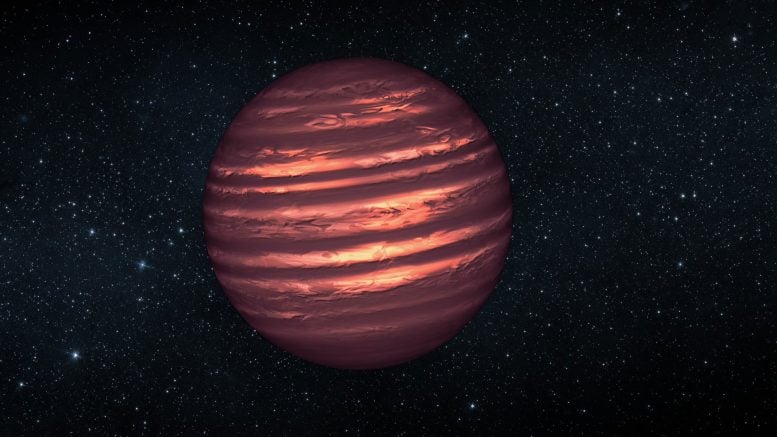
A new Keck Observatory study indicates that giant planets can spin faster than more massive brown dwarfs, revealing important clues about how planetary systems form and evolve.
Astronomers have long suspected that a planet’s mass may be linked to how quickly it spins. In our solar system, Jupiter and Saturn rotate especially fast, each completing a full turn in about 10 hours, and together they hold much of the solar system’s rotational energy.
To test this idea, researchers used the W. M. Keck Observatory on Maunakea in Hawaii to study 32 distant gas giants and brown dwarfs. The group included six giant planets larger than Jupiter and 25 brown dwarf companions.
Using high-resolution spectroscopy from the Keck Planet Imager and Characterizer (KPIC), the team found that gas giant planets rotate faster than more massive objects after accounting for mass, size, and age. The researchers also combined their results with earlier spin measurements, building a curated sample of 43 stellar and substellar companions and giant planets, along with 54 free-floating brown dwarfs and planetary-mass objects.
The research was led by scientists at Northwestern University’s Center for Interdisciplinary Exploration and Research in Astrophysics (CIERA). The team also included researchers from the Center for Astrophysics and Space Sciences (CASS) at UC San Diego, the Division of Geological & Planetary Sciences (GPS) at Caltech, W. M. Keck Observatory, Steward Observatory, the James C. Wyant College of Optical Sciences, NASA’s Jet Propulsion Laboratory, and several universities. Their study was published in The Astronomical Journal.
How Astronomers Measured Exoplanet Spin Rates
Many of the planets observed in this study orbit their stars at a distance of tens to hundreds of astronomical units (AUs), the distance between the Earth and the Sun. Astronomers are still debating how such distant worlds form, whether it’s a gradual process within a circumstellar disk or a gravitational collapse similar to that of stars. To investigate, the team used the KPIC to isolate light from these rotating planets, which broadens the spectra of atmospheric features.
By analyzing these features, scientists can determine how rapidly a planet is spinning. Lead author Dino Chih-Chun Hsu, a researcher at the CIERA at Northwestern University, says:
“Spin is a fossil record of how a planet formed. By measuring how quickly these worlds rotate, we can start to piece together the physical processes that shaped them tens to hundreds of millions of years ago. With KPIC, we can detect these tiny signals that reveal a planet’s rotation around other nearby stars. Our results suggest that both the planet’s mass and the ratio between the planet’s mass and its star’s mass influence how fast the planet ultimately spins. That helps us narrow down the physics of how these systems form.”
Planetary Mass, Magnetic Fields, and Rotation
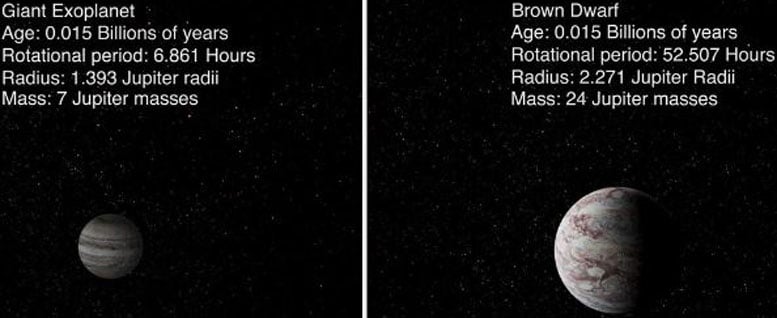
This complex relationship is illustrated by one planet and one brown dwarf in particular. In the system HR 8799, there is a gas giant roughly 7 times the mass of Jupiter that spins six times more rapidly than a brown dwarf companion in the same system that is 24 times the mass of Jupiter. This can be explained by interactions between the planet’s magnetic field in its infancy and the circumplanetary disk that caused it to lose rotational speed.
https://www.youtube.com/watch?v=jzNoKKeohIM
Basically, the spin of the more massive companion was slowed because it had a much stronger magnetic field. Understanding this relationship between size, mass, and spin is also helping scientists learn more about the history of our solar system.
Hsu states: “The way that angular momentum is distributed among planets influences the overall architecture of a planetary system. Even Earth’s rotation and magnetic field ultimately connect to how that spin budget was divided when the solar system formed. KPIC is the first instrument of its kind, opening an entirely new way to study exoplanets. It allowed us to measure properties like spin that were previously almost impossible to detect.”
Future Exoplanet Research With HISPEC
The research team plans to expand its studies by examining the spins of free-floating planets (FFPs), also known as “Rogue Planets.” They also hope to investigate the composition of these planets’ atmospheres. This will be assisted by next-generation instrumentation, such as the Keck Observatory’s upcoming HISPEC (High-resolution Infrared Spectrograph for Exoplanet Characterization), which will become operational in 2027. As Hsu explained, HISPEC will extend these measurements to even smaller and more distant worlds.
Jason Wang, an assistant professor at Northwestern University and co-author of the study explains: “We took the lessons learned from KPIC, and put them into HISPEC, which will have better sensitivity, higher spectral resolution, and wider wavelength coverage. With HISPEC we will be able to drastically increase the number of planets that we can measure spins of, and in particular, we can study planets closer to our own Jupiter in nature to see if our own Jupiter is typical.”
“We’re just beginning to explore what planetary spin can tell us,” said Hsu. “With future instruments and larger telescopes, we’ll be able to measure spins for even more worlds and connect rotation, chemistry, and formation history across entire planetary systems.”
Reference: “Distinct Rotational Evolution of Giant Planets and Brown Dwarf Companions” by Chih-Chun Hsu, Jason J. Wang, Jerry W. Xuan, Yapeng Zhang, Jean-Baptiste Ruffio, Dimitri Mawet, Luke Finnerty, Katelyn Horstman, Julianne Cronin, Yinzi Xin, Ben Sappey, Daniel Echeverri, Nemanja Jovanovic, Ashley Baker, Randall Bartos, Geoffrey A. Blake, Benjamin Calvin, Sylvain Cetre, Jacques-Robert Delorme, Gregory W. Doppmann, Michael P. Fitzgerald, Quinn M. Konopacky, Joshua Liberman, Ronald A. López, Evan Morris, Jacklyn Pezzato, Tobias Schofield, Andrew Skemer, J. Kent Wallace and Ji Wang, 18 March 2026, The Astronomical Journal.
DOI: 10.3847/1538-3881/ae434b
Adapted from an article originally published in UniverseToday.
Never miss a breakthrough: Join the SciTechDaily newsletter.
Follow us on Google and Google News.
1 Comment
thanks for this