
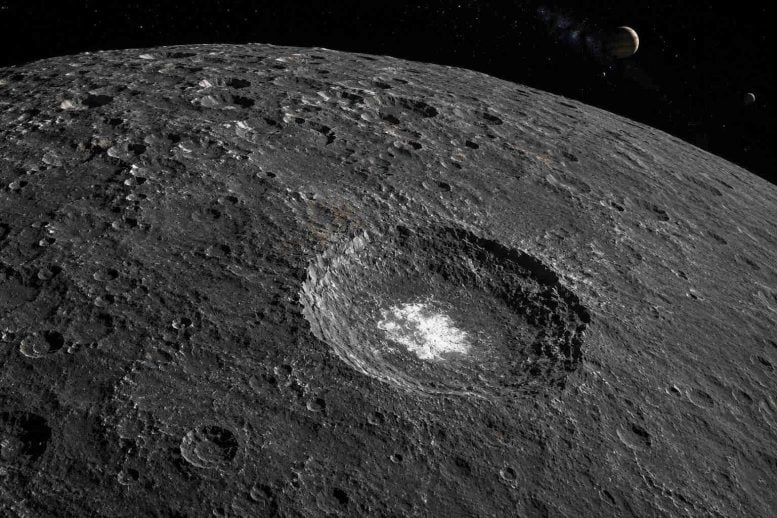
A meteorite that blasted through a New Jersey roof carried a startling secret: evidence of ancient salty fluids and complex organic chemistry inside a primitive asteroid.
A space rock that tore through a New Jersey roof has turned out to be far more than an astronomical curiosity. Sealed inside were traces of ancient salty fluids and organic chemistry that may help scientists reconstruct how primitive asteroids once processed some of the raw ingredients associated with life.
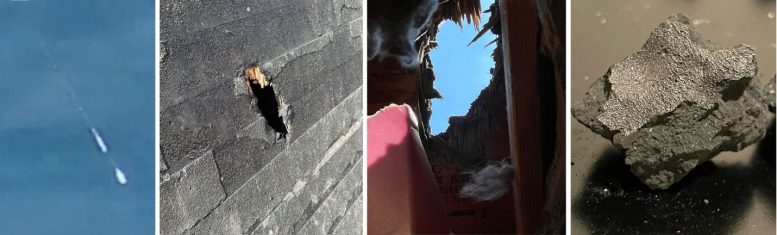
The meteorite landed in Hillsborough, New Jersey, after a daytime fireball raced across the New York City region on July 16, 2024. The meteor produced a sonic boom as it passed just south of the Statue of Liberty before breaking apart high above the ground. An international team has now published the first detailed analysis of the recovered material in Science Advances.
“A forensic study of the fragments revealed that they contained preserved bits from near the surface of a primitive asteroid where it experienced concentrated salty fluids—a process not previously known from this type of protoplanet world,” said lead author and meteor astronomer Peter Jenniskens of the SETI Institute and NASA’s Ames Research Center in California’s Silicon Valley.
Tracking the Fireball’s Violent Descent
The original object was roughly the size of a heavily packed airline bag. It struck Earth’s atmosphere at 32,000 miles/h (14.4 kilometers per second), generating a bright meteor visible across several states. Sixty observers in New York, New Jersey, Connecticut, Rhode Island, and Pennsylvania reported the event to the American Meteor Society. Sixteen people in New York and New Jersey also felt the shockwave.
“Our cameras in Northford, Connecticut, and Douglassville, Pennsylvania, as well as a doorbell camera in Wayne, New Jersey, captured the meteor, and from that we measured its trajectory,” said American Meteor Society operations manager Mike Hankey. “The path traced back to low in the asteroid belt.”
The incoming rock was too fragile to remain intact. It fragmented rapidly, and the visible meteor disappeared about 22 miles (35 kilometers) above Earth. Doppler weather radar at Newark Airport later detected a narrow trail of falling debris stretching from Staten Island into New Jersey.
A Meteorite Crashes Into a Bedroom
Hillsborough sat near the end of that debris field, where the largest surviving pieces were expected to land. Yet only one meteorite was recovered. It was found because it crashed directly through a house.
The homeowner described the impact: “I was at home at the time, heard a loud crash, and found a hole in the ceiling of the master bedroom. I smelled a strong sulfur-like odor and saw many black fragments along with debris and black dust that covered my bed, carpet, and surrounding areas.”
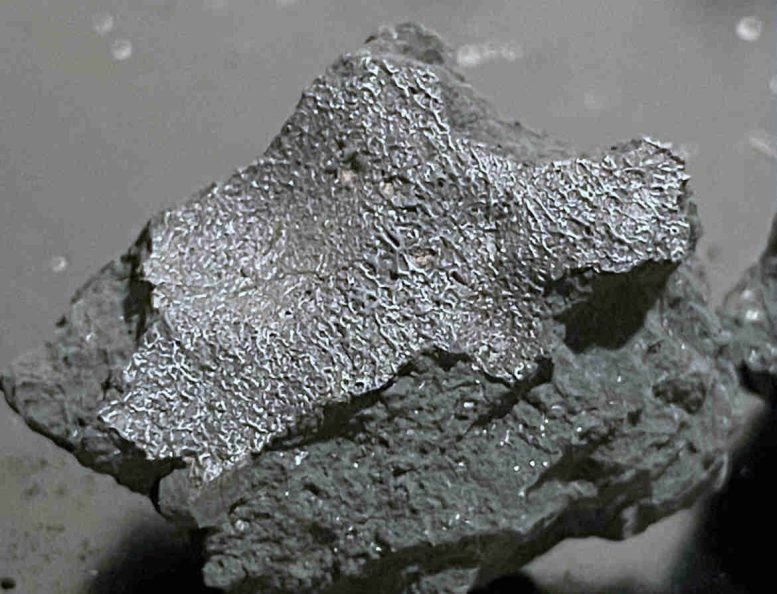
His next actions proved scientifically important. Rather than handling the fragments with bare hands or leaving them exposed, he documented the room and collected the pieces with disposable gloves and aluminum foil before sealing them in glass jars. That quick response limited contamination from skin oils, dust, moisture, and other terrestrial material.
“Thanks to the homeowner’s quick reaction, these are the most pristine CM1/2 meteorites we know of,” said Jenniskens.
A Primitive Relic From the Early Solar System
Carbonaceous chondrites are among the most primitive meteorites known. Unlike rocks that were heavily melted and reworked inside planets, they preserve material dating back to the early solar system, when planets and asteroids were still assembling. Many contain water-altered minerals, carbon-rich compounds, and amino acids, making them especially valuable to scientists studying the chemical conditions that preceded life on Earth.
The Hillsborough meteorite belongs to the CM group, named after the Mighei meteorite that fell in Ukraine in 1889. CM meteorites are usually classified according to how extensively their minerals were changed by liquid water inside their parent asteroid.
Mike Zolensky, a meteoriticist at NASA’s Johnson Space Center in Houston and a co-author of the study, found that the Hillsborough material had experienced more water-driven alteration than a typical CM2 meteorite. Researchers classified it as CM1/2, placing it between the more altered CM1 type and the less altered CM2 type.
That makes the fall exceptionally rare. Hillsborough is only the 22nd observed CM meteorite fall and just the second witnessed fall of a CM1/2 carbonaceous chondrite. The first was the Kolang meteorite, which fell in North Sumatra, Indonesia, in 2020. Every other witnessed CM fall has been classified as CM2, while no CM1 meteorite has ever been seen falling to Earth.
Ancient Brines Hidden Inside an Asteroid
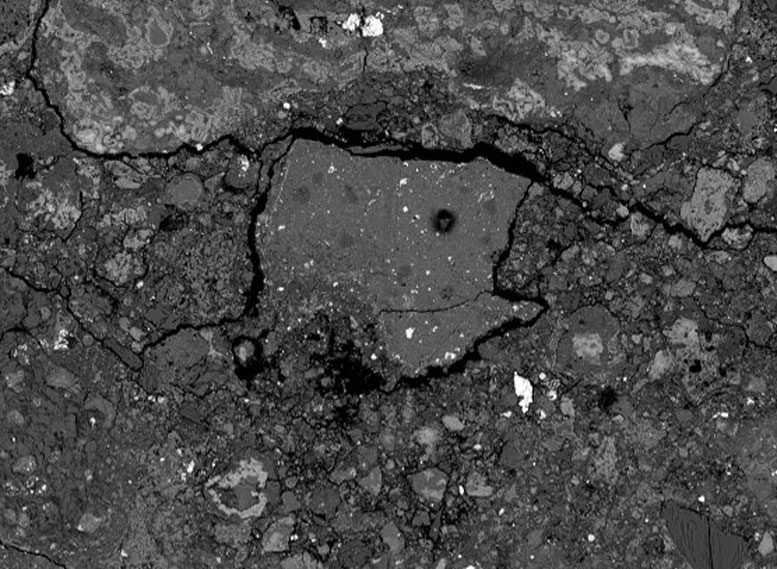
The most surprising discovery came from tiny salt-rich CM1 fragments embedded within the meteorite. Zolensky and colleague JangMi Han concluded that these pieces may have formed near the surface of the parent asteroid, where liquid water evaporated and left behind increasingly concentrated brines.
That process resembles what happens when a salt lake or shallow pool dries on Earth. As water disappears, dissolved chemicals become more concentrated, potentially creating conditions that favor unusual reactions between minerals and organic molecules.
Scientists had already found evidence of briny fluids in another primitive meteorite group known as CI carbonaceous chondrites. The CI designation comes from the Ivuna meteorite, which fell in Tanzania in 1938. Similar material was later returned directly from asteroid Ryugu by JAXA’s Hayabusa 2 mission and from asteroid Bennu by NASA’s OSIRIS-REx mission.
Those asteroid samples arrived on Earth under tightly controlled conditions, giving researchers uncontaminated evidence that salty water once moved through primitive asteroid material. The Hillsborough discovery suggests that concentrated brines also developed in CM asteroids, broadening the range of early solar system environments where this chemistry may have occurred.
Salty Water May Have Fueled Prebiotic Chemistry
Researchers are now identifying the salt minerals in the Hillsborough fragments and comparing them with material collected from Ryugu and Bennu.
Brines are particularly interesting because they may encourage chemical pathways relevant to prebiotic chemistry. Concentrated salty fluids can keep phosphate dissolved, bring reactive compounds into close contact, and promote interactions between organic molecules and newly forming minerals.
“Isotope studies of carbon and nitrogen suggest that primitive carbonaceous chondrites, including CM-types, delivered organic matter to the early Earth,” said cosmochemist Queenie Chan of Royal Holloway University of London, England, and biogeochemist Nana Ogawa of the Biogeochemistry Research Center at the Japan Agency for Marine-Earth Science and Technology. “The Hillsborough meteorite contained 1.8% by weight of carbon and 0.07% of nitrogen and had carbon and nitrogen isotopes typical for CM-type meteorites.”
Organic Molecules and Amino Acids Revealed
The meteorite also held a diverse collection of soluble organic compounds. Their chemical range reinforced the conclusion that the rock had been altered by water more extensively than most CM meteorites.
“A high fraction of compounds were the product of organic chemistry with minerals,” said organic mass spectrometry specialist Phil Schmitt-Kopplin of Technical University Munich. “We do not know if these magnesium organic compounds were contributed by brine chemistry or were simply left over from earlier impact shock processes.”
Scientists also found numerous amino acids, the molecular building blocks used to make proteins in living organisms. Their presence does not mean the asteroid contained life. Amino acids can form through nonbiological chemistry, including reactions inside asteroids. Their importance lies in showing that space rocks can manufacture and transport complex organic material.
Organometallic compounds were present as well. On Earth, this broad class of molecules includes compounds that play critical roles in blood and photosynthesis, although the compounds in the meteorite formed without biology.
Astrobiologist Danny Glavin of NASA’s Goddard Space Flight Center in Greenbelt, Maryland, and his colleagues in Goddard’s Astrobiology Analytical Lab concluded that CM-type bodies could have supplied the early Earth with amino acids, carboxylic acids, and other soluble organic molecules.
Preserving a Cosmic Time Capsule
Such deliveries may have enriched Earth’s prebiotic chemical inventory before the first living systems emerged. The analysis indicates that the Hillsborough meteorite’s complex amino acid mixture formed inside its parent asteroid, likely with assistance from brine chemistry.
Several Hillsborough fragments will now be preserved at the American Museum of Natural History in New York City, allowing future researchers to study the meteorite with analytical techniques that may not yet exist.
“We are thrilled that nature delivered such a precious asteroid sample on our doorstep,” said curator Denton Ebel.
Reference: “Meteor over New York City: Brines in a primitive CM asteroid” by Peter Jenniskens, Michael E. Zolensky, Austin Gordon, Jamie Gordon, Mike Hankey, Elizabeth A. Silber, Miro Ronac Giannone, Jangmi Han, Loan Le, Marc D. Fries, Karen Ziegler, Queenie H. S. Chan, Diptimayee Behera, Jonathan S. Watson, Mark A. Sephton, James Brakeley, Bianka Munday, Yoko Kebukawa, Zack Gainsforth, Masanori Suzuki, Gregory A. Brennecka, Jan H. Render, Henner Busemann, Daniela Krietsch, Colin Maden, Kees C. Welten, Kunihiko Nishiizumi, Marc W. Caffee, Takahiro Hiroi, Stefan Ruchti, Philippe Schmitt-Kopplin, Jasmine Hertzog, Vincent Carré, Daniel P. Glavin, Jason P. Dworkin, Hannah L. McLain, Angel Mojarro, José Aponte, Denise Buckner, Nanako O. Ogawa, Yoshinori Takano, Naohiko Ohkouchi, Sonia M. Tikoo, Ji-In Jung, Eva M. Riveros, Jon M. Friedrich and Denton S. Ebel, 15 July 2026, Science Advances.
DOI: 10.1126/sciadv.aea2105
Never miss a breakthrough: Join the SciTechDaily newsletter.
Follow us on Google and Google News.