
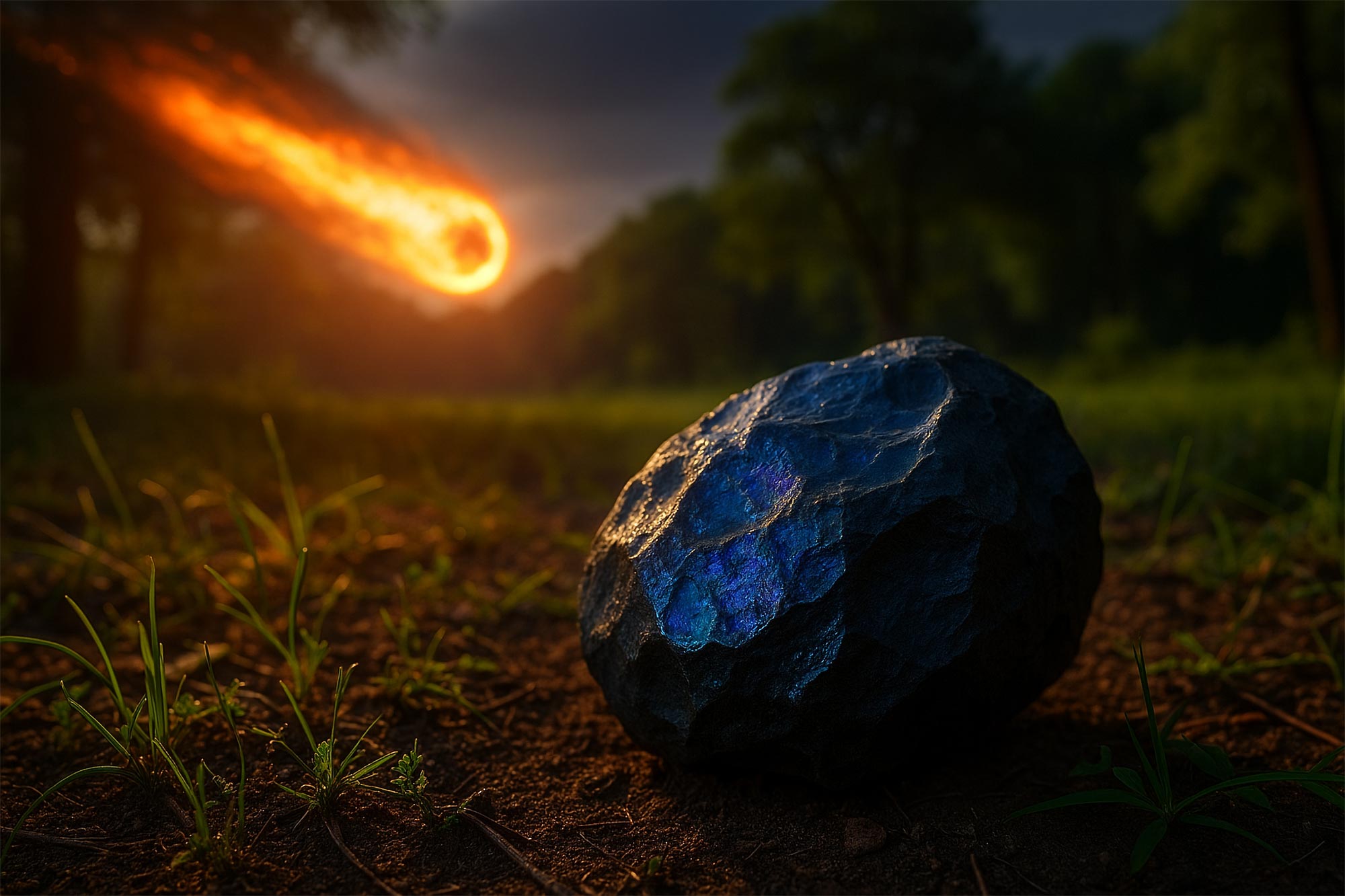
A mysterious “mudball” meteorite exploded in the skies above Costa Rica in 2019, scattering rare, water-rich rocks across the jungle. Scientists rushed to recover 27 kilograms of these stunning fusion-crusted stones, some with iridescent blue surfaces.
What made this event so captivating was not just the beauty of the meteorites, but their surprising strength and pristine condition – tracing their origins back two million years and deep into the asteroid belt. Researchers now believe Aguas Zarcas is a rare glimpse at an untouched piece of the early solar system.
Rare Meteorite Fall in Costa Rica
In April 2019, rare primitive meteorites fell near the town of Aguas Zarcas in northern Costa Rica. In a study published in Meteoritics & Planetary Science, an international team of researchers described the event and challenged the common assumption that so-called “mudball” meteorites are fragile.
“27 kilos of rocks were recovered, making this the largest fall of its kind since similar meteorites fell near Murchison in Australia in 1969,” said meteor astronomer Peter Jenniskens of the SETI Institute and NASA Ames Research Center.
Echoes of Murchison
The Murchison fall occurred just two months after the first crewed Moon landing, when scientists were actively analyzing lunar samples and eager to study other rocks from space.
“The recovery of Aguas Zarcas, too, was a small step for man, but a giant leap for meteoritics,” said geologist Gerardo Soto of the University of Costa Rica in San José, paraphrasing Neil Armstrong’s words. “76 papers have since been written about this meteorite.”

Widespread Excitement and Investigation
Jenniskens teamed up with Soto to investigate the new fall.
“The fall of Aguas Zarcas was huge news in the country. No other fireball was as widely reported and then recovered as stones on the ground in Costa Rica in the last 150 years,” Soto added.
Analysis of video camera footage by the team showed that the rock entered at a near-vertical angle into Earth’s atmosphere from a WNW direction at a speed of 14.6 kilometers per second. The intense heat of collisions with the atmosphere melted (ablated) much of the rock, but there was surprisingly little sign of fragmentation.
A Brilliant Explosion in the Sky
“It penetrated deep into Earth’s atmosphere, until the surviving mass shattered at 25 km above the Earth’s surface,” said Jenniskens, “where it produced a bright flash that was detected by satellites in orbit.”
Nature was kind to this meteorite in that the fall occurred at the end of an unusually long dry season in Costa Rica.
“The Aguas Zarcas fall produced an amazing selection of fusion-crusted stones with a wide range of shapes,” said co-author and meteoriticist Laurence Garvie at the Buseck Center for Meteorite Studies at Arizona State University. “Some stones have a beautiful blue iridescence to the fusion crust.”
Many of the stones are unbroken as they landed on the relatively soft jungle and grassy surfaces. Researchers were surprised by the unusual shape of many of the rocks caused by ablation, without the relatively flat surfaces that result from secondary fragmentation.
Stronger Than Expected
“Other meteorites of this type are often described as mudballs, as they contain water-rich minerals,” said Jenniskens, “Apparently, that does not mean they are weak.”
The research team now believes that Aguas Zarcas is strong because it avoided collisions in space and did not have the cracks that weaken many meteorites.
“The last collision experienced by this rock was 2 million years ago,” said cosmochemist Kees Welten of UC Berkeley.
He and his team measured how long the rock was exposed to cosmic rays after it had broken off from a larger asteroid.
“We know of other Murchison-like meteorites that broke off at approximately the same time, and likely in the same event,” said Welten, “but most broke much more recently.”
Tracing the Meteorite’s Origins
The team determined the rock was about 60 centimeters in diameter when it hit the Earth’s atmosphere. From the path it traveled through the atmosphere, the team traced the meteorite back to the asteroid belt.
“We can tell that this object came from a larger asteroid low in the asteroid belt, likely from its outer regions,” said Jenniskens. “After getting loose, it took two million years to hit the tiny target of Earth, all the time avoiding getting cracked.”
Because the rock was strong and entered at a steep angle, a relatively large fraction of its mass survived to the ground.
Reference: “Orbit, meteoroid size, and cosmic ray exposure history of the Aguas Zarcas CM2 breccia” by Peter Jenniskens, Gerardo J. Soto, Gabriel Goncalves Silva, Oscar Lücke, Pilar Madrigal, Tatiana Ballestero, Carolina Salas Matamoros, Paulo Ruiz Cubillo, Daniela Cardozo Mourao, Othon Cabo Winter, Rafael Sfair, Clemens E. Tillier, Jim Albers, Laurence A. J. Garvie, Karen Ziegler, Qing-Zhu Yin, Matthew E. Sanborn, Henner Busemann, My E. I. Riebe, Kees C. Welten, Marc W. Caffee, Matthias Laubenstein, Darrel K. Robertson and David Nesvorny, 29 March 2025, Meteoritics & Planetary Science.
DOI: 10.1111/maps.14337
Never miss a breakthrough: Join the SciTechDaily newsletter.
Follow us on Google and Google News.