
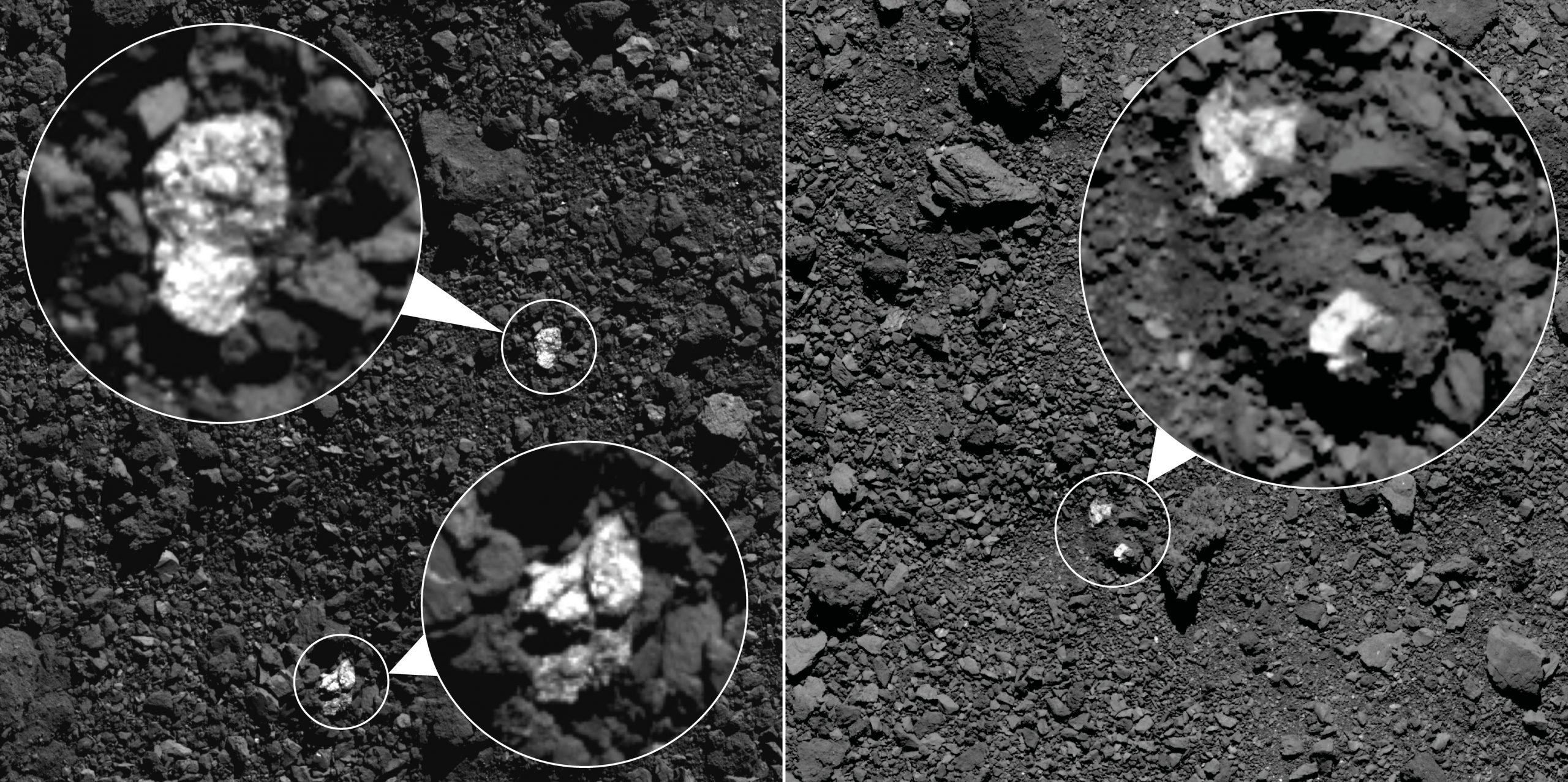
In an interplanetary faux pas, it appears some pieces of asteroid Vesta ended up on asteroid Bennu, according to observations from NASA’s OSIRIS-REx spacecraft. The new result sheds light on the intricate orbital dance of asteroids and on the violent origin of Bennu, which is a “rubble pile” asteroid that coalesced from the fragments of a massive collision.
“We found six boulders ranging in size from 5 to 14 feet (about 1.5 to 4.3 meters) scattered across Bennu’s southern hemisphere and near the equator,” said Daniella DellaGiustina of the Lunar & Planetary Laboratory, University of Arizona, Tucson. “These boulders are much brighter than the rest of Bennu and match material from Vesta.”
“Our leading hypothesis is that Bennu inherited this material from its parent asteroid after a vestoid (a fragment from Vesta) struck the parent,” said Hannah Kaplan of NASA’s Goddard Space Flight Center in Greenbelt, Maryland. “Then, when the parent asteroid was catastrophically disrupted, a portion of its debris accumulated under its own gravity into Bennu, including some of the pyroxene from Vesta.”
DellaGiustina and Kaplan are primary authors of a paper on this research appearing in Nature Astronomy that was published on September 21, 2020.
It appears some pieces of asteroid Vesta ended up on asteroid Bennu, according to observations from NASA’s OSIRIS-REx spacecraft. The new result sheds light on the intricate orbital dance of asteroids and on the violent origin of Bennu. Credit: NASA’s Goddard Space Flight Center
The unusual boulders on Bennu first caught the team’s eye in images from the OSIRIS-REx (Origins, Spectral Interpretation, Resource Identification, Security-Regolith Explorer) Camera Suite (OCAMS). They appeared extremely bright, with some almost ten times brighter than their surroundings. They analyzed the light from the boulders using the OSIRIS-REx Visible and Infrared Spectrometer (OVIRS) instrument to get clues to their composition. A spectrometer separates light into its component colors. Since elements and compounds have distinct, signature patterns of bright and dark across a range of colors, they can be identified using a spectrometer. The signature from the boulders was characteristic of the mineral pyroxene, similar to what is seen on Vesta and the vestoids, smaller asteroids that are fragments blasted from Vesta when it sustained significant asteroid impacts.
Of course it’s possible that the boulders actually formed on Bennu’s parent asteroid, but the team thinks this is unlikely based on how pyroxene typically forms. The mineral typically forms when rocky material melts at high-temperature. However, most of Bennu is composed of rocks containing water-bearing minerals, so it (and its parent) couldn’t have experienced very high temperatures. Next, the team considered localized heating, perhaps from an impact. An impact needed to melt enough material to create large pyroxene boulders would be so significant that it would have destroyed Bennu’s parent body. So, the team ruled out these scenarios, and instead considered other pyroxene-rich asteroids that might have implanted this material to Bennu or its parent.
Observations reveal it’s not unusual for an asteroid to have material from another asteroid splashed across its surface. Examples include dark material on crater walls seen by the Dawn spacecraft at Vesta, a black boulder seen by the Hayabusa spacecraft on Itokawa, and very recently, material from S-type asteroids observed by Hayabusa2 at Ryugu. This indicates many asteroids are participating in a complex orbital dance that sometimes results in cosmic mashups.
As asteroids move through the solar system, their orbits can be altered in many ways, including the pull of gravity from planets and other objects, meteoroid impacts, and even the slight pressure from sunlight. The new result helps pin down the complex journey Bennu and other asteroids have traced through the solar system.
Based on its orbit, several studies indicate Bennu was delivered from the inner region of the Main Asteroid Belt via a well-known gravitational pathway that can take objects from the inner Main Belt to near-Earth orbits. There are two inner Main Belt asteroid families (Polana and Eulalia) that look like Bennu: dark and rich in carbon, making them likely candidates for Bennu’s parent. Likewise, the formation of the vestoids is tied to the formation of the Veneneia and Rheasilvia impact basins on Vesta, roughly about two billion years ago and approximately one billion years ago, respectively.
“Future studies of asteroid families, as well as the origin of Bennu, must reconcile the presence of Vesta-like material as well as the apparent lack of other asteroid types. We look forward to the returned sample, which hopefully contains pieces of these intriguing rock types,” said Dante Lauretta, OSIRIS-REx principal investigator at the University of Arizona in Tucson. “This constraint is even more compelling given the finding of S-type material on asteroid Ryugu. This difference shows the value in studying multiple asteroids across the solar system.”
The spacecraft is going to make its first attempt to sample Bennu in October and return it to Earth in 2023 for detailed analysis. The mission team closely examined four potential sample sites on Bennu to determine their safety and science value before making a final selection in December 2019. DellaGiustina and Kaplan’s team think they might find smaller pieces of Vesta in images from these close-up studies.
Reference: “Exogenic basalt on asteroid (101955) Bennu” by D. N. DellaGiustina, H. H. Kaplan, A. A. Simon, W. F. Bottke, C. Avdellidou, M. Delbo, R.-L. Ballouz, D. R. Golish, K. J. Walsh, M. Popescu, H. Campins, M. A. Barucci, G. Poggiali, R. T. Daly, L. Le Corre, V. E. Hamilton, N. Porter, E. R. Jawin, T. J. McCoy, H. C. Connolly Jr, J. L. Rizos Garcia, E. Tatsumi, J. de Leon, J. Licandro, S. Fornasier, M. G. Daly, M. M. Al Asad, L. Philpott, J. Seabrook, O. S. Barnouin, B. E. Clark, M. C. Nolan, E. S. Howell, R. P. Binzel, B. Rizk, D. C. Reuter and D. S. Lauretta, 21 September 2020, Nature Astronomy.
DOI: 10.1038/s41550-020-1195-z
The research was funded by the NASA New Frontiers Program. The primary authors acknowledge significant collaboration with the French space agency CNES and Japan Society for the Promotion of Science Core-to-core Program on this paper. NASA’s Goddard Space Flight Center in Greenbelt, Maryland provides overall mission management, systems engineering, and the safety and mission assurance for OSIRIS-REx. Dante Lauretta of the University of Arizona, Tucson, is the principal investigator, and the University of Arizona also leads the science team and the mission’s science observation planning and data processing. The late Michael Drake of the University of Arizona pioneered the study of vestoid meteorites and was the first principal investigator for OSIRIS-REx. Lockheed Martin Space in Denver built the spacecraft and is providing flight operations. Goddard and KinetX Aerospace are responsible for navigating the OSIRIS-REx spacecraft. OSIRIS-REx is the third mission in NASA’s New Frontiers Program, which is managed by NASA’s Marshall Space Flight Center in Huntsville, Alabama, for the agency’s Science Mission Directorate in Washington. NASA is exploring our Solar System and beyond, uncovering worlds, stars, and cosmic mysteries near and far with our powerful fleet of space and ground-based missions.
Never miss a breakthrough: Join the SciTechDaily newsletter.
Follow us on Google and Google News.