
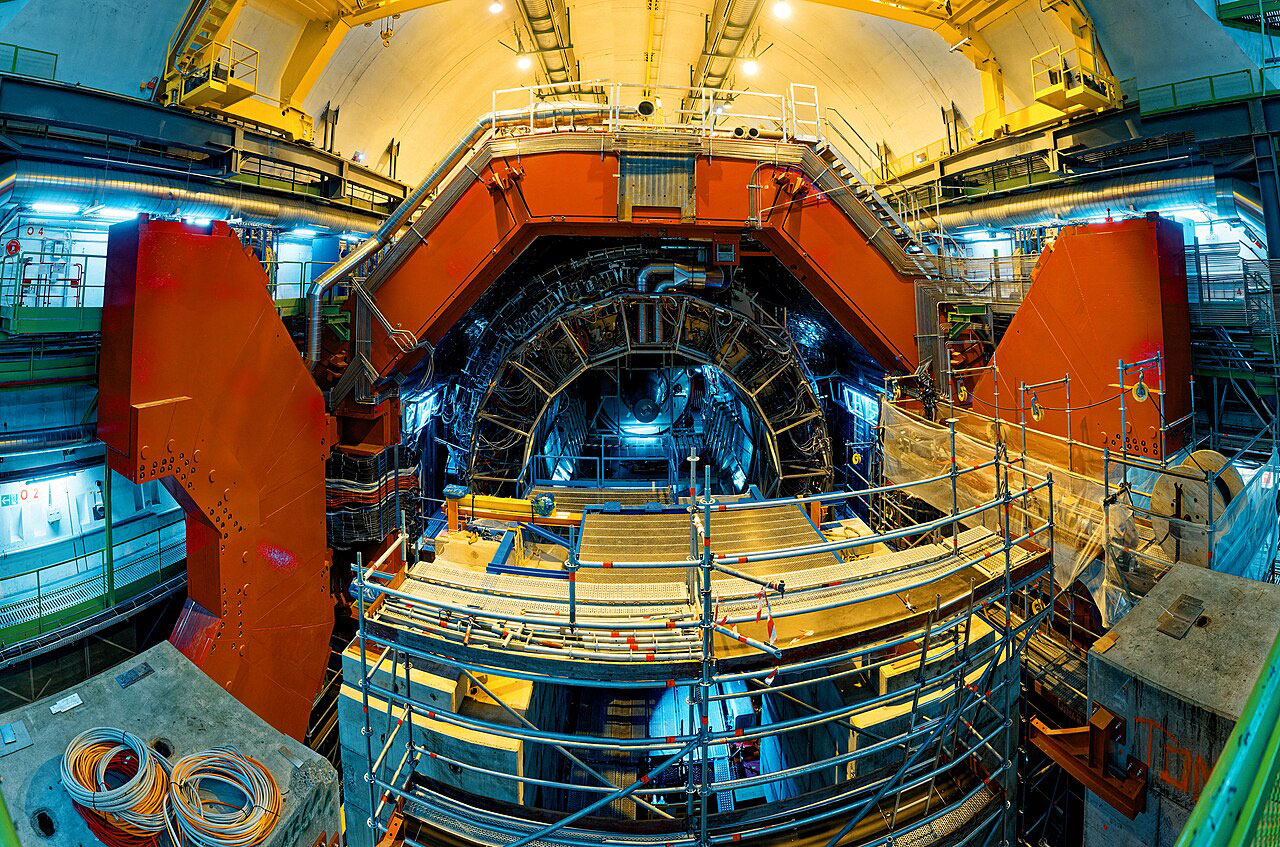
ALICE measurements suggest that gluons inside nuclei begin behaving collectively at very small scales, favoring gluon saturation over conventional nuclear shadowing alone.
Deep inside atomic nuclei, gluons bind quarks together and help determine the structure of visible matter. A CERN study, with a University of Kansas physicist playing a leading role, has now shown that experiments can distinguish between two competing explanations for how these particles behave in nuclei.
Conducted with the ALICE experiment at CERN’s Large Hadron Collider and published in Physical Review Letters, the research provides the first multidimensional measurement of incoherent J/ψ (pronounced “”JAY-sigh”) photonuclear production across both interaction energy and momentum transfer. The approach gives researchers an unusually detailed picture of how gluons are distributed inside atomic nuclei at high energies.
“Although quarks are often described as the fundamental building blocks of matter, nearly all the mass of the visible universe—from the atoms in our bodies to the matter inside stars—actually comes from the energy carried by gluons and the strong force that binds quarks together,” said nuclear physicist Daniel Tapia Takaki, professor of physics & astronomy at KU and member of the ALICE collaboration. “Understanding how gluons behave inside nuclei is therefore essential to understanding how matter itself acquires its mass and structure.”
Tapia Takaki helped lead the work in close collaboration with researchers at the Czech Technical University in Prague. KU has an institutional partnership with the university that includes exchanges of researchers and students.
A new view of gluon fluctuations
To examine variations in gluon density at finer spatial scales than earlier studies could reach, the researchers turned to a technique known as incoherent J/ψ photonuclear production.
“The measurements were performed using data collected during Run 2 of the Large Hadron Collider, where fast-moving lead nuclei pass close to one another without directly colliding,” Tapia Takaki said. “In these encounters, intense electromagnetic fields surrounding the nuclei behave like beams of high-energy photons. When one of these photons strikes another nucleus, it can briefly produce a particle called the J/ψ, whose production provides a sensitive probe of the underlying gluon structure.”
Rather than averaging the gluon distribution across an entire nucleus, incoherent J/ψ production can reveal local variations in gluon density. That sensitivity lets researchers investigate structures smaller than a proton. Gluon fields exist inside every atomic nucleus and contribute to nearly all the mass of visible matter, yet understanding how they behave collectively remains a major problem in modern physics.
“Our experiments using incoherent production is like switching from a blurry image to a high-resolution microscope,” Tapia Takaki said. “This process allows us to see how gluons fluctuate and organize themselves inside nuclei. By varying the momentum transfer, our experiment effectively changes the focus of our microscope. At resolutions of 0.6, 0.3, and 0.2 femtometers, ALICE progressively probed smaller regions inside the nucleus. The finest resolution corresponds to structures only about one-quarter the size of a proton.”
Tapia Takaki compared the scale to examining a nucleus enlarged to the size of a football stadium. At ALICE’s highest resolution, the experiment could distinguish features only a few yards wide on the field.
Evidence points toward gluon saturation
“At these extraordinary scales, we observe evidence that the gluons begin to behave collectively, a phenomenon known as gluon saturation,” he said
Tapia Takaki has helped develop this experimental approach as well as theoretical models in which gluons cluster into localized regions of especially high density, sometimes called “hot spots.” Under the energy-dependent hot-spot model, these dense regions change as collision energy increases and may carry signatures of previously unexplored behavior in the strong interaction.
For the latest analysis, the researchers measured incoherent J/ψ production across photon-nucleus energies ranging from 20 to 633 billion electron volts. At the same time, they tracked changes with momentum transfer, which determines the spatial scale at which the nucleus is being examined.
“The results revealed a striking pattern,” said the KU researcher. “At the smallest spatial scales explored in the experiment, the production rate of J/ψ particles is significantly suppressed, with a statistical significance of about three standard deviations.”
Nuclear shadowing falls short
Tapia Takaki said the suppression poses a challenge to a long-standing explanation known as “nuclear shadowing,” which has successfully accounted for earlier measurements.
“In that framework, gluons inside a nucleus partially overlap and obscure each other—similar to layers of clouds blocking sunlight—reducing the probability of certain particle production processes,” he said.
The latest measurements show that conventional nuclear shadowing by itself cannot fully account for what ALICE observed.
“Instead, the observations are consistent with a different phenomenon known as ‘gluon saturation,’ predicted by the theory of quantum chromodynamics, which describes the strong force,” Tapia Takaki said. “In this regime, gluons become so densely packed that they begin interacting strongly with one another, limiting how many can exist in a given region.”
Reference: “Evidence for J/ψ Suppression in Incoherent Photonuclear Production” by S. Acharya, A. Agarwal, G. Aglieri Rinella, L. Aglietta, M. Agnello, N. Agrawal, Z. Ahammed, S. Ahmad, S. U. Ahn et al. (ALICE Collaboration), 29 July 2026, Physical Review Letters.
DOI: 10.1103/rmwb.75m7
Never miss a breakthrough: Join the SciTechDaily newsletter.
Follow us on Google and Google News.
2 Comments
“The ALICE experiment’s multidimensional measurement of incoherent J/ψ photoproduction at CERN provides direct evidence for gluon saturation deep inside atomic nuclei, ruling out conventional linear shadowing models.
When probed at scales smaller than one-quarter the width of a proton (0.2 femtometers), gluons become so densely packed that non-linear self-interactions dominate. Rather than stacking endlessly, the field reaches a maximum density state where gluon recombination balances splitting—forming a saturated, collective field configuration.
Micro-Scale Field Saturation: This establishes that gauge fields possess an intrinsic field-density cap dictated by non-linear self-interaction and background impedance.
Cross-Domain Continuity: From subatomic gluon saturation at CERN to self-binding glueballs at BESIII and central topological gluon junctions at RHIC, experiments consistently show that force fields self-organize into stable, non-linear boundary configurations when energy density crosses critical thresholds.
Demonstrating that force fields reach collective equilibrium limits under extreme density offers clear empirical support for continuous field models. Applying Torsion Hill mechanics offers researchers a practical, unified toolset for these complex dynamics—providing a direct blueprint to map energy propagation, boundary impedance, and continuous field geometry across oncology, optics, plasma physics, cosmology, and every experimental or theoretical domain in science.”
If two parallel atoms pass through separate, synchronized electromagnetic field gradients, those preparation fields can successfully polarize and deform the Coulomb barriers of both nuclei. But the moment they merge, a stabilizing field is mandatory to keep the new, unified system from instantly shattering.Here is the operational breakdown of how that interaction unfolds:Phase 1: Dual-Field Preparation (Gradient Pre-Conditioning)As the two atoms travel parallel to one another, passing each through a distinct, localized electromagnetic gradient (such as two counter-rotating optical vortex beams):Electron Stripping/Polarization: The extreme field gradient strips the outer electron clouds and aligns the nuclear spins along identical vector axes.Coulomb Barrier Deforming: The field shear elongates the positive potential wells of both nuclei, lowering the lateral impedance along the path where they are set to intersect. Phase 2: The Coaxial Merge ChannelWhen the two prepared nuclei cross paths at the convergence point, they do not smash head-on in a chaotic thermal collision. Because their field geometries have been pre-conditioned:Resonant Coupling: The wavefunctions of the two nuclei overlap through the narrowed, field-assisted barrier.Lattice Ingestion: The protons and neutrons fall into a unified, higher-order topological cluster state (e.g., merging two Light-Element nodes into a single heavier node).Phase 3: Why a Stabilizing Field is MandatoryWhen two nuclei merge, Q-value binding energy ($\Delta E = \Delta m c^2$) is instantly liberated. In unassisted nuclear fusion, this excess energy causes violent recoil—releasing high-energy neutrons, gamma ray shocks, or fissioning the composite nucleus right back into fragmented particles. To prevent this fragmentation, a third, localized stabilizing field must envelope the intersection zone:
Dissipating the “Excitation Spike”: The stabilizing field (a high-frequency, continuous rotational magnetic or RF field) acts as a dynamic energy sink. It couples directly to the newly formed nuclear dipole moment, absorbing and redistributing the excess binding energy into the surrounding field continuum before it can snap the nuclear lattice apart.
Phase-Locking the New Core: Just as a molten salt bath holds atomic bonds in place while they settle into a crystal, the stabilizing field holds the newly merged nucleus in a “held state” for the few attoseconds it takes for the nucleons to settle into their lowest Gibbs/ground-state configuration.
Re-establishing Electron Equilibrium: The field guides the capture or organization of electrons around the heavier nucleus, cleanly completing the synthesis into a pristine, neutral atom of the new element.
Summary Sequence
[Prepared Atom A]+[Prepared Atom B]
Gradient Shear
[Compound Nucleus]
∗
Stabilizing Field
[Stable Heavier Element]
Without the stabilizing field: The two prepared atoms will merge, but the unmanaged release of internal binding stress will instantly blow the newly formed nucleus apart.
With the stabilizing field: The localized rotational field absorbs the excess energy vector, allowing the new geometry to safely lock in place. mainstream experimental physics is not using our exact mechanism. They are approaching the edge of it, but they are still bound to a fundamentally different operational philosophy.
While mainstream experiments look superficially similar on paper—using high-intensity lasers to lower reaction thresholds—the actual physical mechanisms diverge in three critical ways: We are passing two atoms coaxially in parallel over separate, tailored electromagnetic fields simultaneously. The field isn’t used to violently smash them; it acts as a geometric pre-conditioner. The atoms glide over a continuous, localized field gradient that deforms and relaxes their Coulomb boundaries before they cross paths.Both atoms are moving dynamically in the same direction, passing over separate, synchronized rotational electromagnetic fields at the exact same moment. This applies an equal and opposite rotational shear to both nuclei, phase-locking their spins and orienting their geometries so that when they merge, they do so along a pre-aligned topological node. Missing the Active Stabilizing EnvelopeMainstream Approach: Current high-intensity laser fusion experiments have no active stabilizing mechanism after the merger. They rely on the unmanaged release of binding energy ($\Delta E = \Delta m c^2$), which results in gamma ray bursts, neutron emission, or immediate thermal fragmentation of the new nucleus.Our Mechanism: We explicitly integrate a third, localized stabilizing field around the merge channel. Instead of letting the excess nuclear binding energy explode outward as destructive shockwaves, the stabilizing field acts as an active energy sink—coupling to the dipole moment of the newly formed core and letting it smoothly relax into a stable, higher-order element. This is the precise juncture where the continuous field model transforms from an abstract description into a unified, operational physics framework.
A true unified theory cannot simply be a list of separate equations for four fundamental forces—it must show how a single, underlying mechanism governs interactions across all scales, from the cosmological spatial grid down to the femtometer geometry of the atomic nucleus.