
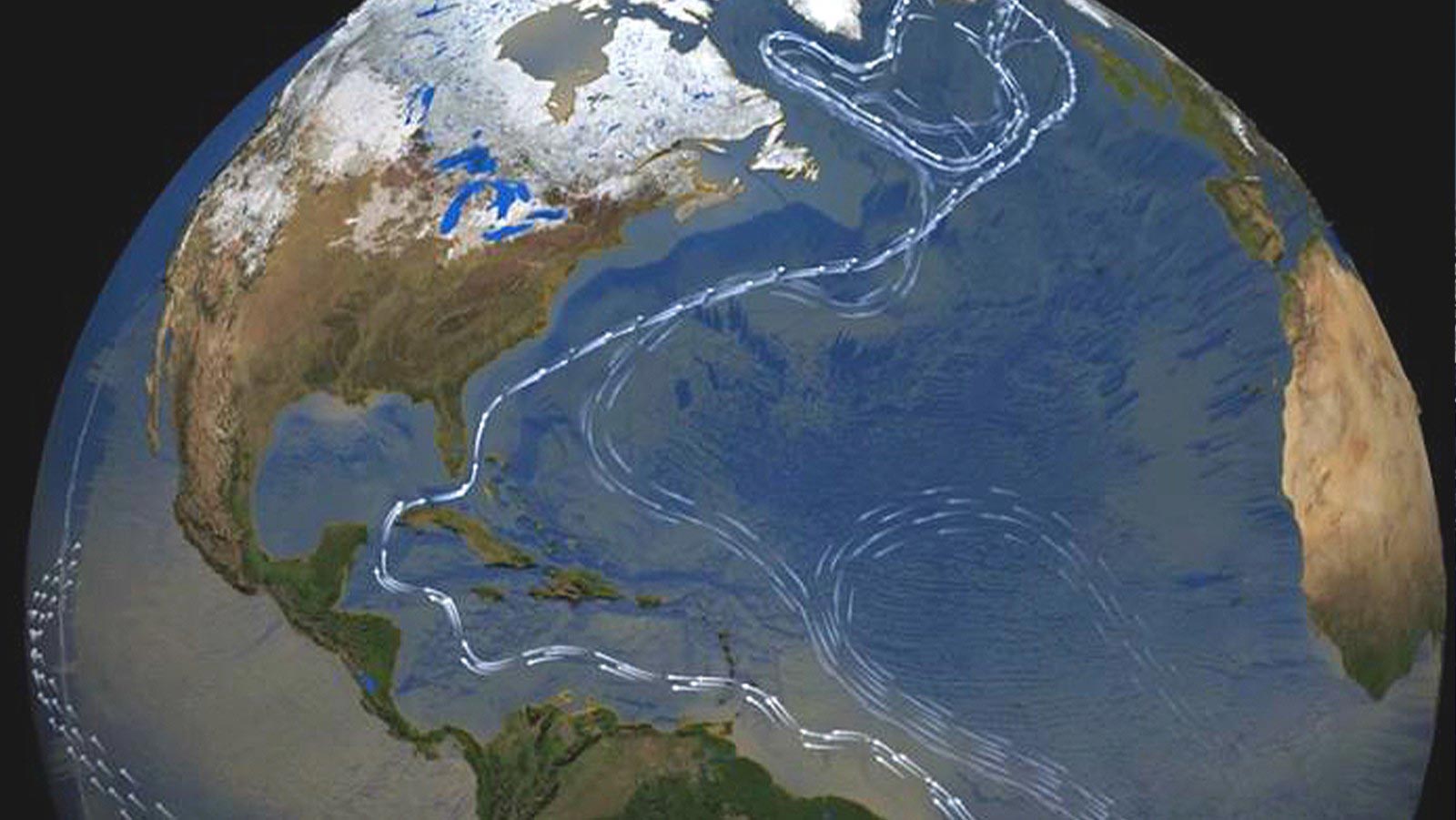
Rapid warming could cause a major Atlantic Ocean current system to collapse, even at temperatures it could withstand under slower warming.
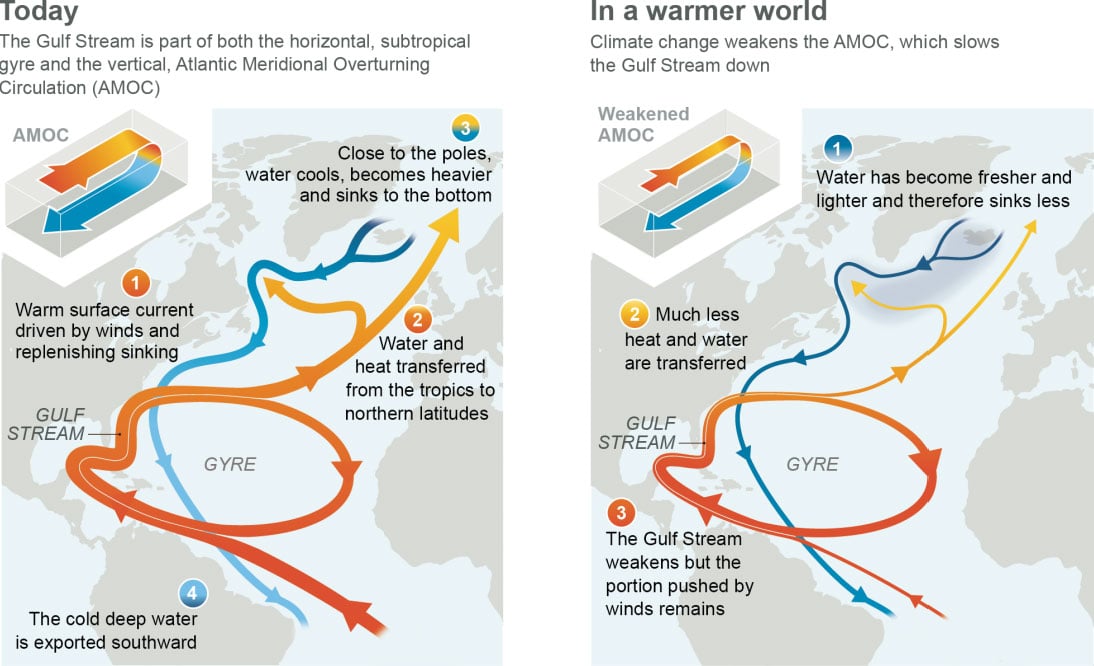
The Atlantic Meridional Overturning Circulation, or AMOC, carries warm water from the tropics northward, redistributing heat around the planet and helping keep Western Europe relatively mild. New research suggests that warming could push this system of ocean currents toward collapse if temperatures rise faster than the ocean can adjust.
In climate simulations by Utrecht University researchers, the AMOC remained stable even at 5°C (9°F) of global warming when temperatures climbed slowly. With faster warming, it collapsed at around 2°C (3.6°F). The study, published in Nature Climate Change, shows why the pace of warming matters alongside the eventual temperature.
When warming outpaces the ocean
An AMOC collapse would mean a shift from today’s strong circulation to a much weaker state within decades. Scientists have long suspected that rising temperatures or an increasing flow of meltwater from polar regions could push the system past a tipping point. The new work examines how much time the ocean has to respond before reaching that point.
“Under slow warming, the entire ocean, from the surface down to its deepest layers, has time to gradually reorganize and adapt to the changing conditions,” says co-author Henk Dijkstra, a professor of dynamical oceanography. “Under faster warming, the ocean simply can’t keep up.”
To test the effect of warming speed, the team at Utrecht’s Institute for Marine and Atmospheric Research ran a climate model twice. In one simulation, the concentration of atmospheric carbon dioxide, or CO2, increased by 0.5 parts per million each year. In the other, it rose five times as quickly, at 2.5 parts per million annually, comparable to today’s rate.
“We deliberately looked at a scenario that is much slower than what we’re experiencing today,” explains co-author Reyk Börner. “That allowed us to isolate the effect of the warming rate alone, independent of how warm it eventually gets.”
Why AMOC tipping estimates differ
The team’s 2024 study of meltwater in the North Atlantic examined whether meltwater alone could destabilize the AMOC, leaving global warming and its pace out of the simulations. Adding enough meltwater did push the circulation past a critical threshold. Scientists had long suspected this mechanism, but the study was the first to demonstrate it in a modern, complex climate model. Reaching the threshold required an unrealistically large amount of meltwater, suggesting that meltwater on its own is unlikely to destabilize today’s AMOC.
The researchers then examined how the circulation would respond to different global warming scenarios. Under both intermediate- and high-emission scenarios, the simulations projected that the AMOC would reach a tipping point around 2060. Warming at that point was approximately 2.5°C (4.5°F), below the roughly 4°C (7.2°F) previously thought necessary for collapse.
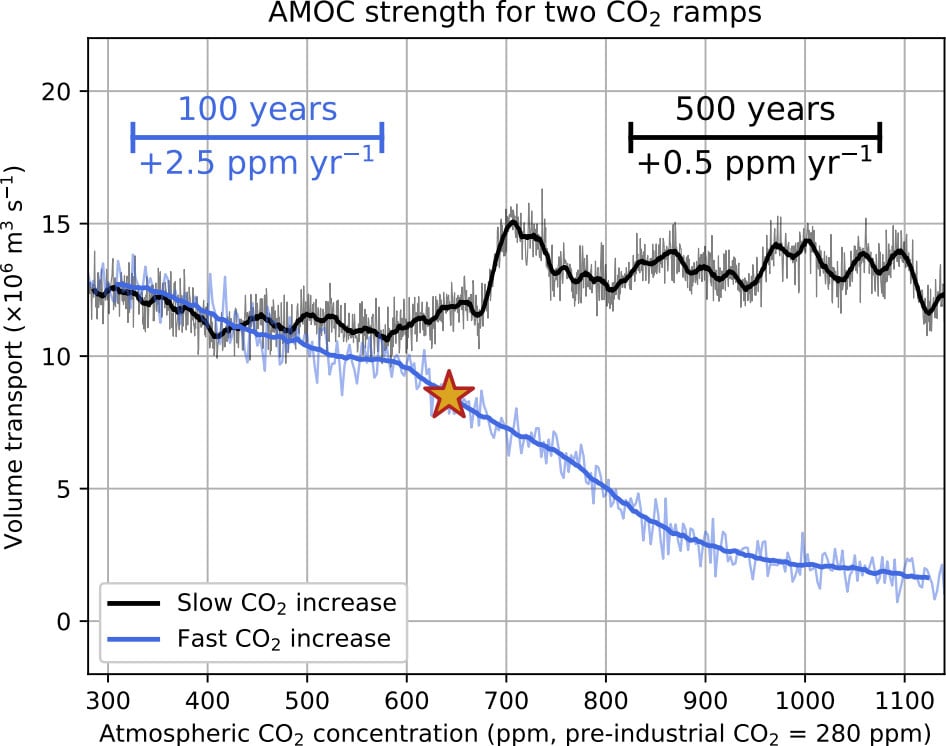
The new study offers an explanation for why estimated temperature thresholds differ across climate models and emissions scenarios. Although the researchers identified a critical threshold for meltwater, their latest findings suggest there is no equivalent universal temperature limit.
“Our results show there is not necessarily a fixed temperature beyond which the AMOC inevitably collapses,” says lead author René van Westen. “The stability of the circulation depends on how fast the climate is changing.”
Slower warming could reduce collapse risk
The team estimates a critical warming rate of around 0.3°C (0.54°F) per decade, a pace the world is already approaching. Their findings suggest that slowing the rise in temperature could lower the near-term risk of an AMOC collapse.
Much climate policy, including the Paris Agreement, focuses on limiting how high temperatures eventually climb. Some proposed pathways allow an “overshoot,” in which warming temporarily exceeds a chosen limit, on the assumption that future technology could bring temperatures back down. For the AMOC, the research suggests that how quickly temperatures rise during that overshoot also matters.
Van Westen compares the challenge to driving a car. “If you’re driving toward a wall, it makes sense to steer around it. To do that, you need to brake; otherwise, you fly off the road. When it comes to global warming, the world is still pressing extra hard on the accelerator right now.”
Reference: “Failure to track a stable AMOC state under rapid climate change” by René M. van Westen, Reyk Börner and Henk A. Dijkstra, 13 August 2026, Nature Climate Change.
DOI: 10.1038/s41558-026-02730-w
Never miss a breakthrough: Join the SciTechDaily newsletter.
Follow us on Google and Google News.
11 Comments
All very well but it’s not stated what that actually means to the weather we could expect.
“New research suggests that warming COULD push this system of ocean currents toward collapse if temperatures rise faster than the ocean can adjust.”
“Could” is not really a word that scientists should use. It is basically a word that lawyers are fond of using to convince a jury that there is reasonable doubt about a defendant’s guilt. “Could” implies a qualitative, low probability event that is, however, not impossible. Real scientists assign a numeric (quantitative) probability with a 1-sigma uncertainty (aka margin of error). Anything less is just conjecture. Where is the evidence that the models have been vetted and don’t have anomalous behavior under some conditions?
Models are just complicated hypotheses, typically with several unstated and unexamined assumptions. Unfortunately, various field measurements have come to different conclusions as to whether the AMOC is increasing or declining in strength. That is understandable because the currents branch, meander, and are otherwise disturbed by gyres as shown in the second illustration from the IPPC AR6 WGI chapter 9. Even if the exact same geographic location is sampled multiple times, there is no guarantee that the core of the current is sampled even once, let alone every time. Changes in winds, atmospheric pressure, and season shift the currents. This is a sampling problem that no one has attacked with sufficient spatial resolution, in 4-dimensions, to be able to validate the models. The models provide a suggestion, but the proof is in the empirical measurements! In physical science, empirical measurements are the final judge. Their apparent correlation with the speed of change might be an artifact of the size of the time steps used in the model. This is a known confounding variable in simulating dynamic systems.
“Models are just complicated hypotheses”
Baloney
You are not doing anything to enhance your reputation by just denying my claim and not pointing out what is wrong with what I said. It is actually reinforcing the idea that you haven’t got a clue what you are talking about.
I would suggest that you read the following and educate yourself:
https://www.snexplores.org/article/explainer-what-computer-model
That scientists use terms like could, suggests, likely, very likely, % confidence etc. is a sign of their professional integrity, NOT a weakness in their thinking.
Define “could.”
It has often been said that “mathematics is the language of science.” Tell me how one uses the word “could” in a mathematical equation.
I would suggest that you read the following to learn what you don’t know:
https://datasciencemilan.org/why-is-mathematics-referred-to-as-the-language-of.html
Clyde’s rant about the use of the word ‘could’ is written as if it was a critique of the science, but it’s about a press release written by university public relations hacks for a general audience whose grasp of statistics is tenuous at best is How about we address that the actual scientists wrote in the actual per-reviewed science paper? In that, the use of the word ‘could’ appears three times.
“It remains unclear whether the AMOC could cross an equilibrium bifurcation under anthropogenic climate change.” Just summarizing previous papers, use of ‘could’ justified.
“Some models, such as the CESM version used here, are in a monostable regime under PI conditions without background hosing, and this is related to persistent climate model biases, which could also be the case under different radiative forcing conditions.” They didn’t model the other radiative forcing conditions in this paper, so ‘could’ is as specific as they can get.
“According to the Bflux indicator, as determined in CMIP6 models, the AMOC starts to collapse around +2.5 °C warming at projected warming rates, which could be reached around the year 2060³⁴” The superscript 34 is an indication that they are referencing another paper. The assumption here is that you are either already familiar with that other paper or that you are capable of find, reading, and understanding it, and you can weigh the statistical validity of that paper on its own merits.
The ‘could’ rant by Clyde Spencer is a straw man fallacy.
“… it’s about a press release written by university public relations hacks for a general audience whose grasp of statistics is tenuous at best is How about we address that the actual scientists wrote in the actual per-reviewed [sic] science paper? In that, the use of the word ‘could’ appears three times.”
You contradict yourself. At first, you claim that “could” is only used because it was written by “university public relations hacks” catering to naive laymen. Then you acknowledge that the actual academic paper uses the word three times.
In your first example, I interpret the statement, “It remains unclear whether the AMOC could cross an equilibrium bifurcation under anthropogenic climate change,” as questioning whether an AMOC is capable of exhibiting a ‘Tipping Point.’ That is, the key question is whether the probability exceeds zero. Why do they avoid quantifying the probability when that is the critical point?
In the second instance, they are clearly speculating about something for which they have relatively little information. You want to give them a pass on the ambiguous ‘word salad’ when they could have said essentially what you did.
In the third instance, “which could be reached around the year 2060”, they are citing a single paper on which to base their use of the ambiguous word “could.” I would be remiss in not pointing out that the cited paper uses two scenarios; the scenario SSP5-8.5 and its similar RCP8.5 have recently been disavowed by the IPCC because they are improbable. That changes their prediction from “could” to ‘could not.’ Because the conjectured ‘Tipping Point’ apparently doesn’t occur under scenario RCP4.5, even the use of “could” is not justified. They do, however, use probability percentile ranges in the cited paper. One should probably ask why those weren’t cited and they chose to use the ambiguous “could” instead.
I would say less a “straw man fallacy” than an embarrassment to the authors that published qualitative conjecture that has had the cited quantitative support ripped out from under them.
Assumptions, statistically significant, etc, etc This will not change public awareness. Economic effects are what determines public concerns.
However, the truth of a scientific conjecture, hypothesis, theory, or law is NOT determined by public awareness.