

A river can now move nearly a year’s worth of sediment in just a few intense weeks.
Across the United States, the sand, silt, and soil carried downstream by rivers are becoming increasingly concentrated into short, intense bursts, according to a new study that reconstructed nearly four decades of sediment transport across 175 waterways.
The change is substantial. In 1985, the typical river in the study needed about 69 days to transport 90 percent of its annual suspended sediment. By 2023, that window had narrowed to just 50 days. At one-third of the rivers studied, sediment transport became significantly more compressed over time.
Sediment Is Moving Faster Through U.S. Rivers
The findings suggest that a familiar sight after a major storm—a river suddenly running thick and brown—may be becoming a more important part of how American waterways function.
“Some rivers are transporting more sediment each year. Others are transporting the same amount but packing it into fewer extreme events,” said Admin Husic, an associate professor of civil and environmental engineering at Virginia Tech.
That shift could have consequences for drinking water, reservoirs, aquatic habitats, bridges, dams, and other infrastructure built around rivers.
Sediment is easy to dismiss as mud, but rivers depend on it.
Why River Sediment Matters
Moving sediment reshapes channels, replenishes beaches and wetlands, creates and modifies habitat, and carries nutrients and other material through watersheds. Too much sediment arriving too quickly, however, can degrade habitat, accelerate reservoir filling, complicate water treatment, increase erosion, and transport nutrients and pollutants downstream.
River sediment has always moved unevenly. Large storms can accomplish in hours or days what ordinary flows might not accomplish in months.
“A rule of thumb is that 90 percent of a river’s sediment is transported during just 10 percent of the time,” Husic said.
The Storms Traditional Monitoring Misses
What scientists have struggled to determine is whether that already uneven pattern has been changing.
One reason is surprisingly practical: sediment is difficult to monitor.
Traditional programs often depend on water samples collected manually at intervals throughout the year. Major storms—the very moments when rivers can transport enormous quantities of material—are among the hardest and sometimes most dangerous times for technicians to collect samples.
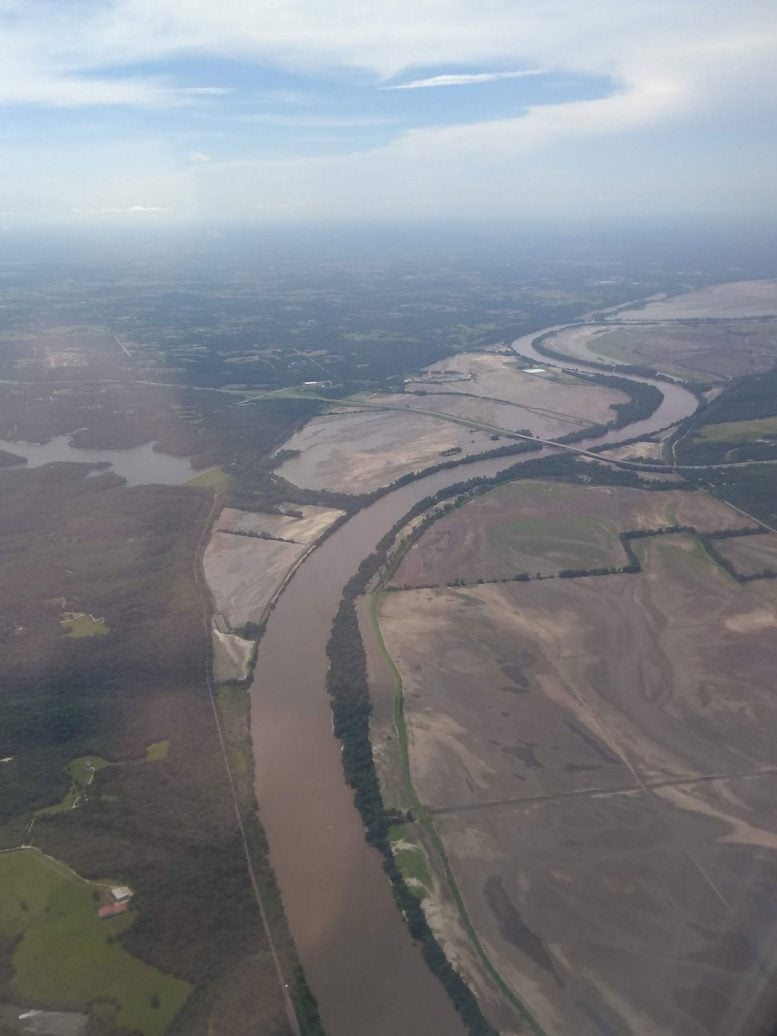
“It’s like trying to understand how a river behaves by looking at only a small snapshot in time,” Husic said. “You may capture part of the story, but you miss the larger patterns and the most important changes happening over short periods of time.”
To fill those gaps, Husic and Virginia Tech researcher Nishchal Sigdel combined millions of high-frequency turbidity observations with deep learning.
AI Reconstructs 40 Years of Sediment Transport
Turbidity sensors continuously measure how cloudy water becomes as particles pass through it. Those measurements can provide far more detail than occasional physical samples, but they do not automatically translate into a complete, decades-long record of sediment transport.
The researchers used artificial intelligence to bridge that gap, reconstructing daily sediment fluxes from 1985 through 2023 at 175 U.S. rivers. That allowed them to examine two questions separately: whether rivers were carrying more sediment overall and whether they were carrying it in increasingly concentrated bursts.
The distinction turned out to be crucial.
Annual Totals Hide a Major Shift
Annual sediment yields significantly increased at 28 percent of the rivers. But sediment transport became significantly more compressed in time at 33 percent. Only about 15 percent experienced both trends simultaneously.
In other words, simply measuring how much sediment passes a location over an entire year can conceal an important transformation in river behavior.
Two rivers might carry roughly the same annual amount. One might distribute that sediment across months; the other might deliver most of it during a few violent storms. For ecosystems and infrastructure downstream, those are very different rivers.
The researchers also found that the forces controlling sediment quantity were not identical to those controlling its timing.
Heavy Rain and Urbanization Drive Different Changes
Intensifying precipitation was the strongest predictor of rising sediment yields. More powerful rainfall can erode soil and mobilize greater quantities of material.
The increasing concentration of sediment into shorter periods, however, was associated most strongly with land-use change. Urbanization was particularly important, and the strongest shifts occurred in smaller, developing watersheds.
Forests, vegetation, and permeable soil can slow rainfall and allow some water to soak into the ground. Development replaces part of that landscape with roads, rooftops, parking lots, and other hard surfaces. Water can then reach streams more rapidly, producing sharper surges capable of moving sediment quickly.
The result is not necessarily just a river carrying more material. It can be a river becoming more abrupt.
Sediment Bursts Leave Less Time to React
That gives communities less time to react.
A treatment plant may have to contend with a sudden pulse of extremely turbid water. A reservoir may receive a disproportionate share of its annual sediment during a few storms. Habitat can be disturbed by intense episodes of erosion and deposition rather than gradual change.
The problem is therefore partly one of timing.
A separate Virginia Tech study points to a related change occurring in the water itself.
Husic and researcher Chuqiang Chen analyzed nearly 24,000 storm events across 754 U.S. catchments and reconstructed how much streamflow came from recent precipitation—water that reached streams relatively quickly after falling as rain.
Rain Is Reaching Rivers Faster, Too
That fraction increased significantly in 27 percent of the catchments studied. The shift occurred nearly twice as often as significant increases in streamflow itself, meaning a watershed’s behavior could change substantially even when the total volume of water flowing through it showed little obvious trend. Intensifying precipitation, urbanization, and forest loss emerged as major drivers.
Taken together, the two studies point toward the same broader transformation.
In many places, rain is reaching rivers faster, and the sediment those rivers carry is increasingly being transported in shorter bursts.
Why River Management Must Focus on Timing
That combination could make watersheds more responsive to individual storms while making annual averages less informative about the stresses experienced downstream.
The findings also expose a problem with the way rivers are often monitored and managed.
Annual totals are convenient. Engineers can calculate how much sediment entered a reservoir in a year, how much water passed a gauge, or how much material a river exported from a watershed.
But an annual number cannot show whether those loads arrived steadily or nearly all at once.
“For decades, we’ve managed rivers like accountants adding up annual totals, looking only at how much material moves per year,” Husic said. “But the record of sediment transport revealed by our study tells us that timing is equally important.”
Managing Rivers for Short, Intense Sediment Bursts
The narrowing sediment window could therefore change how monitoring programs are designed. If most of the consequential transport occurs during a relatively small number of events, sensors and forecasting systems capable of capturing those events become increasingly valuable.
It may also change what water managers need to prepare for.
A river does not have to transport dramatically more sediment over the course of a year to become harder to manage. It only has to deliver that sediment faster.
“If we want to protect our drinking water, bridges, and ecosystems in an era of rapid development and stronger storms,” Husic said, “we have to start managing for those intense, few days when most of the work happens.”
References:
“U.S. rivers are transporting more suspended sediment, often in less time” by Nishchal Sigdel, and Admin Husic, 23 July 2026, Communications Earth & Environment.
DOI: 10.1038/s43247-026-03847-8
“Streamflow composition in U.S. rivers is shifting toward recent precipitation” by Chuqiang Chen, and Admin Husic, 7 July 2026, Communications Earth & Environment.
DOI: 10.1038/s43247-026-03788-2
Never miss a breakthrough: Join the SciTechDaily newsletter.
Follow us on Google and Google News.
4 Comments
Really, you mean like massive flooding and rain events? Everyone already knows that!!!
After reading the article herein and I will further follow-up by reading the original paper, I have to wonder why it is that some civil engineers and environmental scientists have just now discovered geology. In this particular case sedimentology. It is not like this has not been know for decades and more by sedimentologists or overlooked. It has been well studied for decades and published in numerous journals. Sediment loads and river flow we all know are seasonal as well as cyclical in many cases. 1985 is no special time point in my opinion and I think the authors would do well to visit the USACE Vicksburg Waterways Experiment Station. This study seems to be nothing more than another attempt to perpetrate a new “climate caused” crisis, for which there is no real basis in this instance.
👍
“… over the past four decades, this fraction [event water] has significantly increased in 27% of 754 U.S. catchments.”
If there were no trend, one would naively expect that about half the catchments would experience an increase and about half a decrease of the event water fraction, of varying sizes. That would be random variation. What happened in the other 73% of catchments? Did they decline, or did the increase just not meet the threshold of the undefined “significantly”?
The authors claim that 27% of the catchment event water fraction “significantly increased”; however, they do not define “significantly.” Do they mean “statistically significant,” or something more qualitative? What was the 1-sigma Margin of Error for the nominal 27%? What is the relative role of precipitation versus urbanization? How were the catchments selected for inclusion in the study? How does “loss of forest cover” play out when New England has seen an abandonment of farming and consequent re-forestation over the last 200 years?