
Inside an unusual magnetic material, electrons are doing something physicists did not expect: slowing to a near crawl while moving together in quantum lockstep.
A team at the University of Chicago Pritzker School of Molecular Engineering (UChicago PME) found that electrons in Fe5GeTe2 can enter a charge-ordered state where they move collectively, remain quantum coherent, and travel far more slowly than expected.
The result could force scientists to rethink how magnetism works in this material. It may also offer a new way to store information by switching between distinct electronic and magnetic states.
“This is a fundamental discovery that deviates from theoretical predictions,” said Shuolong Yang, an assistant professor at UChicago PME. “We now have to go back and think about the magnetic interactions of this material from scratch, but it also leads to new possibilities in using this material for new kinds of memory devices.”
The research was published in Science Advances.
Why Fe5GeTe2 Stands Out
Fe5GeTe2 belongs to a family known as van der Waals magnets. Unlike ordinary three-dimensional solids, these materials are built from strongly bonded atomic sheets held together by relatively weak forces between layers. That structure makes it possible to produce extremely thin samples while retaining properties that can be dramatically different from those of conventional magnetic materials.
Two-dimensional magnets have attracted intense interest because shrinking magnetic components to just a few atomic layers could eventually lead to thinner and more easily controlled electronic and spintronic devices.
Fe5GeTe2 is particularly intriguing because its magnetism can survive at unusually high temperatures for a van der Waals material. Previous experiments have reported ferromagnetism around room temperature in thin Fe₅GeTe₂ films. In one study, 12-nanometer films remained ferromagnetic up to 293 kelvins, while bilayer material remained ordered up to about 229 kelvins.
A Surprising Flat Electronic Band
The newly observed coherent response persisted to about 100 degrees above absolute zero, or roughly 100 kelvins (about -280°F). That is still extremely cold, but considerably warmer than the temperatures required for many delicate quantum phenomena.
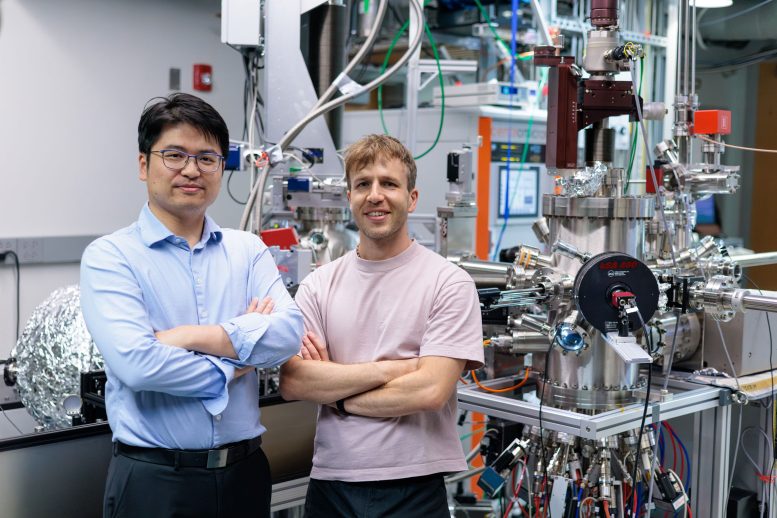
Yang’s team, including postdoctoral scholars Gabriele Berruto and Qiang Gao, investigated Fe5GeTe2 using angle-resolved photoemission spectroscopy (ARPES).
The technique shines photons onto a material and measures electrons that are knocked from its surface. From their energies and momenta, scientists can reconstruct the material’s electronic band structure, essentially a map of the states that electrons are allowed to occupy.
When Electrons Move Together
Using an ultraviolet laser focused to a spot just 10 micrometers (about 0.00039 inches) across, the researchers discovered something unexpected: part of the electronic band was remarkably flat.
The slope of an electronic band is connected to how quickly electrons can move through a material. A steeply dispersing band is associated with faster motion. Flatten that band, and the electrons effectively become much slower.
Yang compares the idea to water flowing downhill. Water accelerates down a steep slope but moves more slowly across a shallow one.
In Fe5GeTe2, however, the story goes beyond simply finding sluggish electrons. Their behavior appears to be strongly collective.
“We’re not measuring one electron,” Yang said. “We’re measuring the interaction of thousands or millions of electrons, and they are all moving together in a coherent way. That’s a quantum many-body phenomenon, and it’s actually a very weird thing.”
That collective behavior is important because strongly interacting electrons can produce properties that would never be predicted by treating each electron independently. Superconductivity, magnetism, and other exotic phases of matter can all emerge from interactions among enormous numbers of particles.
A Quantum State Theory Missed
Here, those interactions appear to be creating both the flat band and an unexpected charge order.
Fe5GeTe2 was already considered a complicated material. Its atomic structure can vary, including changes in the arrangement and occupancy of iron atoms. Earlier research has found that iron vacancies and different iron sites can strongly influence its magnetic behavior, one reason scientists have struggled to develop a simple picture of how its magnetism works.
The newly identified phase adds another layer to that puzzle.
“From a scientific perspective, it suggests that the magnetic interactions within the material are totally different from what theory predicts,” Berruto said.
Toward Quantum Memory Devices
The electrons are not merely responding to a preexisting magnetic structure. Their interactions may be helping create a more complex electronic state that current theoretical models fail to capture.
Modern memory technologies store information by placing a physical system into distinguishable states that can represent data. If Fe5GeTe2 can be reliably pushed between different magnetic or electronic phases, those states could potentially serve the same purpose. Researchers are now testing whether they can deliberately control that switching.
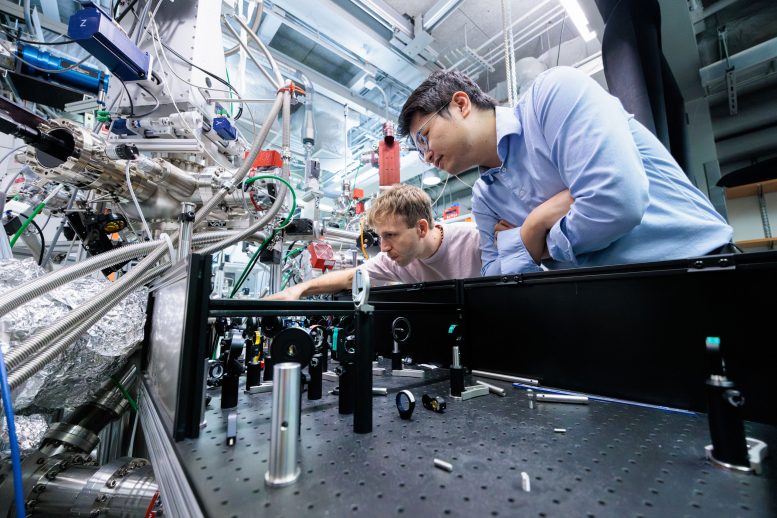
The researchers are using a microfocused laser to switch the material between the newly observed quantum many-body phase and other phases. Their experiments indicate that such switching is possible, raising the prospect of controlling information with light rather than relying entirely on conventional electrical methods.
That remains a research goal rather than a ready-made memory technology. Several major hurdles remain, including determining whether the effect can survive at substantially higher temperatures.
The Next Test: A Single Atomic Layer
“If we eventually want to use it in a memory device, it needs to work at room temperature,” said Gao, who is now a research scientist at Lawrence Berkeley National Laboratory.
Next, the team plans to exfoliate Fe5GeTe2 down to a single atomic layer and test whether the same electronic behavior survives. If it does, the finding would bring the phenomenon closer to the ultrathin limit that makes van der Waals materials so attractive for future devices.
The study was also among the final research publications of distinguished UChicago physicist Peter Littlewood, who died on June 15.
“He was a great theoretical physicist and a leader of quantum materials research at UChicago,” Yang said. “We dedicate this paper to him.”
Reference: “Interaction-driven flat band and charge order in Fe5GeTe2” by Qiang Gao, Gabriele Berruto, Khanh Duy Nguyen, Chaowei Hu, Paul Malinowski, Haoran Lin, Beomjoon Goh, Bo Gyu Jang, Xiaodong Xu, Peter Littlewood, Jiun-Haw Chu and Shuolong Yang, 7 August 2026, Science Advances.
DOI: 10.1126/sciadv.aeg5930
This work at the University of Chicago was supported by the U.S. Department of Energy, Grant No. DE-SC0022960, and partially supported by the Gordon and Betty Moore Foundation, Grant No. GBMF12763.
Never miss a breakthrough: Join the SciTechDaily newsletter.
Follow us on Google and Google News.
3 Comments
“Watching millions of electrons slow to a crawl inside a 2D magnet while keeping their quantum synchronization up to 100 Kelvin is a striking demonstration of collective field mechanics.
Normally, we think of electrons like free-flowing billiard balls zipped along by voltage. But when a material’s magnetic environment creates a flat energy band, it acts like a sudden viscous fluid or structural traffic jam. The electrons stop moving individually and lock into a unified, low-velocity wave—behaving less like chaotic solitary particles and more like a synchronized school of fish gliding through a continuous medium.
What makes this result so compelling is how the exact same principle of background-medium interaction reveals itself across different branches of science:
In Condensed Matter (This UChicago Study): Magnetic resistance forces independent charges to merge into a slow, coherent wave state (flat-band lockstep).
In Photonics & Infrared Optics (Stuttgart/Milan): Light travels along an ‘invisible waveguide’ without etched physical walls because the crystal’s internal 3D grid dictates the path of least resistance (directional anisotropy).
In Materials Chemistry (Argonne/UChicago): Flawless crystal synthesis occurs when a molten salt bath relaxes rigid, defective atomic bonds, allowing them to reorient into their lowest-energy shape (kinetic barrier relief).
Whether dealing with light rays, electron streams, or atomic lattices, structure and transport aren’t driven by brute-force collisions—they are governed by continuous, 3D background-medium interactions.”
«Наблюдаемая синхронная динамика электронов в Fe₅GeTe₂ и аналогичные эффекты в кагоме‑системах указывают на важность коллективных, часто беззарядовых, мод переноса порядка. Эффективное описание таких процессов (в духе “пустых волн”) может дополнить традиционные модели, особенно в условиях сильных корреляций и фрустрации. При этом для воспроизводимости и контроля этих состояний критически важны не только геометрия решётки и внешние условия, но и качество образцов: контроль дефектов, изотопный состав и межслоевая упорядоченность. Комплексный подход, объединяющий микроскопические модели, мезоскопические описания коллективных мод и материаловедческий контроль, представляется наиболее перспективным для дальнейшего изучения и практического использования этих эффектов.» Более подробно можно найти в Теории Спираль Бытия(R). Где процессы в кагоме структуре рассмотрены через Треугольник сил по Норман Уайлдбергер, и позволяют создать единую базу данных и моделировать нужные процессы.
293 Kelvin is equal to 19.85 degrees Celsius (virtually room temperature). Is this an error?