
German quantum physicist Christian Schneider has been awarded an ERC Consolidator Grant.
Physicist Christian Schneider has been awarded a prestigious Consolidator Grant from the European Research Council (ERC) for his groundbreaking research into two-dimensional materials and their optical properties. Schneider, a professor at the University of Oldenburg in Germany, will receive approximately two million euros in funding over the next five years to support his “Dual Twist” project.
This research focuses on a novel class of atomically thin materials and their remarkable properties, which hold significant promise for advancing optical technologies.
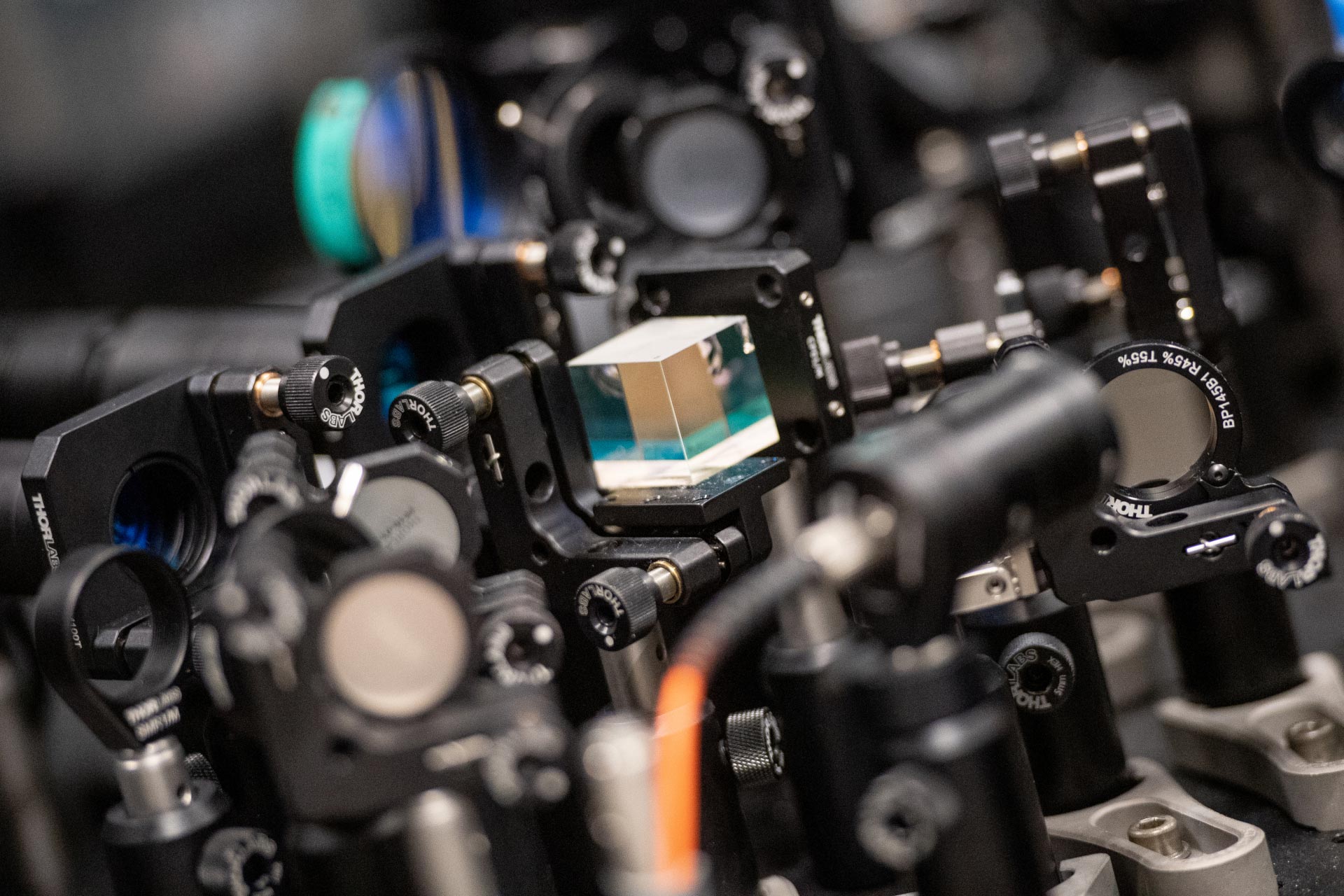
Together with his team, Schneider will develop experimental set-ups specially designed to study the unique properties of the materials under investigation using light, and pave the way for their application in novel quantum technologies. ERC Consolidator Grants aim to support excellent scientists conducting innovative research in Europe and help them to consolidate their scientific independence. Out of a total of 2313 applications, the ERC has now selected 328 projects for funding, 67 of which are based in Germany.
Commenting on the grant, Prof. Dr Ralph Bruder, President of the University of Oldenburg said: “Christian Schneider is an outstanding researcher who has already been awarded a Starting Grant by the European Research Council. The fact that he is once again receiving top-level European funding is a major recognition of his achievements, and at the same time proof that with its possibilities for investigating complex quantum phenomena, the Oldenburg Institute of Physics is excellently equipped for the future.”

The new project focuses on two-dimensional materials (2D materials). These solids are often less than a billionth of a meter (one nanometer) thick and consist of just a few atomic layers. “In these materials, fundamental physical properties such as electrical conductivity change compared to solid bodies, and at the same time interesting quantum phenomena can be observed,” explains Schneider, who heads the Quantum Materials research group at the University of Oldenburg.
In 2021, his team succeeded in inducing 2D materials to emit coherent laser light at both extremely low temperatures and at room temperature – a breakthrough that could serve as the basis for the development of highly versatile next-generation nano-lasers. In the Dual Twist project, Schneider and his team now plan to investigate double layers (bilayers) of these 2D materials, which offer far more possibilities than single-layer crystals.
By twisting two layers, materials can be transformed profoundly
In recent years scientists have discovered that the optical, mechanical and electronic properties of the bilayer structures can be fundamentally altered by twisting their crystal lattices against each other. A well-studied example of this is graphene, a special form of carbon. Graphene consists of a single layer of carbon atoms arranged in a hexagonal lattice.
When two of these honeycomb-patterned lattices are placed on top of each other and slightly rotated, or twisted, interesting patterns known as Moiré structures are formed. These patterns, in turn, have a profound impact on the behavior of the electrons in graphene: by twisting the layers, this material, which is normally conductive, can be transformed into an electrical insulator in which electrons are immobilized, or into a superconductor in which electrons flow freely without resistance. This emerging field of research is known as “twistronics”.
Schneider is particularly interested in the optical properties of the twisted bilayers. For the experiments in the new project, he and his team will prepare special semiconductor materials which they have already worked with in previous studies. These samples will then be placed between two layers of materials that reflect light particles like a mirror. “This structure is basically like a cage for light,” Schneider explains. Experts refer to it as a “microcavity”. In this setup, the team will then excite the 2D materials to create novel quantum states that can potentially be used in new applications in quantum technologies.
A quantum simulator consisting of light trapped in cavities
In a dual approach, the team also plans to analyze the properties of the materials using an innovative quantum simulation technique. “In solid-state physics, one can often only find indirect evidence of how the electrons in a material behave under certain conditions,” Schneider explains.
Furthermore, the 2D materials under investigation are too complex to be able to determine their properties using modern modeling methods, he adds. Instead, the researchers plan to construct a quantum simulator in which light particles (photons) trapped in microcavities are used to simulate the materials under investigation. “Because the physical equations that describe the behavior of atoms are similar to those that describe the behavior of light, it is possible to create analogous structures,” reports Schneider.
The appeal is that in these photonic simulated systems, the scientists can observe under the microscope which quantum states emerge and how the different particles interact with each other. In this way, they hope to identify the most interesting constellations in the real materials – and thus be able to control quantum states that were previously difficult to control and ultimately pave the way for their application in quantum technologies.
Christian Schneider has been a Professor of Quantum Materials at the University of Oldenburg’s Institute of Physics since 2020. He previously headed a research group at the University of Würzburg, where he received a Starting Grant of 1.5 million euros from the ERC in 2016 for his “unlimit2D” project.
Never miss a breakthrough: Join the SciTechDaily newsletter.
Follow us on Google and Google News.
2 Comments
Physicist Christian Schneider has been awarded a prestigious Consolidator Grant from the European Research Council (ERC) for his groundbreaking research into two-dimensional materials and their optical properties. Schneider professor will receive approximately two million euros in funding over the next five years to support his “Dual Twist” project.
“Dual Twist” project. VERY GOOD!
Dual and Twist are closely related to topological spin. Topological spins create everything, topological spins shape the world.
If anyone is interested in science, they can browse https://zhuanlan.zhihu.com/p/4659236468.
Furthermore, the 2D materials under investigation are too complex to be able to determine their properties using modern modeling methods, Schneider professor adds.
Indeed, despite being only one atom thick, graphene (or the materials using an innovative quantum simulation technique) is theoretically difficult to consider as 2D material, and the cosmos cannot be fully described by algebra, formulas, or fractions. The cosmos is the superposition, deflection, and entanglement of geometric and topological shapes. The topological evolution of geometric shapes is the foundation of high-dimensional spacetime matter. Deviating from the mathematical principles (such as topological transformation) of geometric shapes to imagine high-dimensional spacetime matter will make physics indistinguishable from theology.