
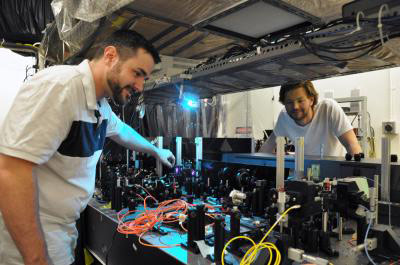
Physicists from the University of Toronto have successfully measured multiple photons in an entangled NOON state, overcoming a major challenge in the science of measurement using quantum mechanics and opening the door to the next generation of ultra-precise measurement technologies.
For the first time, physicists at the University of Toronto have overcome a major challenge in the science of measurement using quantum mechanics. Their work paves the way for great advances in using quantum states to enable the next generation of ultra-precise measurement technologies.
“We’ve been able to conduct measurements using photons – individual particles of light – at a resolution unattainable according to classical physics,” says Lee Rozema, a Ph.D. candidate in Professor Aephraim Steinberg’s quantum optics research group in U of T’s Department of Physics, and one of the lead authors along with M.Sc. candidate James Bateman of a report on the discovery published online today in Physical Review Letters. “This work opens up a path for using entangled states of light to carry out ultra-precise measurements.”
Many of the most sensitive measurement techniques in existence, from ultra-precise atomic clocks to the world’s largest telescopes, rely on detecting interference between waves – which occurs, for example, when two or more beams of light collide in the same space. Manipulating interference by producing photons in a special quantum state known as an “entangled” state – the sort of state famously dismissed by a skeptical Albert Einstein as implying “spooky action at a distance” – provided the result Rozema and his colleagues were looking for. The entangled state they used contains N photons which are all guaranteed to take the same path in an interferometer – either all N take the left-hand path or all N take the right-hand path, but no photons leave the pack.
The effects of interference are measured in devices known as “interferometers.” It is well known that the resolution of such a device can be improved by sending more photons through it – when classical light beams are used, increasing the number of photons (the intensity of the light) by a factor of 100 can improve the resolution of an interferometer by a factor of 10. However, if the photons are prepared in a quantum-entangled state, an increase by a factor of 100 should improve the resolution by that same full factor of 100.
The scientific community already knew resolution could be improved by using entangled photons. Once scientists figured out how to entangle multiple photons the theory was proved correct but only up to a point. As the number of entangled photons rose, the odds of all photons reaching the same detector and at the same time became astronomically small, rendering the technique useless in practice.
So Rozema and his colleagues developed a way to employ multiple detectors in order to measure photons in entangled states. They designed an experimental apparatus that uses a “fiber ribbon” to collect photons and send them to an array of 11 single-photon detectors.
“This allowed us to capture nearly all of the multi-photons originally sent,” says Rozema. “Sending single photons as well as two, three, and four entangled photons at a time into our device produced dramatically improved resolution.”
The U of T experiment built on a proposal by National University of Singapore physicist Mankei Tsang. In 2009, Tsang posited the idea of placing detectors at every possible position a photon could reach so that every possible event could be recorded, whether or not multiple photons hit the same detector. This would enable the calculation of the average position of all the detected photons, and could be done without having to discard any of them. The theory was quickly tested with two photons and two detectors by University of Ottawa physicist Robert Boyd.
“While two photons are better than one, we’ve shown that 11 detectors are far better than two,” says Steinberg, summarizing their advancement on Boyd’s results. “As technology progresses, using high-efficiency detector arrays and on-demand entangled-photons sources, our techniques could be used to measure increasingly higher numbers of photons with higher resolution.”
The discovery is reported in a study titled “Scalable spatial superresolution using entangled photons” published in the June 6 issue of Physical Review Letters. It is recommended as an Editor’s Suggestion, and is accompanied by a commentary in the journal Physics which describes the work as a viable approach to efficiently observing superresolved spatial interference fringes that could improve the precision of imaging and lithography systems.
In addition to Steinberg, Rozema and Bateman’s collaborators on the research included Dylan Mahler, Ryo Okamoto of Hokkaido and Osaka Universities, Amir Feizpour, and Alex Hayat, now at the Technion – Israel Institute of Technology. Support for the research was provided by the Natural Sciences and Engineering Research Council of Canada and the Canadian Institute for Advanced Research, as well as the Yamada Science Foundation.
Reference: “Scalable Spatial Superresolution Using Entangled Photons” by Lee A. Rozema, James D. Bateman, Dylan H. Mahler, Ryo Okamoto, Amir Feizpour, Alex Hayat and Aephraim M. Steinberg, 2 June 2014, Physical Review Letters.
DOI: 10.1103/PhysRevLett.112.223602
arXiv: 1312.2012
Never miss a breakthrough: Join the SciTechDaily newsletter.
Follow us on Google and Google News.