
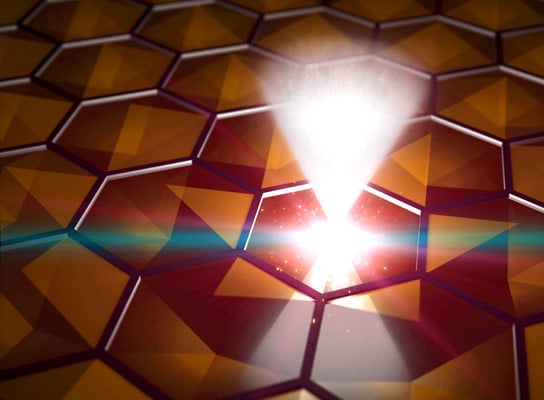
Scientists have discovered a stronger 3D material (cadmium arsenide) that has the same electronic properties as 2-D graphene.
Scientists have discovered a material that has the same extraordinary electronic properties as 2-D graphene, but in a sturdy 3-D form that should be much easier to shape into electronic devices such as very fast transistors, sensors, and transparent electrodes.
The material, cadmium arsenide, is being explored independently by three groups, one of which includes researchers at the University of Oxford, SLAC, Stanford, and Lawrence Berkeley National Laboratory who described their results in a paper published in Nature Materials.
“Now more and more people realize the potential in the science and technology of this particular material. This growing interest will promote rapid progress in the field – including the exploration of its use in functional devices and the search for similar materials,” said Yulin Chen of the University of Oxford, who led the research.
The group’s work builds on its earlier studies of a sodium bismuth compound that also mimics graphene but turns to powder when exposed to air. Both compounds had been predicted by co-authors Zhong Fang and Xi Dai, theoretical physicists from the Chinese Academy of Sciences, who suggested that cadmium arsenide, which is used in detectors and sensors, would provide the same properties in a much more stable form.
Their prediction proved correct, said Zhongkai Liu, the paper’s first author and a graduate student at SIMES, the Stanford Institute for Materials and Energy Sciences at SLAC. “The environmental stability of cadmium arsenide allows us to explore it very systematically, and makes it easier to study,” he said.
Graphene is a one-atom-thick sheet of carbon atoms peeled from a piece of graphite, which is familiar as the lead in pencils. One of its hallmarks is the weird behavior of its electrons: When confined to this thin layer of regularly spaced atoms, these lightweight particles act as if they have no mass at all. This allows them to zip through the material much faster than usual. The scientists who first isolated graphene in 2004 were awarded the Nobel Prize in Physics, and researchers have been racing to explore its properties and find practical uses for it ever since.
One such quest has been to find graphene-like materials that are three-dimensional, and thus much easier to craft into practical devices. Two other international collaborations based at Princeton University and in Dresden, Germany, have also been pursuing cadmium arsenide as a possibility. One published a paper on its results in the May 7 issue of Nature Communications, and the other has posted an unpublished paper on the preprint server arXiv.
Chen’s group made samples of cadmium arsenide at Oxford and tested them at the Diamond Light Source in the United Kingdom and at Berkeley Lab’s Advanced Light Source.
“We think this family of materials can be a good candidate for everyday use,” Chen said, “and we’re working with theorists to see if there are even better materials out there. In addition, we can use them as a platform to create and explore even more exotic states of matter; when you open a door, you find there are many other doors behind it.”
The research team included Zhi-Xun Shen, a professor at SLAC and Stanford and SLAC’s advisor for science and technology; Zahid Hussain, senior staff scientist at Berkeley Lab; and other researchers from SIMES, Berkeley Lab, Oxford University, Fudan University in Shanghai, the Chinese Academy of Sciences and Diamond Light Source. The work was partially funded by the U.S. Department of Energy Office of Science and the Defense Advanced Research Projects Agency (DARPA) Mesodynamic Architectures program.
Reference: “A stable three-dimensional topological Dirac semimetal Cd3As2” by Z. K. Liu, J. Jiang, B. Zhou, Z. J. Wang, Y. Zhang, H. M. Weng, D. Prabhakaran, S-K. Mo, H. Peng, P. Dudin, T. Kim, M. Hoesch, Z. Fang, X. Dai, Z. X. Shen, D. L. Feng, Z. Hussain and Y. L. Chen, 25 May 2014, Nature Materials.
DOI: 10.1038/nmat3990
Never miss a breakthrough: Join the SciTechDaily newsletter.
Follow us on Google and Google News.
1 Comment
Opposable, flexible graphene substitute? This seemingly small technology could easily be the catalyst for a new generational of advancement in electronic engineering.