
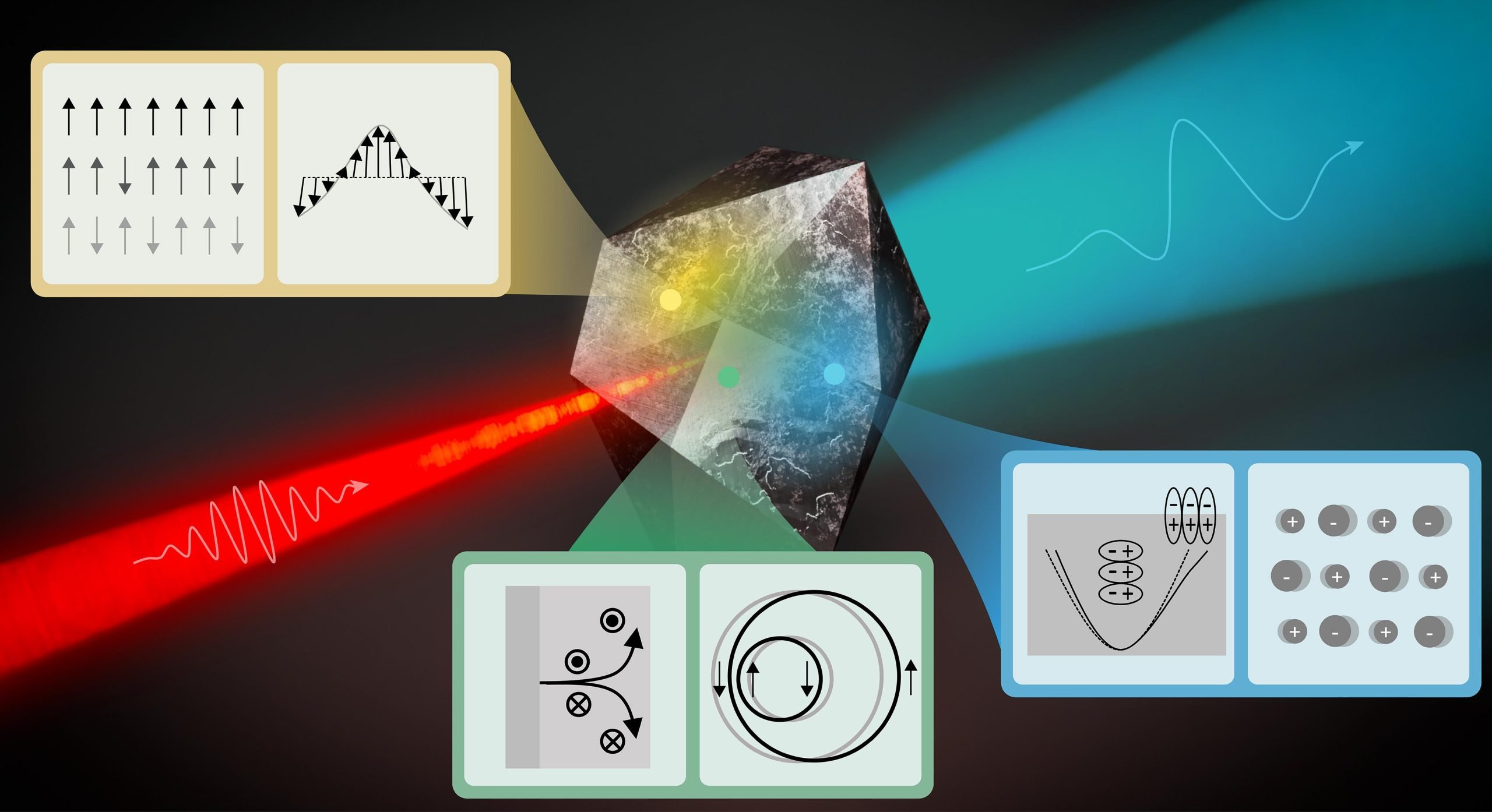
A team of scientists has published an article discussing the utilization of terahertz (THz) emission spectroscopy to reveal the properties of emerging materials, such as quantum materials and low-dimensional ones like graphene. They review studies on the interplay between intrinsic and extrinsic structuring and foresee opportunities in designing new material interaction symmetries, potentially discovering novel material properties.
In a new article published in the journal Light: Science & Applications on June 1, a team of scientists, led by Hou-Tong Chen of the Center for Integrated Nanotechnologies at Los Alamos National Laboratory, reviews a selection of recent studies that have utilized terahertz (THz) emission spectroscopy to uncover basic properties and complex dynamical behaviors of emerging materials. These include quantum materials such as superconductors and magnets, as well as low-dimensional materials such as graphene and metal nanostructures.
“Although a variety of nonlinear optical spectroscopies exists, terahertz emission allows you to probe material properties and dynamics that can remain hidden to other techniques,” said one of the paper’s co-lead authors, Jacob Pettine. “This method has therefore become quite important for interrogating novel materials.”
The central concept of THz emission spectroscopy is the rectification of high-frequency optical fields into low-frequency fields, similar to the rectification required to convert alternating (AC) currents from the wall into directional (DC) currents that can power devices or charge batteries. Underlying any rectification process is a broken symmetry—often a spatial mirror/inversion symmetry, though time-reversal symmetry breaking becomes key in magnetic systems.
“At the most basic level, the emission of terahertz radiation requires some sort of directionality in your material, in space and/or time,” co-lead author Nicholas Sirica noted. “So, if you get any terahertz light out, it immediately tells you something about the symmetry of the system.”
Co-lead author Prashant Padmanabhan added, “You can then gain detailed insights into material structure, electronic and magnetic properties, and light-matter interactions by measuring the emitted THz field in response to different incident light polarization, frequency, or amplitude.”
A complementary theme explored in the review is the interplay between intrinsic (i.e., atomic lattice) and extrinsic (artificial/nanoscale) structuring, where artificial structuring can introduce new symmetries and enhance THz current responses that might be otherwise weak or forbidden in the intrinsic/bulk material. So far, the emphasis has primarily been on exploring either (i) complex bulk properties of emerging quantum materials, or (ii) intricate behaviors that can occur in low-dimensional/nanostructured forms of relatively simple metals, semimetals, or semiconductors. One goal of this review is to highlight opportunities at the intersection of these ideas.
“In this review paper, we aim to provide an overview of the essential systems and basic mechanisms explored thus far via THz emission,” noted Chen. “We also try to highlight opportunities for designing such material and light-matter interaction symmetries in artificially structured systems, such as plasmonic metasurfaces.”
The interplay between intrinsic, extrinsic, and hybrid material structuring may stimulate the discovery of exotic properties and phenomena beyond existing material paradigms, the paper notes.
Reference: “Ultrafast terahertz emission from emerging symmetry-broken materials” by Jacob Pettine, Prashant Padmanabhan, Nicholas Sirica, Rohit P. Prasankumar, Antoinette J. Taylor and Hou-Tong Chen, 1 June 2023, Light: Science & Applications.
DOI: 10.1038/s41377-023-01163-w
Never miss a breakthrough: Join the SciTechDaily newsletter.
Follow us on Google and Google News.
2 Comments
According to the topological vortex gravitational field theory, asymmetry is a local manifestation in the interactions of symmetric, not a Symmetry-Broken.
The physical phenomena observed in scientific research are often not complete. Symmetry-Broken is pseudoscience misled by the local manifestation in interactions of symmetric.
https://zhuanlan.zhihu.com/p/574723221.