
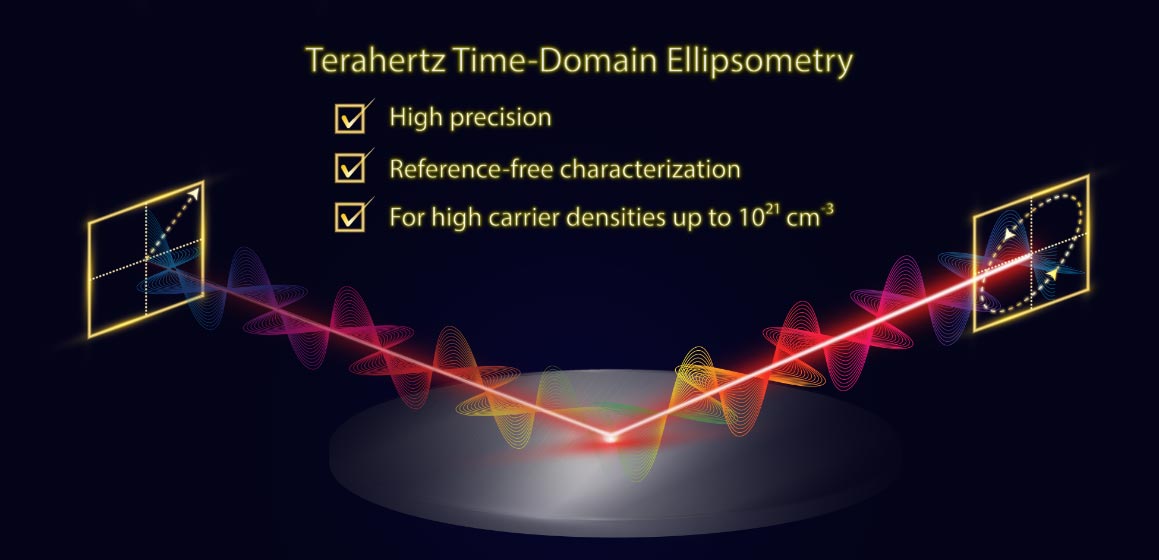
Tera Evaluator® uses THz ellipsometry to nondestructively measure ultra-high carrier densities in semiconductors like GaN, advancing high-frequency electronics and 6G development.
In semiconductor device applications, there is an increasing demand for semiconductors with very high carrier concentrations. The semiconductor material parameters, namely carrier density and mobility, are what primarily determine device performance. Hence, it is important to accurately characterize the carrier density and mobility of a semiconductor for the development of its device applications.
The use of THz waves, or electromagnetic radiation with wavelengths of around 300 µm and frequency of about 1 THz, in the nondestructive testing of semiconductors has been continuously expanding. Free carriers in a material absorb THz radiation, which makes it possible to estimate the electrical properties of semiconductors using THz waves.
Researchers at Osaka University, in collaboration with Nippo Precision Co., Ltd., developed a THz time-domain ellipsometry system (Tera Evaluator®) that extends the range of carrier concentrations measurable by THz waves up to ~1020 cm-3 and potentially higher by improving the precision of said optical technique. In THz time-domain ellipsometry, linearly polarized THz pulses are incident on a sample and the electric field strength of the reflected THz waves as a function of time is measured. Specifically, the reflected waves polarized in the direction parallel (p) and perpendicular (s) to the plane of incidence are of interest.
How THz Time-Domain Ellipsometry Works
The ratio of the p– and s– polarization components yields information on the electric permittivity of the sample, allowing for the evaluation of the carrier density and mobility. As such, unlike THz time-domain spectroscopy, THz time-domain ellipsometry does not require reference measurements through an aperture or standard mirror.
Tera Evaluator® employs a polarizer-sample-rotating analyzer optical configuration, wherein the analyzer angular orientation is varied from 0° to 360° in 15° increments. This multi-angle technique is used to eliminate the systematic errors from the amplitude and phase of the detected THz electric field in the analysis, which is newly employed in THz time-domain ellipsometry. This novel correction method improves the precision of THz time-domain ellipsometry by over ten times. Consequently, the maximum carrier concentration that can be evaluated is over 2 orders of magnitude higher than usually reported using other THz time-domain techniques.
As a demonstration, the researchers evaluated the gallium nitride (GaN) wide-gap semiconductor, which is one of the most technologically important semiconductors present in various power electronics as well as 5G devices. GaN is also the leading candidate material for future 6G devices operating beyond 100 GHz. In a Scientific Reports publication, they show that the high-precision THz time-domain ellipsometry system is effective in the evaluation of carrier densities up to 1020–1021 cm-3 with superior accuracy and precision, which has been a challenge using THz waves, particularly at very high conductivities. The investigated GaN crystals were fabricated using a crystal growth method also developed at Osaka University called the point-seed technique via the Na-flux method, which produces high-quality GaN crystals.
The high-precision THz time-domain ellipsometry system is anticipated to be widely useful in the accurate, noninvasive characterization of various semiconductors with very high carrier concentrations.
Reference: “Terahertz time-domain ellipsometry with high precision for the evaluation of GaN crystals with carrier densities up to 1020 cm-3” by Verdad C. Agulto, Toshiyuki Iwamoto, Hideaki Kitahara, Kazuhiro Toya, Valynn Katrine Mag-usara, Masayuki Imanishi, Yusuke Mori, Masashi Yoshimura and Makoto Nakajima, 15 September 2021, Scientific Reports.
DOI: 10.1038/s41598-021-97253-z
Funding: METI Monozukuri R&D Support Grant Program for SMEs
Never miss a breakthrough: Join the SciTechDaily newsletter.
Follow us on Google and Google News.