
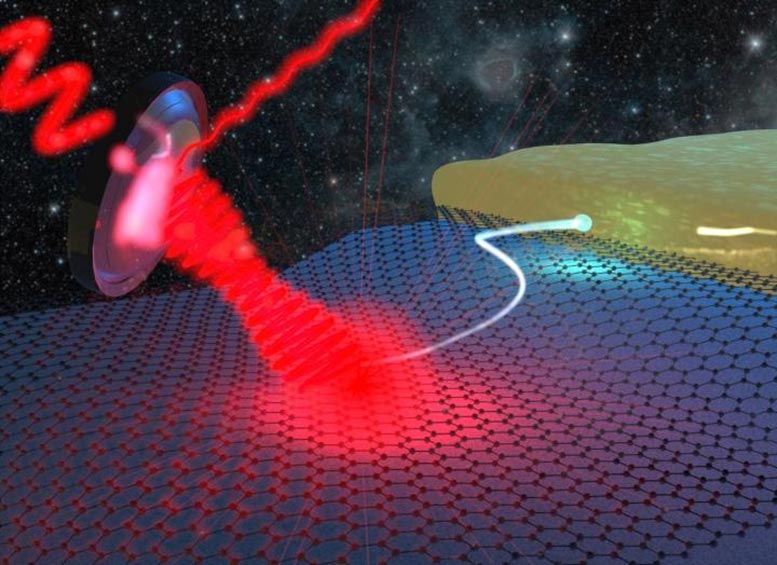
Researchers from Chalmers University of Technology have demonstrated a detector made from graphene that could revolutionize the sensors used in next-generation space telescopes. The findings were recently published in the scientific journal Nature Astronomy.
Beyond superconductors, there are few materials that can fulfill the requirements needed for making ultra-sensitive and fast terahertz (THz) detectors for astronomy. Chalmers researchers have shown that engineered graphene adds a new material paradigm for THz heterodyne detection.
“Graphene might be the only known material that remains an excellent conductor of electricity/heat even when having, effectively, no electrons. We have reached a near zero-electron scenario in graphene, also called the Dirac point, by assembling electron-accepting molecules on its surface. Our results show that graphene is an exceptionally good material for THz heterodyne detection when doped to the Dirac point”, says Samuel Lara-Avila, assistant professor at the Quantum Device Physics Laboratory and lead author of the paper.

In detail, the experimental demonstration involves heterodyne detection, in which two signals are combined, or mixed, using graphene. One signal is a high-intensity wave at a known THz frequency, generated by a local source (i.e. a local oscillator). The second is a faint THz signal that mimics the waves coming from space. Graphene mixes these signals and then produces an output wave at a much lower gigahertz (GHz) frequency, called the intermediate frequency, that can be analyzed with standard low-noise gigahertz electronics. The higher the intermediate frequency can be, the higher bandwidth the detector is said to have, required to accurately identify motions inside the celestial objects.
Sergey Cherednichenko, professor at the Terahertz and Millimeter Wave Laboratory and co-author of the paper, says:
“According to our theoretical model, this graphene THz detector has a potential to reach quantum-limited operation for the important 1-5 THz spectral range. Moreover, the bandwidth can exceed 20 GHz, larger than 5 GHz that the state-of-the-art technology has to offer.”
This is an experimental demonstration of THz wave detection with charge-neutral epitaxial graphene.
Another crucial aspect of the graphene THz detector is the extremely low power needed for the local oscillator to achieve a trustable detection of faint THz signals, a few orders of magnitude lower than superconductors require. This could enable quantum-limited THz coherent detector arrays, hence opening the door to 3D imaging of the universe.
Elvire De Beck, an astronomer at the Department of Space, Earth, and Environment, who did not take part in the research, explains the possible implications for practical astronomy:
“This graphene-based technology has enormous potential for future space missions that aim at e.g. unveiling how water, carbon, oxygen, and life itself came to earth. A lightweight, power-effective 3D imager that is quantum-limited at terahertz frequencies is crucial for such ambitious tasks. But, at the moment, THz 3D imagers are simply not available”.
Sergey Kubatkin, professor at the Quantum Device Physics Laboratory and co-author of the paper, explains:
“The core of the THz detector is the system of graphene and molecular assemblies. This is in itself a novel composite 2D material that deserves deeper investigation from a fundamental point of view, as it displays a whole new regime of charge/heat transport governed by quantum-mechanical effects.”
Facts:
Astronomers resort to coherent detectors, based on heterodyne technology, to study fingerprints of water, carbon, oxygen, and many other species originating from the most remote locations in the universe. Coherent THz detectors should ideally have: high sensitivity, to detect faint cosmic signals; large bandwidth, to accurately identify motions inside the celestial objects; and low local oscillator power requirements, to enable efficient operation of many pixels.
Astronomical heterodyne observations for THz frequencies (0.1-10THz) have been dominated by superconducting devices. Despite all design and optimization efforts, some of the intrinsic material properties of superconductors have made it challenging to simultaneously fulfill all the stringent requirements (sensitivity, bandwidth, low local oscillator power) needed to build THz heterodyne detector arrays capable of imaging large portions of the THz universe.
Researchers Involved:
Besides Samuel Lara-Avila, Sergey Cherednichenko, and Sergey Kubatkin, several Chalmers researchers have been involved in the research and are co-authors of the paper: Andrey Danilov, senior researcher, Hans He, PhD student, Kyung Ho Kim, postdoc, Floriana Lombardi, professor, and Thilo Bauch, associate professor. Collaborating co-authors are Dmitry Golubev, research fellow at Aalto University, Finland, and Rositsa Yakimova, professor emerita at Linköping University.
The research was supported by the Swedish Foundation for Strategic Research (SSF), Knut and Alice Wallenberg Foundation, Chalmers Excellence Initiative Nano, the Swedish Research Council (VR), the Korea-Sweden Research Cooperation of the NRF, and the European Union’s Horizon 2020 research and innovation program.
Reference: “Towards quantum-limited coherent detection of terahertz waves in charge-neutral graphene” by S. Lara-Avila, A. Danilov, D. Golubev, H. He, K. H. Kim, R. Yakimova, F. Lombardi, T. Bauch, S. Cherednichenko and S. Kubatkin, 5 August 2019, Nature Astronomy.
DOI: 10.1038/s41550-019-0843-7
Never miss a breakthrough: Join the SciTechDaily newsletter.
Follow us on Google and Google News.