
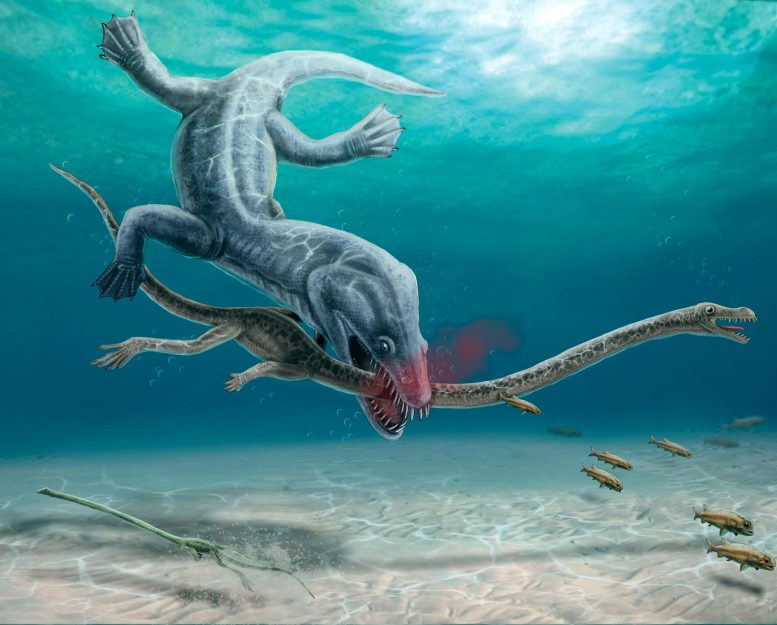
Fossil evidence reveals that the long necks of the ancient marine reptiles, Tanystropheus, made them vulnerable to predators. The study found bite marks on the necks of the fossils, providing the first direct proof of this long-suspected evolutionary disadvantage despite their survival success over a span of 175 million years.
In the age of dinosaurs, many marine reptiles had extremely long necks compared to reptiles today. While it was clearly a successful evolutionary strategy, paleontologists have long suspected that their long-necked bodies made them vulnerable to predators. Now, after almost 200 years of continued research, direct fossil evidence confirms this scenario for the first time in the most graphic way imaginable.
Researchers reporting in the journal Current Biology on June 19 studied the unusual necks of two Triassic species of Tanystropheus, a type of reptile distantly related to crocodiles, birds, and dinosaurs. The species had unique necks composed of 13 extremely elongated vertebrae and strut-like ribs. Consequently, these marine reptiles likely possessed stiffened necks and waited to ambush their prey. But Tanystropheus’s predators apparently also took advantage of the long neck for their own gain.
Careful examination of their fossilized bones now shows that the necks of two existing specimens representing different species with severed necks have clear bite marks on them, in one case right where the neck was broken. The findings offer gruesome and exceedingly rare evidence for predator-prey interactions in the fossil record going back over 240 million years ago, the researchers say.
A 200-Year-Old Hypothesis Confirmed
“Paleontologists speculated that these long necks formed an obvious weak spot for predation, as was already vividly depicted almost 200 years ago in a famous painting by Henry de la Beche from 1830,” said Stephan Spiekman of the Staatliches Museum für Naturkunde Stuttgart, Germany. “Nevertheless, there was no evidence of decapitation—or any other sort of attack targeting the neck—known from the abundant fossil record of long-necked marine reptiles until our present study on these two specimens of Tanystropheus.”
Spiekman had studied these reptiles as the main subject of his doctoral work at the Paleontological Museum of the University of Zurich, Switzerland, where the specimens are housed. He recognized that two species of Tanystropheus lived in the same environment, one small species, about a meter and a half in length, likely feeding on soft-shelled animals like shrimp, and a much larger species of up to six meters long that fed on fish and squid. He also found clear evidence in the shape of the skull that Tanystropheus likely spent most of its time in the water.
It had been well known that two specimens of these species had well-preserved heads and necks that abruptly ended. It had been speculated that these necks were bitten off, but no one had studied this in detail. In the new study, Spiekman teamed up with Eudald Mujal, also of the Stuttgart Museum, and a research associate at the Institut Català de Paleontologia Miquel Crusafont, Spain, who is an expert on fossil preservation and predatory interactions in the fossil record based on bite traces on bones. After an afternoon spent examining the two specimens in Zurich, they concluded that the necks had clearly been bitten off.
“Something that caught our attention is that the skull and portion of the neck preserved are undisturbed, only showing some disarticulation due to the typical decay of a carcass in a quiet environment,” Mujal said. “Only the neck and head are preserved; there is no evidence whatsoever of the rest of the animals. The necks end abruptly, indicating they were completely severed by another animal during a particularly violent event, as the presence of tooth traces evinces.”
“The fact that the head and neck are so undisturbed suggests that when they reached the place of their final burial, the bones were still covered by soft tissues like muscle and skin,” Mujal continued. “They were clearly not fed on by the predator. Although this is speculative, it would make sense that the predators were less interested in the skinny neck and small head, and instead focused on the much meatier parts of the body. Taken together, these factors make it most likely that both individuals were decapitated during the hunt and not scavenged, although scavenging can never be fully excluded in fossils that are this old.”
A Recurring Evolutionary Trade-Off
“Interestingly, the same scenario—although certainly executed by different predators—played out for both specimens, which remember, represent individuals of two different Tanystropheus species, which are very different in size and possibly lifestyle,” Spiekman says.
The findings confirm earlier interpretations that the ancient reptiles’ necks represent a completely unique evolutionary structure that was much narrower and stiffer than those of long-necked plesiosaurs, according to the researchers. They also show that evolving a long neck as a sea reptile came with potential downsides. Nevertheless, they note, elongated necks were clearly a highly successful evolutionary strategy, found in many different marine reptiles over a time span of 175 million years.
“In a very broad sense, our research once again shows that evolution is a game of trade-offs,” Spiekman says. “The advantage of having a long neck clearly outweighed the risk of being targeted by a predator for a very long time. Even Tanystropheus itself was quite successful in evolutionary terms, living for at least 10 million years and occurring in what is now Europe, the Middle East, China, North America, and possibly South America.”
Reference: “Decapitation in the long-necked reptile Tanystropheus (Archosauromorpha, Tanystropheidae)” by Stephan N.F. Spiekman and Eudald Mujal, 19 June 2023, Current Biology.
DOI: 10.1016/j.cub.2023.04.027
This work was supported by the Fundación Española para la Ciencia y la Tecnología – Ministerio de Ciencia e Innovación, Deutsche Forschungsgemeinschaft, Generalitat de Catalunya.
Never miss a breakthrough: Join the SciTechDaily newsletter.
Follow us on Google and Google News.