
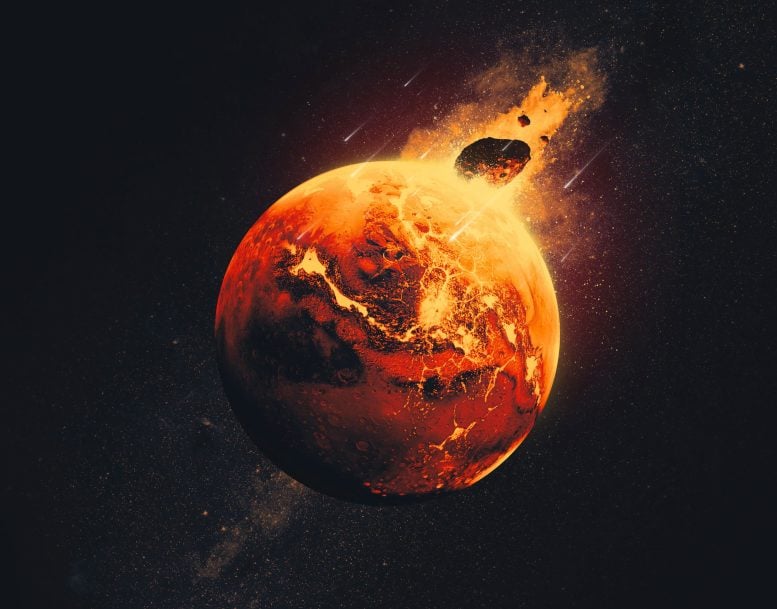
A meteorite found in Algeria has opened a rare window into nearly 2 billion years of Mars’ history that had largely been missing from the geological record.
Researchers at Boston College have determined that Northwest Africa (NWA) 13441, a rock blasted from Mars before eventually reaching Earth, crystallized about 1.273 billion years ago. Its age places it squarely within a huge gap in the known record of shergottites, the most common type of Martian igneous meteorite. Even more unexpectedly, its chemistry points to a deep Martian source unlike any previously identified in this group.
“The characteristics of this meteorite were entirely surprising,” said Ethan Baxter, a Boston College professor of Earth and Environmental Sciences and founder of the university’s Center for Isotope Geochemistry. “No other Martian meteorite like this has an age of 1.27 billion years.”
A Rare Meteorite Opens a Window Into Mars
The findings, reported in Geochimica et Cosmochimica Acta, could help scientists reconstruct a poorly understood era of Martian volcanism while providing evidence that part of the planet’s interior retained a chemical fingerprint dating back almost to the birth of the solar system.
Scientists cannot simply visit a Martian outcrop and bring home whatever rocks they want. Until samples collected by spacecraft are returned to Earth, naturally delivered meteorites provide some of the only Martian material that researchers can examine directly in terrestrial laboratories.
These rocks begin their journey when a powerful impact on Mars launches fragments into space. Some eventually cross Earth’s path and survive their plunge through the atmosphere.
Only about 400 Martian meteorites have been identified, according to the Boston College researchers. Shergottites make up the dominant group and are volcanic or intrusive igneous rocks that can preserve clues about magma generated inside Mars. NASA has likewise described shergottites as the most abundant class of known Martian meteorites.
The Missing Years in Mars’ Meteorite Record
But their ages have presented scientists with a puzzle.
Nearly all previously dated shergottites are younger than about 600 million years. The next oldest characterized examples date to roughly 2.4 billion years ago. That leaves an approximately 1.8 billion year interval with virtually no shergottite record.
Other rare Martian meteorites called chassignites and nakhlites date to around 1.3 to 1.4 billion years ago, but their chemistry is quite different. NWA 13441 provides something scientists did not have before: a shergottite from the middle of the missing interval.

“Martian meteorites of this type are either younger than 600 million years old, or approximately 2.4 billion years old,” said lead author Dylan M. Seal, a Boston College doctoral candidate. “We dated this sample to be 1.273 billion years old, which fills a roughly 2 billion year gap for which we had no shergottite samples to provide information about magmatic and volcanic activity on Mars.”
An Unexpected Isotopic Signature
Age alone would have made NWA 13441 unusual. Its isotopes made it stranger.
The team studied neodymium, a rare element that naturally occurs in seven isotopic forms. Isotopes of the same element contain different numbers of neutrons, and their relative abundances can function as chemical tracers. In planetary rocks, those patterns can reveal information about the material from which magma originated and how that source changed through time.
NWA 13441’s initial neodymium isotope composition is essentially chondritic, meaning it resembles the primordial material represented by chondrite meteorites.
Chondrites are among the most primitive meteorites known. Their material dates back to the formation of the solar system about 4.56 billion years ago and escaped the extensive melting and geological processing that transformed material inside planets.
A Pristine Reservoir Deep Inside Mars
No other known shergottite had revealed this same initial neodymium signature, according to the researchers. Their isotope measurements therefore suggest that the magma that produced NWA 13441 tapped a previously unsampled reservoir inside Mars.
The team’s conference description of the work identifies it as the first direct evidence for a broadly chondritic Martian mantle source from this period. The meteorite may be carrying a chemical memory from extraordinarily early in Mars’ existence.
Mars Preserves a Geological Record That Earth Has Erased
The finding highlights one of the fundamental differences between Mars and Earth.
Earth’s interior and crust are constantly being reworked. Plate tectonics moves, destroys, melts, and recycles enormous sections of the planet over geological time, making pristine remnants of its earliest history difficult to preserve.
Mars followed a different path. It formed rapidly near the beginning of solar system history and lacks Earth’s system of moving tectonic plates. Research on Martian geology indicates that the planet instead evolved largely under a stagnant outer shell, allowing ancient chemical reservoirs and geological structures to survive far longer than they typically would on Earth.
That makes Martian meteorites more than fragments of another world’s crust. Some can potentially act as geological time capsules, preserving evidence of planetary processes that began billions of years ago.
A Martian Geological Time Capsule
The new meteorite appears to be an especially valuable example.
Researchers have found evidence that the crystallization of NWA 13441 began near Mars’ crust and mantle boundary. The rock is an olivine-rich basalt and also bears signs of intense shock, consistent with the violent impact processes that eventually eject Martian rocks into space.
NWA 13441 itself was discovered in Algeria in 2019. Baxter’s group received a small cleaned and crushed sample from a colleague at Appalachian State University, along with a thin section mounted on a glass slide. At the time, the meteorite had not been fully characterized.
Unlocking the Meteorite’s Martian Origins
Working with scientists at the Scripps Institution of Oceanography and The Open University in Britain, the team first needed to establish that the rock really came from Mars. They then investigated its age and chemical composition using high-precision isotope techniques.
The results provided two discoveries in the same small piece of rock: a shergottite from a previously missing period of Martian history and evidence for an ancient source inside the planet that had escaped billions of years of major chemical modification.
The researchers are not finished with NWA 13441. Baxter’s laboratory is studying additional isotope systems to determine where this unusual meteorite fits into the larger story of Mars and whether its hidden reservoir can reveal more about the planet’s earliest evolution.
“Our goal is to analyze additional isotope systems that will help us better understand how this unique sample relates to other Martian meteorites on early Mars,” Baxter said.
Reference: “Implications for martian mantle reservoirs from petrogenesis of the 1.27 Ga olivine-phyric shergottite Northwest Africa 13441” by Dylan M. Seal, Melody Z. Chen, Robert W. Nicklas, Ethan F. Baxter, James M.D. Day, Ben G. Rider-Stokes, Anthony B. Love and James Malley, 27 June 2026, Geochimica et Cosmochimica Acta.
DOI: 10.1016/j.gca.2026.06.035
Never miss a breakthrough: Join the SciTechDaily newsletter.
Follow us on Google and Google News.