
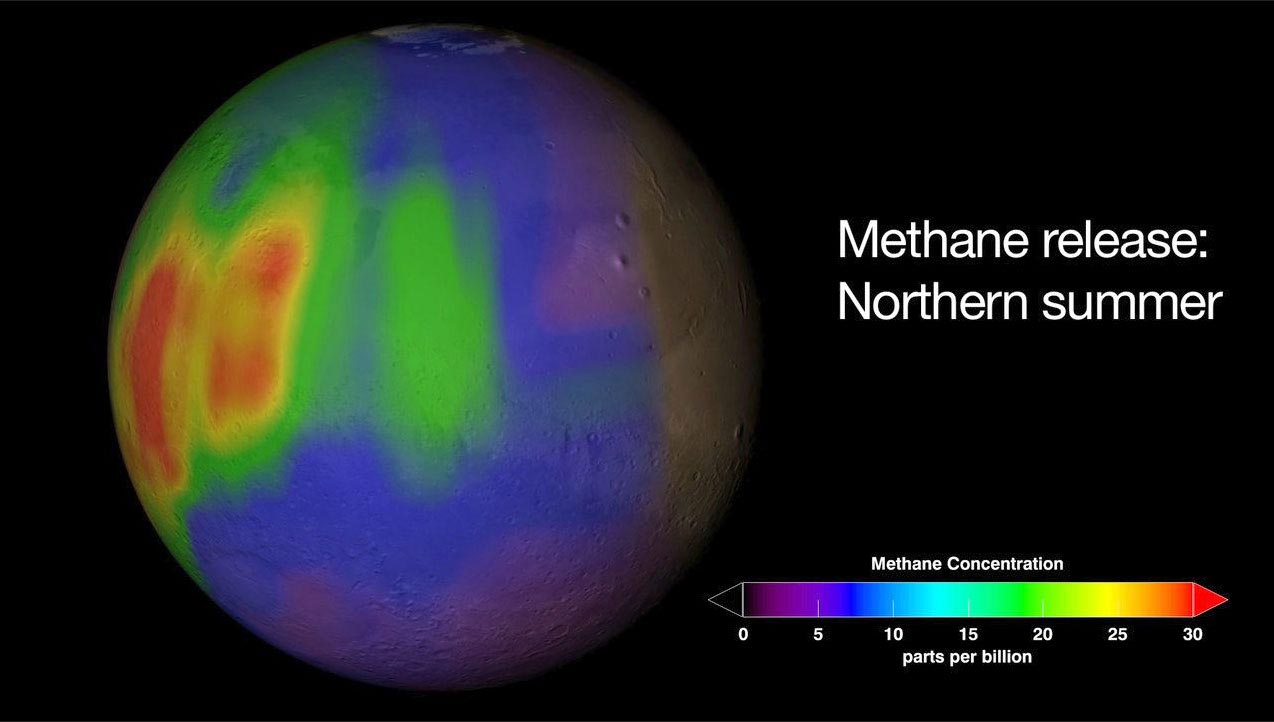
Scientists at the Max Planck Institute believe that they now know where the methane on Mars is originating from. In their published work, the scientists conclude that high-energy UV radiation triggers the release of methane from meteorites, which carry along carbonaceous compounds and continuously impact on the Martian surface.
It was a sensation when scientists discovered methane in Mars’ atmosphere nine years ago. Many saw the presence of the gas as a clear indication of life on the inhospitable planet, as on Earth methane is produced predominantly by biological processes. Others assumed geological processes, such as volcanoes, to be the cause. What has been missing until now is proof of where the methane actually comes from, however. Researchers at the Max Planck Institute for Chemistry in Mainz and the universities in Utrecht and Edinburgh have now been able to show that methane escapes from a meteorite if it is irradiated with ultraviolet light under Martian conditions. Since meteorites and interplanetary dust from space, which carry along carbonaceous compounds, continuously impact on the Martian surface, the researchers conclude that high-energy UV radiation triggers the release of methane from the meteorites.
After scientists identified larger quantities of methane in the Martian atmosphere in 2003, there has been much speculation about its source. The best-known hypothesis states that microorganisms produce the methane, and is, therefore, an indication of life on the red planet. Another hypothesis assumes the origin to be geological methane sources in Mars’ interior. To date, none of the theories has been able to conclusively explain the large quantity of 200 to 300 tonnes of methane annually that are produced on Mars, according to projections.
Without an expedition to Mars and with nothing more than a meteorite to help them, researchers at the Max Planck Institute for Chemistry in Mainz and the universities in Utrecht and Edinburgh have now found a major source. “Methane is produced from innumerable, small micro-meteorites and interplanetary dust particles that land on the Martian surface from space,” explains Frank Keppler, lead author of the study now published in the research journal Nature. “The energy is provided by the extremely intense ultraviolet radiation,” adds the atmospheric chemist.
UV light decomposes carbon compounds in meteoritic matter
Unlike Earth, Mars has no protective ozone layer which could absorb most of the UV radiation from space. Moreover, the Martian atmosphere is very thin, so a significantly smaller portion of the meteoritic material burns up in the atmosphere compared to Earth.
Together with colleagues from Great Britain and the Netherlands, the researchers from Mainz irradiated samples of the Murchison meteorite with ultraviolet light. “The meteorite contains several percent carbon and has a similar chemical composition to most of the meteoritic matter that lands on Mars,” says the cosmochemist Ulrich Ott. The 4.6 billion-year-old meteorite fell to Earth in 1969 in the Australian town of Murchison. The researchers selected conditions identical to those on Mars for the UV irradiation, which caused considerable quantities of methane to escape from the meteorite almost immediately. Their conclusion: carbonaceous compounds in the meteoritic matter are decomposed by the high-energy UV radiation, and methane molecules are formed in the process.
The methane production from meteorites depends on temperature
Since the temperature on the red planet varies from minus 143 degrees Celsius (-225 degrees Fahrenheit) at the poles to plus 17 degrees Celsius (63 degrees Fahrenheit) at Mars’ equator, the scientists also investigated the meteoritic samples at appropriate temperatures. The warmer it became, the more methane was released by the meteoritic fragments. This temperature dependence also agrees with the different methane concentrations at different locations in the Martian atmosphere. In infrared spectra, the largest concentration of methane was found in the equatorial region, the warmest place on Mars, relatively speaking.
The results obtained by Frank Keppler’s team should bring “down to earth” all those who firmly believe in the biological origin of the methane. The researchers cannot fully exclude the hypothesis of Martian microbes, however, because, although the process found here is inevitable, it is quite possible that further processes contribute to methane production. The researchers hope that Curiosity, the Mars Rover that NASA expects to land on our neighboring planet at the beginning of August, will provide more details on the formation of methane, and maybe even final clarification as to whether there is life on Mars.
Reference: “Ultraviolet-radiation-induced methane emissions from meteorites and the Martian atmosphere” by Frank Keppler, Ivan Vigano, Andy McLeod, Ulrich Ott, Marion Früchtl and Thomas Röckmann, 30 May 2012, Nature.
DOI: 10.1038/nature11203
Never miss a breakthrough: Join the SciTechDaily newsletter.
Follow us on Google and Google News.