
Close Menu
    Facebook X (Twitter) Instagram
    SciTechDaily
    • Biology
    • Chemistry
    • Earth
    • Health
    • Physics
    • Science
    • Space
    • Technology
    Facebook X (Twitter) Pinterest YouTube RSS
    SciTechDaily
    Home»Space»Acidic Fluids: Finding Evidence of Life on Mars Just Got Harder
    Space

    Acidic Fluids: Finding Evidence of Life on Mars Just Got Harder

    By Cornell UniversityNovember 3, 20201 Comment3 Mins Read
    Facebook Twitter Pinterest Telegram LinkedIn WhatsApp Email Reddit
    Share
    Facebook Twitter LinkedIn Pinterest Telegram Email Reddit
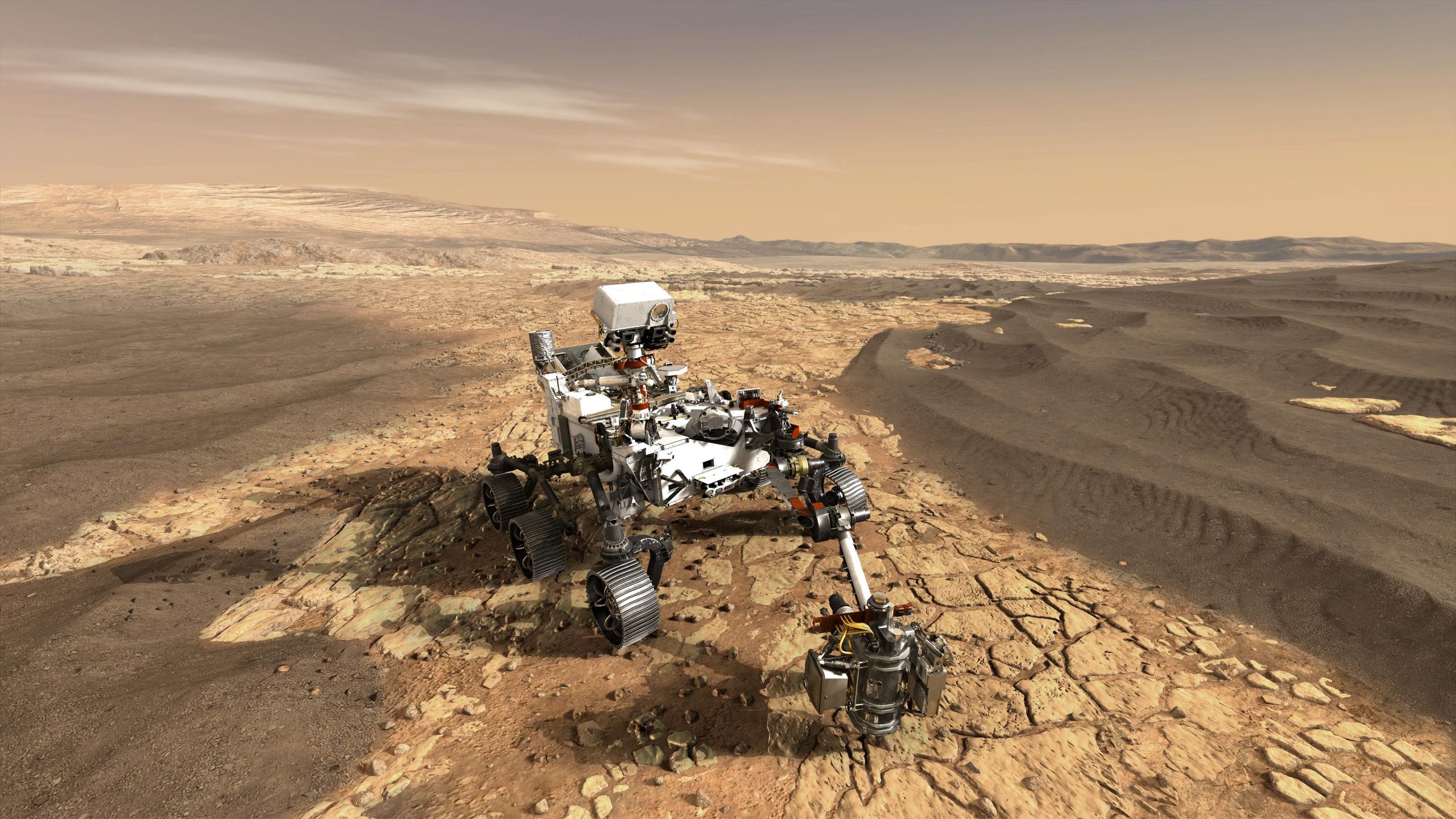
    NASA Perseverance Rover Artistic Rendering
    NASA’s Perseverance rover, shown in this artistic rendering, will land at Mars’ Jezero Crater in February 2021 and will start gathering soil samples soon after that. Scientists are now concerned about acidic fluids, once on Mars, may have ruined the evidence of life contained in the clays. Credit: NASA/JPL-Caltech

    In a little more than a decade, samples of rover-scooped Martian soil will rocket to Earth.

    While scientists are eager to study the red planet’s soils for signs of life, researchers must ponder a considerable new challenge: Acidic fluids – which once flowed on the Martian surface – may have destroyed biological evidence hidden within Mars’ iron-rich clays, according to researchers at Cornell and at Spain’s Centro de Astrobiología.

    The researchers conducted simulations involving clay and amino acids to draw conclusions regarding the likely degradation of biological material on Mars. Their paper, “Constraining the Preservation of Organic Compounds in Mars Analog Nontronites After Exposure to Acid and Alkaline Fluids,” published in Nature Scientific Reports.

    Alberto G. Fairén, a visiting scientist in the Department of Astronomy in the College of Arts and Sciences, is a corresponding author.

    NASA’s Perseverance rover, launched July 30, will land at Mars’ Jezero Crater next February; the European Space Agency’s Rosalind Franklin rover will launch in late 2022. The Perseverance mission will collect Martian soil samples and send them to Earth by the 2030s. The Rosalind Franklin rover will drill into the Martian surface, collect soil samples, and analyze them in situ.

    In the search for life on Mars, the red planet’s clay surface soils are a preferred collection target since the clay protects the molecular organic material inside. However, the past presence of acid on the surface may have compromised the clay’s ability to protect evidence of previous life.

    “We know that acidic fluids have flowed on the surface of Mars in the past, altering the clays and its capacity to protect organics,” Fairén said.

    He said the internal structure of clay is organized into layers, where the evidence of biological life – such as lipids, nucleic acids, peptides and other biopolymers – can become trapped and well preserved.

    In the laboratory, the researchers simulated Martian surface conditions by aiming to preserve an amino acid called glycine in clay, which had been previously exposed to acidic fluids. “We used glycine because it could rapidly degrade under the planet’s environmental conditions,” he said. “It’s perfect informer to tell us what was going on inside our experiments.”

    After a long exposure to Mars-like ultraviolet radiation, the experiments showed photodegradation of the glycine molecules embedded in the clay. Exposure to acidic fluids erases the interlayer space, turning it into a gel-like silica.

    “When clays are exposed to acidic fluids, the layers collapse and the organic matter can’t be preserved. They are destroyed,” Fairén said. “Our results in this paper explain why searching for organic compounds on Mars is so sorely difficult.”

    Reference: “Constraining the preservation of organic compounds in Mars analog nontronites after exposure to acid and alkaline fluids” by Carolina Gil-Lozano, Alberto G. Fairén, Victoria Muñoz-Iglesias, Maite Fernández-Sampedro, Olga Prieto-Ballesteros, Luis Gago-Duport, Elisabeth Losa-Adams, Daniel Carrizo, Janice L. Bishop, Teresa Fornaro and Eva Mateo-Martí, 15 September 2020, Scientific Reports.
    DOI: 10.1038/s41598-020-71657-9

    The paper’s lead author was Carolina Gil‐Lozano of Centro de Astrobiología, Madrid, and the Universidad de Vigo, Spain. The European Research Council funded this research.

    Never miss a breakthrough: Join the SciTechDaily newsletter.
    Follow us on Google and Google News.

    Astrobiology Astronomy Astrophysics Cornell University Mars Popular
    Share. Facebook Twitter Pinterest LinkedIn Email Reddit

    Related Articles

    Webb Space Telescope Shocks Astronomers With Surprising Exoplanet Atmospheric Composition

    Alien Life in These Star-Systems Could Have Spotted Earth After Human Civilization Blossomed

    Astronomers Could Spot Clues to Alien Life Orbiting Long-Dead Stars

    Scientists Discover Evidence of Methane in Martian Meteorites

    Astronomers Discover Complex Organic Molecules in Infant Star System

    Martian Meteorite Reveals the Possibility of Life on Mars

    Early Chemistry of a Star’s Protoplanetary Disc Shapes Life-Friendly Atmospheres

    Searching for Life on Earth-Like Planets May Be a Mistake, Need to Consider Superhabitable Planets

    Astronomers Obtain Precise Measurements of the Two Kepler-16 Stars

    1 Comment

    1. Logan on November 5, 2020 9:33 am

      Good

      Reply
    Leave A Reply Cancel Reply

    • Facebook
    • Twitter
    • Pinterest
    • YouTube

    Don't Miss a Discovery

    Subscribe for the Latest in Science & Tech!

    Trending News

    The Universe Is Expanding Too Fast and Scientists Can’t Explain Why

    “Like Liquid Metal”: Scientists Create Strange Shape-Shifting Material

    Early Warning Signals of Esophageal Cancer May Be Hiding in Plain Sight

    Common Blood Pressure Drug Shows Surprising Power Against Deadly Antibiotic-Resistant Superbug

    Scientists Uncover Dangerous Connection Between Serotonin and Heart Valve Disease

    Scientists Discover a “Protector” Protein That Could Help Reverse Hair Loss

    Bone-Strengthening Discovery Could Reverse Osteoporosis

    Scientists Uncover Hidden Trigger Behind Stem Cell Aging

    Follow SciTechDaily
    • Facebook
    • Twitter
    • YouTube
    • Pinterest
    • Newsletter
    • RSS
    SciTech News
    • Biology News
    • Chemistry News
    • Earth News
    • Health News
    • Physics News
    • Science News
    • Space News
    • Technology News
    Recent Posts
    • Scientists Overcome Major Quantum Bottleneck, Potentially Transforming Teleportation and Computing
    • Quantum Physics’ Strangest Problem May Hold the Key to Time Itself
    • Scientists Create “Liquid Gears” That Spin Without Touching
    • The Simple Habit That Could Help Prevent Cancer
    • Forgotten Medicinal Plant Shows Promise in Fighting Dangerous Superbugs
    Copyright © 1998 - 2026 SciTechDaily. All Rights Reserved.
    • Science News
    • About
    • Contact
    • Editorial Board
    • Privacy Policy
    • Terms of Use

    Type above and press Enter to search. Press Esc to cancel.