
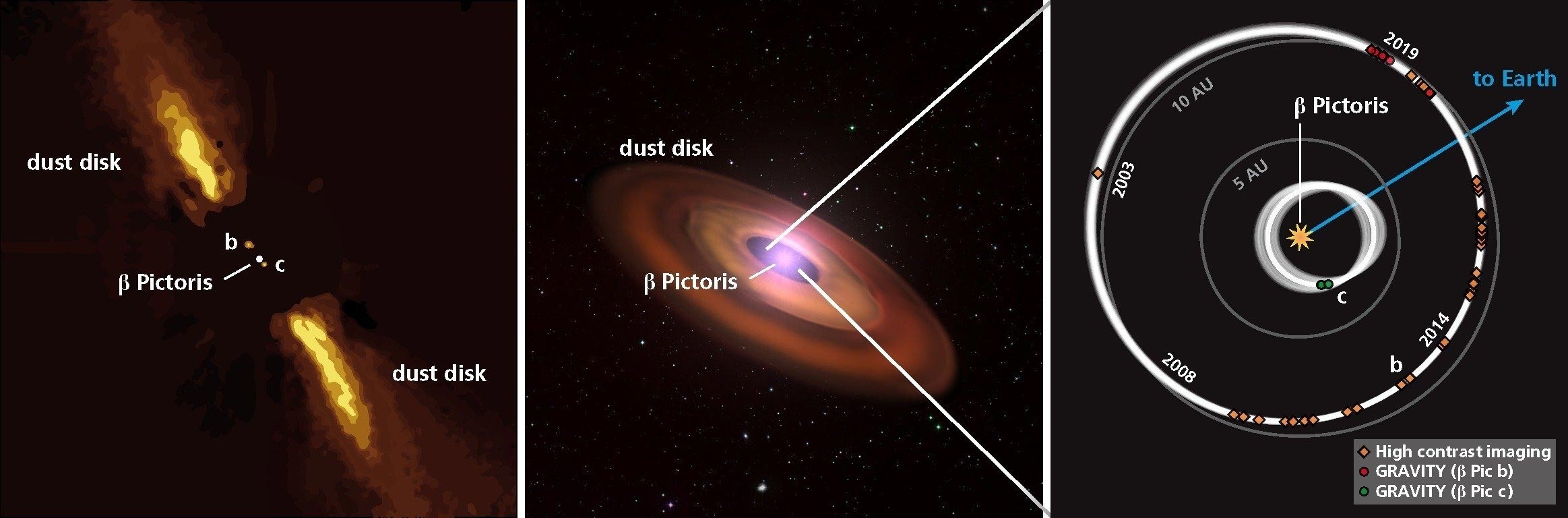
Astronomers using the GRAVITY instrument at the VLT telescopes in Chile have now obtained the first direct confirmation of an exoplanet discovered by radial velocity. As the planet “β Pictoris c” is in a close orbit around its parent star, this is the first time that the faint glint of the exoplanet next to the glare of the star has been directly observed. With these observations, astronomers can obtain both the flux and dynamical masses of exoplanets, allowing them to put closer constraints on formation models for exoplanets.
Combining the light of the four large VLT telescopes, astronomers in the GRAVITY collaboration have managed to directly observe the glint of light coming from an exoplanet close to its parent star. The planet called “β Pictoris c” is the second planet found to orbit its parent star. It was originally detected by the so-called ‘radial velocity’, which measures the drag and pull on the parent star due to the planet’s orbit. β Pictoris c is so close to its parent star that even the best telescopes were not able to directly image the planet so far.
“This is the first direct confirmation of a planet detected by the radial velocity method,” says Sylvestre Lacour, leader of the ExoGRAVITY observing program. Radial velocity measurements have been used for many decades by astronomers, and have allowed for the detection of hundreds of exoplanets. But never before were astronomers able to obtain a direct observation of one of those planets. This was only possible because the GRAVITY instrument, situated in a laboratory underneath the four telescopes it uses, is a very precise instrument. It observes the light from the parent star with all four VLT telescopes at the same time and combines them into a virtual telescope with the detail required to reveal β Pictoris c.
“It is amazing, what level of detail and sensitivity we can achieve with GRAVITY,” marvels Frank Eisenhauer, the lead scientist of the GRAVITY project at MPE. “We are just starting to explore stunning new worlds, from the supermassive black hole at the center of our galaxy to planets outside the solar system.”
The direct detection with GRAVITY, however, was only possible due to new radial velocity data precisely establishing the orbital motion of β Pictoris c, presented in a second paper published also today. This enabled the team to precisely pinpoint and predict the expected position of the planet so that GRAVITY was able to find it.
β Pictoris c is thus the first planet that has been detected and confirmed with both methods, radial velocity measurements, and direct imaging. In addition to the independent confirmation of the exoplanet, the astronomers can now combine the knowledge from these two previously separate techniques. “This means, we can now obtain both the brightness and the mass of this exoplanet,” explains Mathias Nowak, the lead author on the GRAVITY discovery paper. “As a general rule, the more massive the planet, the more luminous it is.”
In this case, however, the data on the two planets is somewhat puzzling: The light coming from β Pictoris c is six times fainter than its larger sibling, β Pictoris b. β Pictoris c has 8 times the mass of Jupiter. So how massive is β Pictoris b? Radial velocity data will ultimately answer this question, but it will take a long time to get enough data: one full orbit for planet b around its star takes 28 of our years!
“We used GRAVITY before to obtain spectra of other directly imaged exoplanets, which themselves already contained hints on their formation process,” adds Paul Molliere, who as postdoc at MPIA is modeling exoplanet spectra. “This brightness measurement of β Pictoris c, combined with its mass, is a particularly important step to constraining our planet formation models.” Additional data might also be provided by GRAVITY+, the next-generation instrument, which is already under development.
Never miss a breakthrough: Join the SciTechDaily newsletter.
Follow us on Google and Google News.