
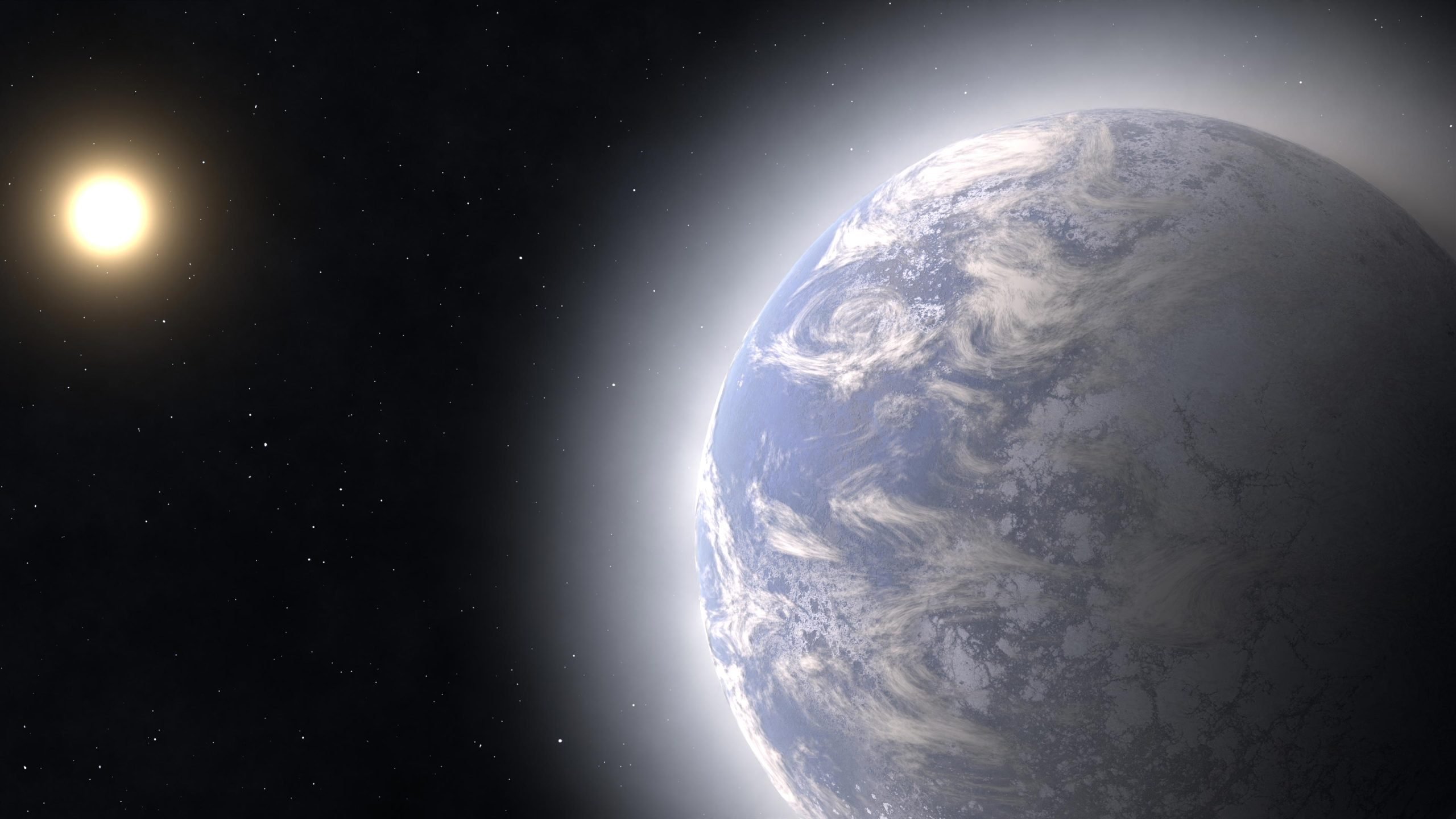
Simulations provide a potential explanation for the mysterious gap in the size distribution of super-Earths.
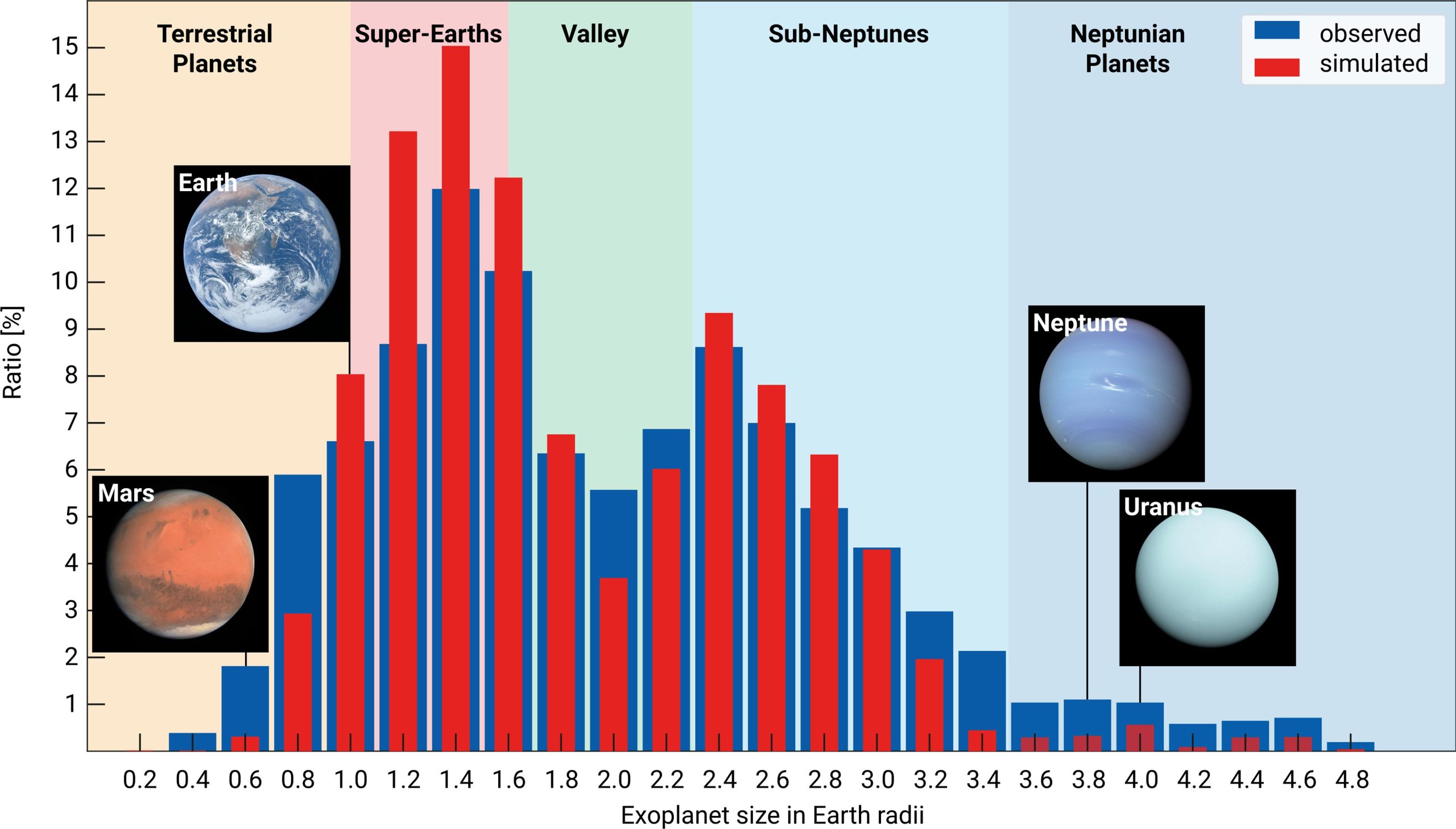
Ordinarily, planets in evolved planetary systems, such as the Solar System, follow stable orbits around their central star. However, many indications suggest that some planets might depart from their birthplaces during their early evolution by migrating inward or outward. This planetary migration might also explain an observation that has puzzled researchers for several years: the relatively low number of exoplanets with sizes about twice as large as Earth, known as the radius valley or gap. Conversely, there are many exoplanets smaller and larger than this size.
“Six years ago, a reanalysis of data from the Kepler space telescope revealed a shortage of exoplanets with sizes around two Earth radii,” Remo Burn explains, an exoplanet researcher at the Max Planck Institute for Astronomy (MPIA) in Heidelberg. He is the lead author of the article reporting the findings outlined in this article, now published in Nature Astronomy.
Where does the radius valley come from?
“In fact, we – like other research groups – predicted based on our calculations, even before this observation, that such a gap must exist,” explains co-author Christoph Mordasini, a member of the National Centre of Competence in Research (NCCR) PlanetS. He heads the Division of Space Research and Planetary Sciences at the University of Bern. This prediction originated during his tenure as a scientist at MPIA, which has been jointly researching this field with the University of Bern for many years.
The most commonly suggested mechanism to explain the emergence of such a radius valley is that planets might lose a part of their original atmosphere due to the irradiation from the central star – especially volatile gases like hydrogen and helium. “However, this explanation neglects the influence of planetary migration,” Burn clarifies. It has been established for about 40 years that under certain conditions, planets can move inward and outward through planetary systems over time. How effective this migration is and to what extent it influences the development of planetary systems impacts its contribution to forming the radius valley.
Enigmatic sub-Neptunes
Two different types of exoplanets inhabit the size range surrounding the gap. On one hand, there are rocky planets, which can be more massive than Earth and are hence called super-Earths. On the other hand, astronomers are increasingly discovering so-called sub-Neptunes (also mini-Neptunes) in distant planetary systems, which are, on average, slightly larger than the super-Earths.
“However, we do not have this class of exoplanets in the Solar System,” Burn points out. “That’s why, even today, we’re not exactly sure about their structure and composition.”
Still, astronomers broadly agree that these planets possess significantly more extended atmospheres than rocky planets. Consequently, understanding how these sub-Neptunes’ characteristics contribute to the radius gap has been uncertain. Could the gap even suggest that these two types of worlds form differently?
Wandering ice planets
“Based on simulations we already published in 2020, the latest results indicate and confirm that instead, the evolution of sub-Neptunes after their birth significantly contributes to the observed radius valley,” concludes Julia Venturini from Geneva University. She is a member of the PlanetS collaboration mentioned above and led the 2020 study.
In the icy regions of their birthplaces, where planets receive little warming radiation from the star, the sub-Neptunes should indeed have sizes missing from the observed distribution. As these presumably icy planets migrate closer to the star, the ice thaws, eventually forming a thick water vapor atmosphere.
This process results in a shift in planet radii to larger values. After all, the observations employed to measure planetary radii cannot differentiate whether the determined size is due to the solid part of the planet alone or an additional dense atmosphere.
At the same time, as already suggested in the previous picture, rocky planets ‘shrink’ by losing their atmosphere. Overall, both mechanisms produce a lack of planets with sizes around two Earth radii.
Physical computer models simulating planetary systems
“The theoretical research of the Bern-Heidelberg group has already significantly advanced our understanding of the formation and composition of planetary systems in the past,” explains MPIA Director Thomas Henning. “The current study is, therefore, the result of many years of joint preparatory work and constant improvements to the physical models.”
The latest results stem from calculations of physical models that trace planet formation and subsequent evolution. They encompass processes in the gas and dust disks surrounding young stars that give rise to new planets. These models include the emergence of atmospheres, the mixing of different gases, and radial migration.
“Central to this study were the properties of water at pressures and temperatures occurring inside planets and their atmospheres,” explains Burn. Understanding how water behaves over a wide range of pressures and temperatures is crucial for simulations. This knowledge has been of sufficient quality only in recent years. It is this component that permits realistic calculation of the sub-Neptunes’ behavior, hence explaining the manifestation of extensive atmospheres in warmer regions.
“It’s remarkable how, as in this case, physical properties on molecular levels influence large-scale astronomical processes such as the formation of planetary atmospheres,” Henning adds.
“If we were to expand our results to cooler regions, where water is liquid, this might suggest the existence of water worlds with deep oceans,” Mordasini says. “Such planets could potentially host life and would be relatively straightforward targets for searching for biomarkers thanks to their size.”
Further work ahead
However, the current work is just an important milestone. Although the simulated size distribution closely matches the observed one, and the radius gap is in the right place, the details still have some inconsistencies. For instance, too many ice planets end up too close to the central star in the calculations. Nonetheless, researchers do not perceive this circumstance as a disadvantage but hope to learn more about planetary migration in this way.
Observations with telescopes like the James Webb Space Telescope (JWST) or the under-construction Extremely Large Telescope (ELT) could also assist. They would be capable of determining the composition of planets depending on their size, thus providing a test for the simulations described here.
Reference: “A radius valley between migrated steam worlds and evaporated rocky cores” by Remo Burn, Christoph Mordasini, Lokesh Mishra, Jonas Haldemann, Julia Venturini, Alexandre Emsenhuber and Thomas Henning, 9 February 2024, Nature Astronomy.
DOI: 10.1038/s41550-023-02183-7
The MPIA scientists involved in this study are Remo Burn and Thomas Henning.
Other researchers include Christoph Mordasini (University of Bern, Switzerland [Unibe]), Lokesh Mishra (Université de Genève, Switzerland [Unige], and Unibe), Jonas Haldemann (Unibe), Julia Venturini (Unige), and Alexandre Emsenhuber (Ludwig Maximilian University Munich, Germany, and Unibe).
The NASA Kepler space telescope searched for planets around other stars between 2009 and 2018 and discovered thousands of new exoplanets during its operation. It utilized the transit method: when a planet’s orbit is inclined in a way that the plane lies within the telescope’s line of sight, planets periodically block part of the star’s light during their orbit. This periodic fluctuation in the star’s brightness enables an indirect detection of the planet and determination of its radius.
Never miss a breakthrough: Join the SciTechDaily newsletter.
Follow us on Google and Google News.