
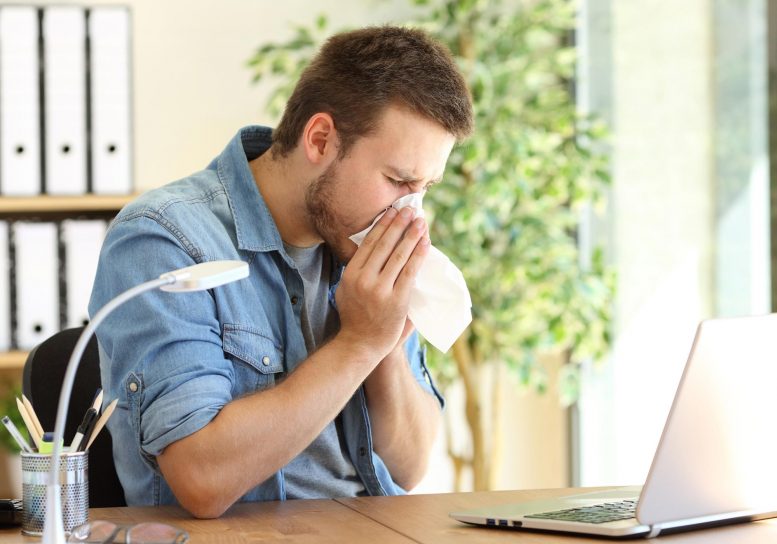
COVID-19 could soon become a common cold, as immunity shifts the balance toward mild infections.
Within the next decade, the novel coronavirus responsible for COVID-19 could become little more than a nuisance, causing no more than common cold-like coughs and sniffles. That possible future is predicted by mathematical models that incorporate lessons learned from the current pandemic on how our body’s immunity changes over time. Scientists at the University of Utah carried out the research, now published in the journal Viruses.
“This shows a possible future that has not yet been fully addressed,” says Fred Adler, PhD, professor of mathematics and biological sciences at the University of Utah. “Over the next decade, the severity of COVID-19 may decrease as populations collectively develop immunity.”
The findings suggest that changes in the disease could be driven by adaptations of our immune response rather than by changes in the virus itself. Adler was senior author on the publication with Alexander Beams, first author and graduate student in the Department of Mathematics and the Division of Epidemiology at University of Utah Health, and undergraduate co-author Rebecca Bateman.
Modeling a Pandemic’s Transformation
Although SARS-CoV-2 (the sometimes-deadly coronavirus causing COVID-19) is the best-known member of that virus family, other seasonal coronaviruses circulate in the human population—and they are much more benign. Some evidence indicates that one of these cold-causing relatives might have once been severe, giving rise to the “Russian flu” pandemic in the late 19th century. The parallels led the U of U scientists to wonder whether the severity of SARS-CoV-2 could similarly lessen over time.
“We’ve shown that mild infections will win, as long as they train our immune systems to fight against severe infections.”
To test the idea, they built mathematical models incorporating evidence on the body’s immune response to SARS-CoV-2 based on the following data from the current pandemic.
- There is likely a dose response between virus exposure and disease severity.
- A person exposed to a small dose of virus will be more likely to get a mild case of COVID-19 and shed small amounts of virus.
- By contrast, adults exposed to a large dose of virus are more likely to have severe disease and shed more virus.
- Masking and social distancing decrease the viral dose.
- Children are unlikely to develop severe disease.
- Adults who have had COVID-19 or have been vaccinated are protected against severe disease.
Just Another Seasonal Coronavirus
Running several versions of these scenarios showed that the three mechanisms in combination set up a situation where an increasing proportion of the population will become predisposed for mild disease over the long term. The scientists felt the transformation was significant enough that it needed a new term. In this scenario, SARS-CoV-2 would become “Just Another Seasonal Coronavirus,” or JASC for short.
“In the beginning of the pandemic, no one had seen the virus before,” Adler explains. “Our immune system was not prepared.” The models show that as more adults become partially immune, whether through prior infection or vaccination, severe infections all but disappear over the next decade. Eventually, the only people who will be exposed to the virus for the first time will be children—and they’re naturally less prone to severe disease.
“The novel approach here is to recognize the competition taking place between mild and severe COVID-19 infections and ask which type will get to persist in the long run,” Beams says. “We’ve shown that mild infections will win, as long as they train our immune systems to fight against severe infections.”
The models do not account for every potential influence on disease trajectory. For example, if new virus variants overcome partial immunity, COVID-19 could take a turn for the worse. In addition, the predictions rely on the key assumptions of the model holding up.
“Our next step is comparing our model predictions with the most current disease data to assess which way the pandemic is going as it is happening,” Adler says. “Do things look like they’re heading in a bad or good direction? Is the proportion of mild cases increasing? Knowing that might affect decisions we make as a society.”
Reference: “Will SARS-CoV-2 Become Just Another Seasonal Coronavirus?” by Alexander B. Beams, Rebecca Bateman and Frederick R. Adler, 7 May 2021, Viruses.
DOI: 10.3390/v13050854
The research was supported by COVID MIND 2020 and a seed grant from the University of Utah Vice President for Research and the Immunology, Inflammation and Infectious Diseases Initiative.
Never miss a breakthrough: Join the SciTechDaily newsletter.
Follow us on Google and Google News.