
An international team of planetary scientists led by astronomers at AOP have found an asteroid trailing behind Mars with a composition very similar to the Moon’s. The asteroid could be an ancient piece of debris, dating back to the gigantic impacts that formed the Moon and the other rocky planets in our solar system like Mars and the Earth. The research, which was published in the journal Icarus, also has implications for finding such primordial objects associated with our own planet.
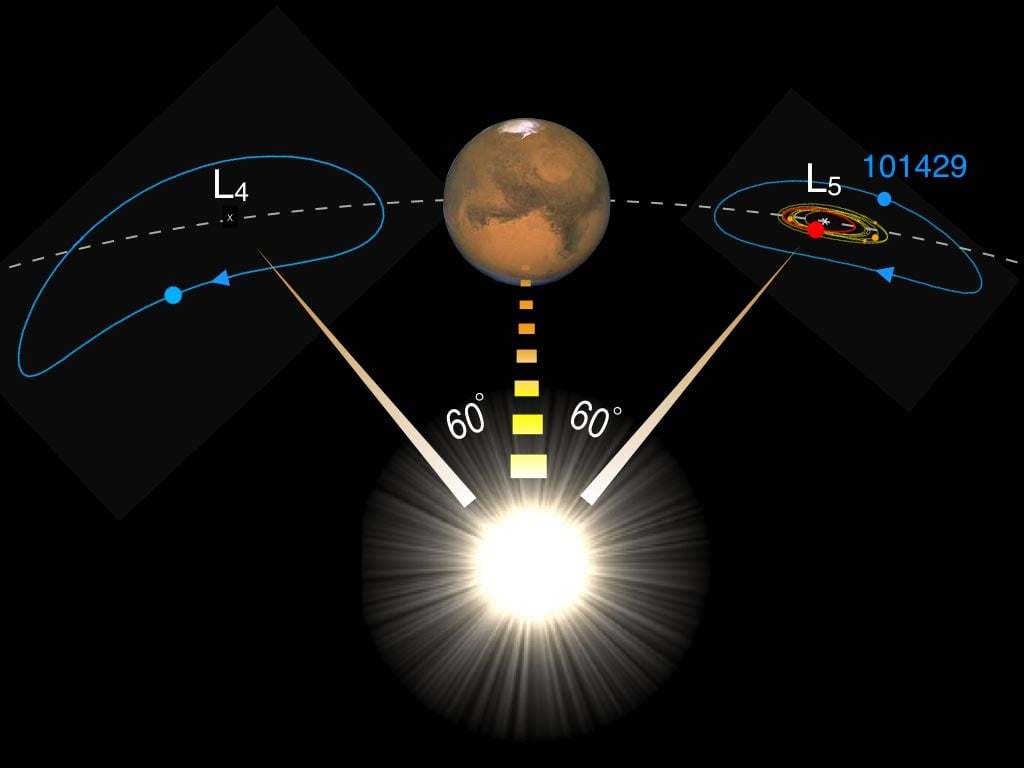
Trojans are a class of asteroid that follows the planets in their orbits as a flock of sheep might follow a shepherd, trapped within gravitational “safe havens” 60 degrees in front of, and behind, the planet (Figure 1). They are of great interest to scientists as they represent leftover material from the formation and early evolution of the solar system. Several thousands of those Trojans exist along the orbit of the giant planet Jupiter. Closer to the Sun, astronomers have so far discovered only a handful of Trojans of Mars, the planet next door to Earth.
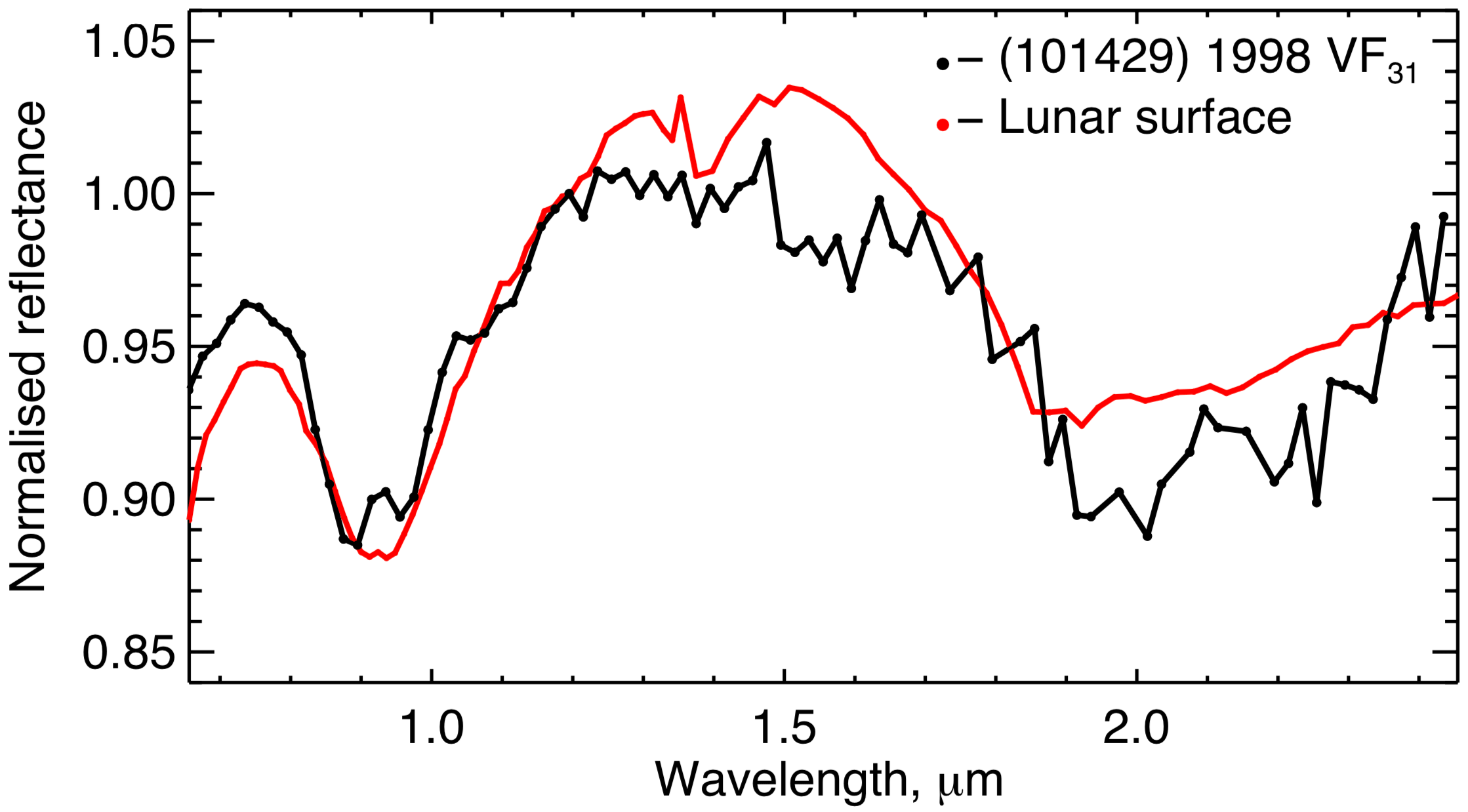
Where could such an unusual object have come from? One possibility is that 101429 is just another asteroid, similar perhaps to ordinary chondrite meteorites, that acquired its lunar-like appearance through eons of exposure to solar radiation, a process called space weathering.
Alternatively, the asteroid may look like the Moon because it does come from the Moon. Dr. Apostolos Christou, AOP astronomer and lead author of the paper explains: “The early solar system was very different from the place we see today. The space between the newly-formed planets was full of debris and collisions were commonplace. Large asteroids – we call these planetesimals – were constantly hitting the Moon and the other planets. A shard from such a collision could have reached the orbit of Mars when the planet was still forming and was trapped in its Trojan clouds.”
A third, and perhaps more likely scenario is that the object came from Mars itself. As Dr. Christou points out, “The shape of the 101429 spectrum tells us that it is rich in pyroxene, a mineral found in the outer layer or crust of planet-sized bodies. Mars, like the Moon and the Earth, was pummeled by impacts early in its history, one of these was responsible for the gigantic Borealis basin, a crater as wide as the planet itself. Such a colossal impact could easily have sent 101429 on its way to the planet’s L5 Lagrangian point.” Indeed, a Mars origin was proposed a few years ago for 101429’s Trojan siblings, a cluster of Trojans collectively known as the Eureka family (Figure 1). These asteroids also have an unusual composition but, whereas 101429 is pyroxene-rich these Eureka family asteroids are mostly olivine, a mineral found deep in a planetary mantle.
101429 and its brethren also have something to teach us about finding the Earth Trojans, if they exist. Previous work by the team had shown that solar radiation causes debris, in the form of boulder- or city-block-sized chunks, from these asteroids to slowly leak out of the Trojan clouds of Mars. If the Earth Trojans are anything like Mars’s, the same mechanism would act as a source of small near-Earth asteroids that will stand out because of their uncommon composition.
Finding these objects might turn out to be a job for the Vera C. Rubin Observatory, poised to begin the most ambitious survey of the solar system to-date. Rubin is expected to discover roughly ten times as many asteroids as currently known and, along with the GAIA satellite already surveying the sky from the L2 Earth-Sun Lagrange point, may offer us the best near-term prospects for tracking down the debris of Earth’s Trojan companions.
Reference: “Composition and origin of L5 Trojan asteroids of Mars: Insights from spectroscopy” by Apostolos A. Christou,
Galin Borisov. Aldo Dell’Oro. Alberto Cellino and Maxime Devogèle, 1 August 2020, Icarus.
DOI: 10.1016/j.icarus.2020.113994
arXiv: 2010.10947
Acknowledgements: Funding and facilities to support this work were provided by the UK Science and Technology Facilities Council, the Northern Ireland Department for Communities and ESO, the European Organisation for Astronomical Research in the Southern Hemisphere.
Never miss a breakthrough: Join the SciTechDaily newsletter.
Follow us on Google and Google News.
4 Comments
Wow! I have researched a Lot about space but didn’t know this! Cool 😎 information!
Just so you readers understand. This is a thesis. It is not proven fact. Almost all of these articles are from post grads, who need to publish to get their sheep skin. The press, very obligingly print it as facts. Most of your science types “Know” nothing. Its all hypothetical. But congress keeps giving them grants to waste on stupid useless crap like this so the poor kids can pay their bills
Just so you understand. Northern Ireland is not part of the United States.
Don’t you have voters to sue for disagreeing with you today?
Acknowledgements: Funding and facilities to support this work were provided by the UK Science and Technology Facilities Council, the Northern Ireland Department for Communities and ESO, the European Organisation for Astronomical Research in the Southern Hemisphere.
O.K. Tenth Man. Dr. Christou is not a post grad. And this is a peer reviewed study.
If you have scientific criticism of this report, the make it. Ad hominem attacks are way out of line.