
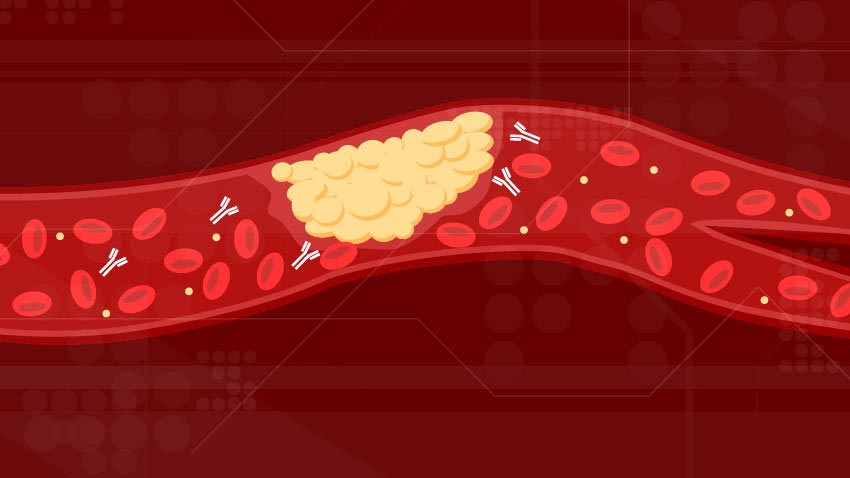
Blood clots continue to wreak havoc for patients with severe COVID-19 infection, and a new study explains what may spark them in up to half of patients.
The culprit: an autoimmune antibody that’s circulating in the blood, attacking the cells and triggering clots in arteries, veins, and microscopic vessels. Blood clots can cause life-threatening events like strokes. And, in COVID-19, microscopic clots may restrict blood flow in the lungs, impairing oxygen exchange.
Outside of novel coronavirus infection, these clot-causing antibodies are typically seen in patients who have the autoimmune disease antiphospholipid syndrome. The connection between autoantibodies and COVID-19 was unexpected, says co-corresponding author Yogen Kanthi, M.D., an assistant professor at the Michigan Medicine Frankel Cardiovascular Center and a Lasker Investigator at the National Institutes of Health’s National Heart, Lung, and Blood Institute.
“In patients with COVID-19, we continue to see a relentless, self-amplifying cycle of inflammation and clotting in the body,” Kanthi says. “Now we’re learning that autoantibodies could be a culprit in this loop of clotting and inflammation that makes people who were already struggling even sicker.”
‘Some of the worst clotting we’ve ever seen’
Co-corresponding author Jason Knight, M.D., Ph.D., a rheumatologist at Michigan Medicine, has been studying antiphospholipid syndrome antibodies in the general population for years.
“Half of the patients hospitalized with COVID-19 were positive for at least one of the autoantibodies, which was quite a surprise,” says Knight, also an associate professor of internal medicine and a leading expert on diseases caused by autoantibodies.
In the new Science Translational Medicine publication, they found about half of the patients who were very sick with COVID-19 were exhibiting a combination of high levels of both the dangerous antibodies and super-activated neutrophils, which are destructive, exploding white blood cells. In April, the team was the first to report that patients hospitalized for severe COVID-19 had higher levels of neutrophil extracellular traps in their blood.
To learn more, they studied the explosive neutrophils and the COVID-19 antibodies together in mouse models to see if this could be the dangerous combination behind the clots.
“Antibodies from patients with active COVID-19 infection created a striking amount of clotting in animals – some of the worst clotting we’ve ever seen,” Kanthi says. “We’ve discovered a new mechanism by which patients with COVID-19 may develop blood clots.”
Attacking COVID-19 blood clots from all angles
The researchers say these findings aren’t yet ready for clinical practice, but they add a new perspective to the robust thrombosis and inflammation research in patients with COVID-19.
Kanthi, Knight, first author Yu (Ray) Zuo, M.D., and colleagues now want to know whether severely ill patients with high levels of these antibodies would have better outcomes if the antibodies are blocked or removed.
If so, that might warrant an aggressive treatment like plasmapheresis, which is commonly used in severe autoimmune diseases, Zuo explains. It involves draining blood through an IV, filtering it, and replacing it with fresh plasma that doesn’t contain those antibodies associated with blood clots.
“We know people with the highest levels of autoantibodies did worse in terms of respiratory function, and the antibodies caused inflammation even in healthy cells,” says Zuo, an assistant professor of internal medicine and a rheumatologist at Michigan Medicine.
“We don’t yet know what is triggering the body to produce these antibodies, so the next step would be additional research to identify the triggers and the targets of the antibodies,” Knight adds.
In addition, these findings bring up new questions surrounding the use of convalescent plasma as a possible COVID-19 treatment, but the team says more research is needed to examine this concern.
“We’re now investigating how long these antibodies remain in circulation after recovery from the novel coronavirus,” Knight says.
The researchers are also currently running a randomized clinical trial called DICER, which is testing a well-known anti-clotting agent, dipyridamole, in patients with COVID-19 to determine whether it’s more effective than a placebo in reducing excessive blood clots.
“Dipyridamole is an old drug that is safe, inexpensive, and scalable,” Kanthi says. “The FDA approved it 20 years ago to prevent clotting, but we only recently discovered its potential to block this specific type of inflammation that occurs in COVID.”
Reference: “Prothrombotic autoantibodies in serum from patients hospitalized with COVID-19” by Yu Zuo, Shanea K. Estes, Ramadan A. Ali, Alex A. Gandhi, Srilakshmi Yalavarthi, Hui Shi, Gautam Sule, Kelsey Gockman, Jacqueline A. Madison, Melanie Zuo, Vinita Yadav, Jintao Wang, Wrenn Woodard, Sean P. Lezak, Njira L. Lugogo, Stephanie A. Smith, James H. Morrissey, Yogendra Kanthi and Jason S. Knight, 2 November 2020, Science Translational Medicine.
DOI: 10.1126/scitranslmed.abd3876
Never miss a breakthrough: Join the SciTechDaily newsletter.
Follow us on Google and Google News.