
Close Menu
    Facebook X (Twitter) Instagram
    SciTechDaily
    • Biology
    • Chemistry
    • Earth
    • Health
    • Physics
    • Science
    • Space
    • Technology
    Facebook X (Twitter) Pinterest YouTube RSS
    SciTechDaily
    Home»Space»Nakhla Fragment Shows First Evidence of Water Dissolving the Surface of Mars
    Space

    Nakhla Fragment Shows First Evidence of Water Dissolving the Surface of Mars

    By University of GlasgowFebruary 5, 2013No Comments3 Mins Read
    Facebook Twitter Pinterest Telegram LinkedIn WhatsApp Email Reddit
    Share
    Facebook Twitter LinkedIn Pinterest Telegram Email Reddit
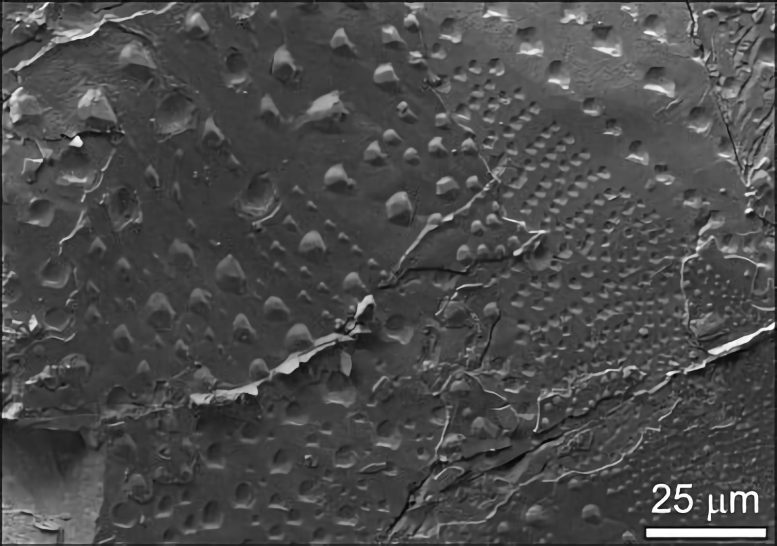
    Nakhla Martian Meteorite Etch Pits
    The etch pits on the Nakhla sample that the team examined. Credit: University of Glasgow

    A newly published study details the test results of a 1.7-gram fragment of a Martian meteorite known as Nakhla, showing the first evidence of water dissolving the surface of Mars.

    Scientists at the University of Glasgow together with the Scottish Universities Environmental Research Center and the Natural History Museum (London) have discovered the first evidence of water dissolving the surface of Mars.

    In a paper published in the Meteoritical Society’s journal MAPS, the research team outlines the results of tests on a 1.7-gram fragment of a Martian meteorite known as Nakhla, which was provided by the Natural History Museum.

    Nakhla, named after the town in Egypt where it landed in 1911 after being blasted from the surface of Mars by a massive impact around 10 million years ago, has been studied for decades by scientists around the world.

    Previous research on Nakhla has provided evidence of the existence of water on Mars through the presence in the meteorite of ‘secondary minerals’ – types of carbonates, hydrous silicates and sulfates most likely formed when Martian minerals reacted with liquid water.

    Professor Martin Lee of the University’s School of Geographical and Earth Sciences, lead author of the paper, said: “What has been unclear in the past is exactly where the chemical elements which made up the secondary minerals within Nakhla came from.

    “Using a scanning electron microscope, we examined many tiny bowl-shaped depressions, known as etch pits, in grains of the minerals olivine and augite found in the meteorite.

    “What we’ve found for the first time is evidence that the etch pits were created when water dissolved the olivine and augite, and that the elements released from those minerals led to the formation of the secondary minerals.

    “It’s an exciting discovery and better informs of our understanding of how water affected rock on Mars.”

    By examining the amount of dissolution which occurred in the etch pits formed within the minerals, the team have also been able to estimate how long the water was present within the sample.

    Professor Lee added: “From the amount of dissolution we observed, it’s likely that this particular piece of Mars was affected by water for only a few months and probably less than a year in total.

    “That’s certainly not long enough to sustain a life-supporting biosphere; however, the findings of our study are from a tiny piece of a very small chunk of the surface of Mars, so it’s difficult to draw any large-scale conclusions about the presence of water on the planet or its implications for life.

    “Our research does raise fascinating questions about exactly how long ago the water interacted with the part of Mars which Nakhla came from and where the water might have gone. We’ll be continuing to look for clues to the answers to these questions in future research. Results from NASA’s Curiosity rover, currently on the surface of Mars, will also help us build a clearer picture of the history of Martian water.”

    Reference: “Evidence for silicate dissolution on Mars from the Nakhla meteorite” by M. R. Lee, T. Tomkinson, D. F. Mark, F. M. Stuart and C. L. Smith, 28 January 2013, Meteoritics & Planetary Science.
    DOI: 10.1111/maps.12053

    Never miss a breakthrough: Join the SciTechDaily newsletter.
    Follow us on Google and Google News.

    Astronomy Mars Meteorites Planetary Science University of Glasgow
    Share. Facebook Twitter Pinterest LinkedIn Email Reddit

    Related Articles

    Scientists Discover Evidence of Methane in Martian Meteorites

    Geochemical Meteorite Data Reveal How Mars Lost Its Water

    Researchers Discover Sample of Ancient Martian Crust

    NASA’s Curiosity Readies for First Drive on Mars

    Color HiRISE Image of Curiosity Rover on Mars

    First 360-Degree Color Panorama From NASA’s Curiosity Mars Rover

    A Connection Between Volatiles in the Subsurface of Mars and the Impact Process

    Diogenites Provide Clues of the Earliest Days of Our Solar System

    High-Energy UV Radiation Triggers Methane on Mars

    Leave A Reply Cancel Reply

    • Facebook
    • Twitter
    • Pinterest
    • YouTube

    Don't Miss a Discovery

    Subscribe for the Latest in Science & Tech!

    Trending News

    Bone-Strengthening Discovery Could Reverse Osteoporosis

    Scientists Uncover Hidden Trigger Behind Stem Cell Aging

    Scientists Find Way to Reverse Fatty Liver Disease Without Changing Diet

    Could Humans Regrow Limbs? New Study Reveals Promising Genetic Pathway

    Scientists Reveal Eating Fruits and Vegetables May Increase Your Risk of Lung Cancer

    Scientists Reverse Brain Aging With Simple Nasal Spray

    Scientists Uncover Potential Brain Risks of Popular Fish Oil Supplements

    Scientists Discover a Surprising Way To Make Bread Healthier and More Nutritious

    Follow SciTechDaily
    • Facebook
    • Twitter
    • YouTube
    • Pinterest
    • Newsletter
    • RSS
    SciTech News
    • Biology News
    • Chemistry News
    • Earth News
    • Health News
    • Physics News
    • Science News
    • Space News
    • Technology News
    Recent Posts
    • Europe’s Most Active Volcano Just Got Stranger – Here’s Why Scientists Are Rethinking It
    • Why Are Giant Ants Letting Tiny Ants Crawl All Over Them?
    • Revolutionary Technique Sends Healthy Mitochondria Exactly Where They’re Needed
    • This Student Recreated the Universe in a Bottle. What She Discovered Could Help Reveal How Life Started on Earth
    • Alzheimer’s Symptoms May Start Outside the Brain, Study Finds
    Copyright © 1998 - 2026 SciTechDaily. All Rights Reserved.
    • Science News
    • About
    • Contact
    • Editorial Board
    • Privacy Policy
    • Terms of Use

    Type above and press Enter to search. Press Esc to cancel.