
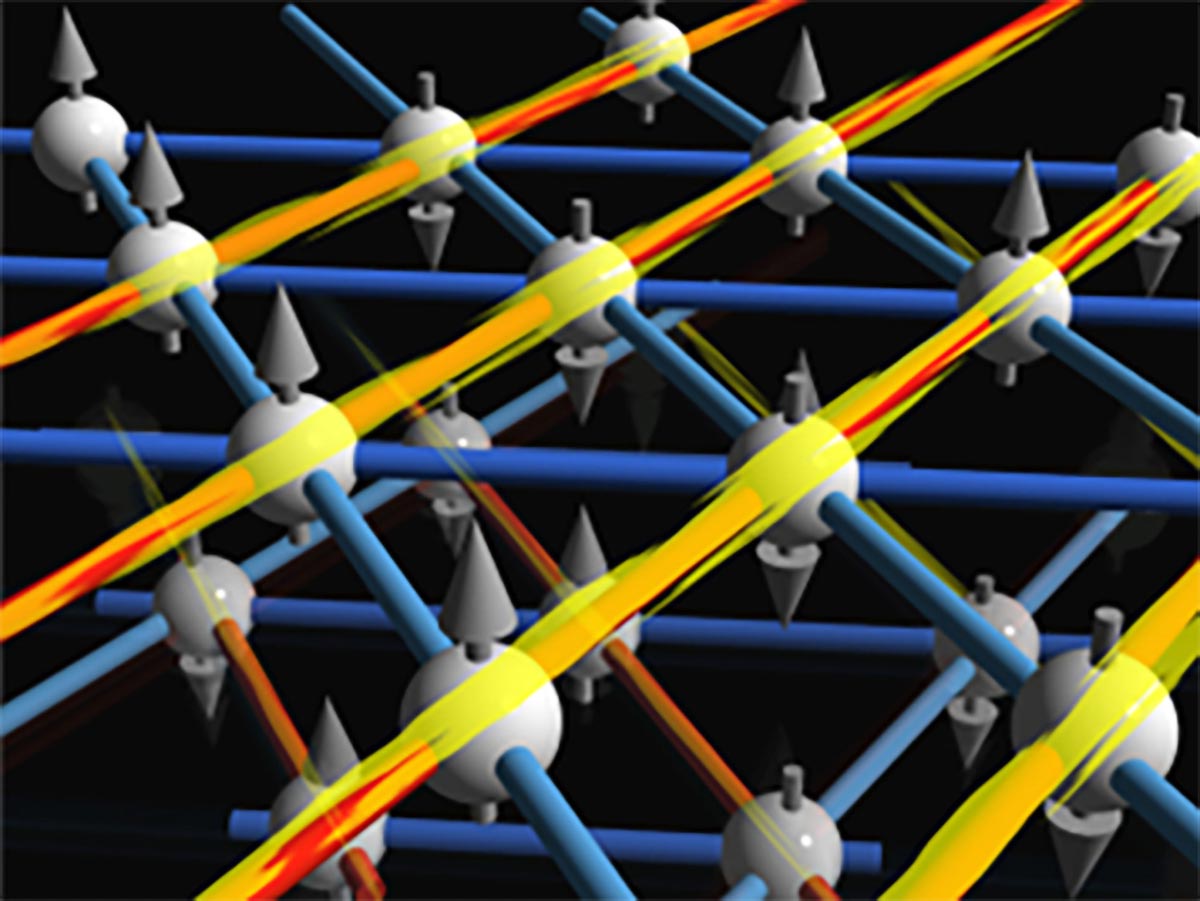
Researchers have discovered unexpected 1D-like spin behavior in a triangular molecular lattice, challenging the conventional understanding of quantum spin liquids.
Quantum spin liquids are unusual states of matter where magnetic spins remain disordered, refusing to settle into a fixed pattern. Professor Yasuyuki Ishii and his team at the Shibaura Institute of Technology studied β’-EtMe3Sb[Pd(dmit)2]2, a material thought to behave as a 2D quantum spin liquid. However, their findings reveal that it instead exhibits 1D spin dynamics, overturning previous assumptions. This breakthrough deepens our understanding of magnetism and could pave the way for new advancements in quantum materials and future technologies.
The Mystery of Quantum Spin Liquids
Quantum spin liquids (QSLs) are a mysterious and intriguing state of matter that defy the usual rules of magnetism. First proposed by Nobel Prize-winning physicist Philip Anderson in the 1970s, these materials never settle into a fixed magnetic state — not even at temperatures near absolute zero. Instead, the atomic spins inside them remain in constant motion, fluctuating and entangling with one another, creating a fluid-like magnetic state. This unusual behavior is caused by magnetic frustration, where competing interactions prevent the system from forming an ordered pattern.
Studying QSLs is exceptionally challenging. Unlike typical magnetic materials, they don’t undergo clear magnetic transitions, making them difficult to detect with conventional methods. As a result, their properties remain one of the great unsolved puzzles in condensed matter physics.
A Unique Material
The material β’-EtMe3Sb[Pd(dmit)2]2, a molecular crystal featuring a triangular lattice, has been a strong candidate for exhibiting QSL behavior. The way these spins are arranged creates inherent frustration because the interactions between neighboring spins cannot all be satisfied at once. This setup seems ideal for a QSL state, but while earlier studies suggested that it might behave like a quantum spin liquid, scientists were not sure whether it was truly a 2D QSL, or if other factors, like a reduction in dimensions, were influencing its behavior. This question has been at the heart of the current research.
Breakthrough Study Challenges 2D Assumptions
A recent study, involving Professor Yasuyuki Ishii from Shibaura Institute of Technology, Yugo Oshima and Hitoshi Seo from the RIKEN Cluster for Pioneering Research, Francis L. Pratt from the Rutherford Appleton Laboratory, and Takao Tsumuraya from the Kumamoto University, published in the journal Physical Review Letters, provides interesting insights into this mystery.
Professor Ishii and Dr Oshima had independently observed signs of one-dimensional spin behavior of β’-EtMe3Sb[Pd(dmit)2]2 in muon spin rotation (µSR) and electron spin resonance (ESR) experiments, respectively, but these were far from the conventional idea of 2D triangular magnets, so they were at a difficult time in interpreting them. They then asked for a theoretical analysis from Dr. Seo, Associate Professor Tsumuraya, and their colleagues. Finally, using advanced theoretical modeling, the researchers discovered that spin dynamics in this material are dominated by quasi-one-dimensional (1D) behavior, challenging traditional expectations of 2D QSLs.The authors, specialists in magnetic resonance and novel magnetic phenomena, combined ESR and μSR with theoretical modeling to explore β’-EtMe3Sb[Pd(dmit)2]2.
“We present a different experimental approach for studying the ground state of β’-EtMe3Sb[Pd(dmit)2]2 using ESR and µSR,” explains one of the authors, Prof. Ishii, introducing their study.
Unexpected 1D Spin Behavior
ESR measures spin anisotropy and diffusion by analyzing the magnetic response of electrons in the material. μSR provides insights into the material’s spin relaxation dynamics and dimensionality by tracking how muon spins interact with magnetic fields. These experimental techniques were complemented by density-functional theory (DFT) calculations and extended Hubbard model simulations to understand the electronic structure and magnetic interactions. They found that the spin behavior in β’-EtMe3Sb[Pd(dmit)2]2 is dominated by quasi-1D (one-dimensional) dynamics, rather than the expected 2D behavior.
Although 1D spin diffusion should normally appear in the direction where the magnetic interaction is strongest, the direction indicated by ESR has been considered the weakest interaction in the triangular lattice based on previous theoretical calculations. This was surprising because the material’s 2D structure led scientists to expect 2D spin dynamics. Muon spin relaxation experiments confirmed these results, B-0.5 pattern in spin relaxation, which is a signature of 1D spin diffusion. ESR also supported this, showing that spin movement was anisotropic or direction-dependent.
Potential for Future Technologies
“The unique properties of quantum spin liquids have the potential for future applications in next-generation technologies such as quantum computers and spintronics devices. The present research is an important step toward this foundation and will open the way for future technological innovations,” adds co-author Yugo Oshima, describing the contributions of the study.
What Comes Next for QSL Research?
Despite these new insights, there are still questions about how exactly dimensional reduction works in this context. The relationship between magnetic frustration, quantum fluctuations, and multi-orbital effects needs further investigation. Prof. Ishii and the team plan to apply their methods to study other QSL candidates, aiming to uncover general rules that govern these materials.
Their work emphasizes the importance of using advanced techniques like ESR and μSR to tackle the challenges of studying QSLs. By confirming that quantum spin-liquid states exist and can be measured dynamically, this study brings researchers closer to unlocking the full potential of these strange materials.
Reference: “Quasi-One-Dimensional Spin Dynamics in a Molecular Spin Liquid System” by Yugo Oshima, Yasuyuki Ishii, Francis L. Pratt, Isao Watanabe, Hitoshi Seo, Takao Tsumuraya, Tsuyoshi Miyazaki and Reizo Kato, 3 December 2024, Physical Review Letters.
DOI: 10.1103/PhysRevLett.133.236702
Never miss a breakthrough: Join the SciTechDaily newsletter.
Follow us on Google and Google News.
1 Comment
Quantum spin liquids (QSLs) are a mysterious and intriguing state of matter that defy the usual rules of magnetism. The atomic spins inside them remain in constant motion, fluctuating and entangling with one another, creating a fluid-like magnetic state.
Ask the researchers:
What do you think is the relationship between quantum and atoms?
Scientific research guided by correct theories can enable researchers to think more.
According to the Topological Vortex Theory (TVT), spins create everything, spins shape the world. There are substantial distinctions between Topological Vortex Theory (TVT) and traditional physical theories. Grounded in the inviscid and absolutely incompressible spaces, TVT introduces the concept of topological phase transitions and employs topological principles to elucidate the formation and evolution of matter in the universe, as well as the impact of interactions between topological vortices and anti-vortices on spacetime dynamics and thermodynamics.
Within TVT, low-dimensional spacetime matter serves as the foundation for high-dimensional spacetime matter, and the hierarchical structure of matter and its interaction mechanisms challenge conventional macroscopic and microscopic interpretations. The conflict between Quantum Physics and Classical Physics can be attributed to their differing focuses: Quantum Physics emphasizes low-dimensional spacetime matter, whereas Classical Physics centers on high-dimensional spacetime matter.
Subatomic particles in the quantum world often defy the familiar rules of the physical world. The fact repeatedly suggests that the familiar rules of the physical world are pseudoscience. In the familiar rules of the physical world, two sets of cobalt-60 can form the mirror image of each other by rotating in opposite directions, and should receive the Nobel Prize for physics.
Please witness the grand performance of some so-called peer review publications (including PRL, PNAS, Nature, Science, etc.). https://scitechdaily.com/microscope-spacecrafts-most-precise-test-of-key-component-of-the-theory-of-general-relativity/#comment-854286. Some so-called academic publications (including PRL, PNAS, Nature, Science, etc.) are addicted to their own small circles and have deviated from science for a long time.
As the background of various material interactions and movements, space exhibits inviscid, absolutely incompressible and isotropic physical characteristics. It may form various forms of spacetime vortices through topological phase transitions. Hence, vortex phenomena are ubiquitous in cosmic space, from vortices of quantum particles and living cells to tornados and black holes. Stars and radioactive elements are one of the most active topological nodes in spacetime. Utilizing them is more valuable and meaningful than simulating them. Small or micro power topology intelligent batteries may be the direction of future energy research and development for human society.
Under the topological vortex architecture, science and pseudoscience are clear at a glance. Topological Vortex Theory (TVT) can play a crucial role in elucidating the foundations of physics, establishing its principles, and combating pseudoscience. Therefore, TVT has been strongly opposed and boycotted by traditional so-called peer review publications (such as PRL, PNAS, Nature, Science, etc.).
These so-called peer review publications (including PRL, PNAS, Nature, Science, etc.) mislead the direction of science and are known for their various absurdities and wonders. They collude together, reference each other, and use so-called Impact Factor (IF) or the Nobel Prize to deceive people around.
Ask the so-called peer review publications (including PRL, PNAS, Nature, Science, etc.):
1. What are your criteria for distinguishing science from pseudoscience?
2. Is your Impact Factor (IF) the standard for distinguishing science from pseudoscience?
3. Is the Nobel Prize the standard for distinguishing science from pseudoscience?
4. What is the most important aspect of academic publications?
5. Is the most important aspect of academic publications being flashy and impractical articles?
Pseudo academic publications (including PRL, PNAS, Nature, Science, etc.) are neither inclusivity nor openness, nor transparency and fairness, and have already had a serious negative impact on the progress of science and technology. Some so-called peer review publications (including PRL, PNAS, Nature, Science, etc.) are addicted to their own small circle and no longer know what science is. They hardly know what is dirty and ugly.
Publications that mislead the public under the guise of scholarship are more reprehensible than ordinary publications. The field of physics faces an ongoing challenge in maintaining scientific rigor and integrity in the face of pervasive pseudoscientific claims. Fighting against rampant pseudoscience, physics still has a long way to go.
While my comments may be lengthy, they are necessary to combat the proliferation of rampant pseudoscience and to promote the advancement of science and technology, and also is all I can do.
Appreciate the SciTechDaily for its inclusivity, openness, transparency, and fairness. If the researchers are truly interested in cosmic matter, please read: A Brief History of the Evolution of Cosmic Matter (https://scitechdaily.com/microscope-spacecrafts-most-precise-test-of-key-component-of-the-theory-of-general-relativity/#comment-873523).