

Scientists at Princeton University have made a groundbreaking discovery in quantum materials, revealing that electron energy levels in certain systems follow a fractal pattern known as Hofstadter’s butterfly.
This phenomenon was first theorized in 1976 but had never been directly observed in a real material until now. The discovery was an unexpected outcome of an experiment on superconductivity in moiré-patterned graphene, where an accidental misalignment created the perfect conditions for visualizing the elusive fractal energy spectrum.
Fractal Patterns in Quantum Materials
A team of scientists at Princeton University has successfully measured the energy levels of electrons in a new type of quantum material and discovered that they follow a fractal pattern, a repeating structure that looks the same at different scales. Fractals are commonly found in nature, in things like snowflakes, ferns, and coastlines. In the quantum world, a similar pattern called Hofstadter’s butterfly was theorized back in 1976. Now, for the first time, researchers have directly observed this pattern in a real material.
Breakthrough in Materials Engineering
This breakthrough was made possible by advances in materials engineering. The researchers stacked and twisted two layers of graphene, sheets of carbon atoms arranged in a hexagonal pattern, creating a repeating interference pattern known as a moiré design, similar to the layered texture of some French fabrics.
“These moiré crystals provided an ideal setting to observe Hofstadter’s spectrum when subjecting electrons moving in them to a magnetic field. These materials have been extensively studied, but up to now the self-similarity of the energy spectrum of these electrons had remained out of reach,” said Ali Yazdani, James S. McDonnell Distinguished University Professor at Princeton, whose team has applied their powerful quantum microscopy technique to study the problem.
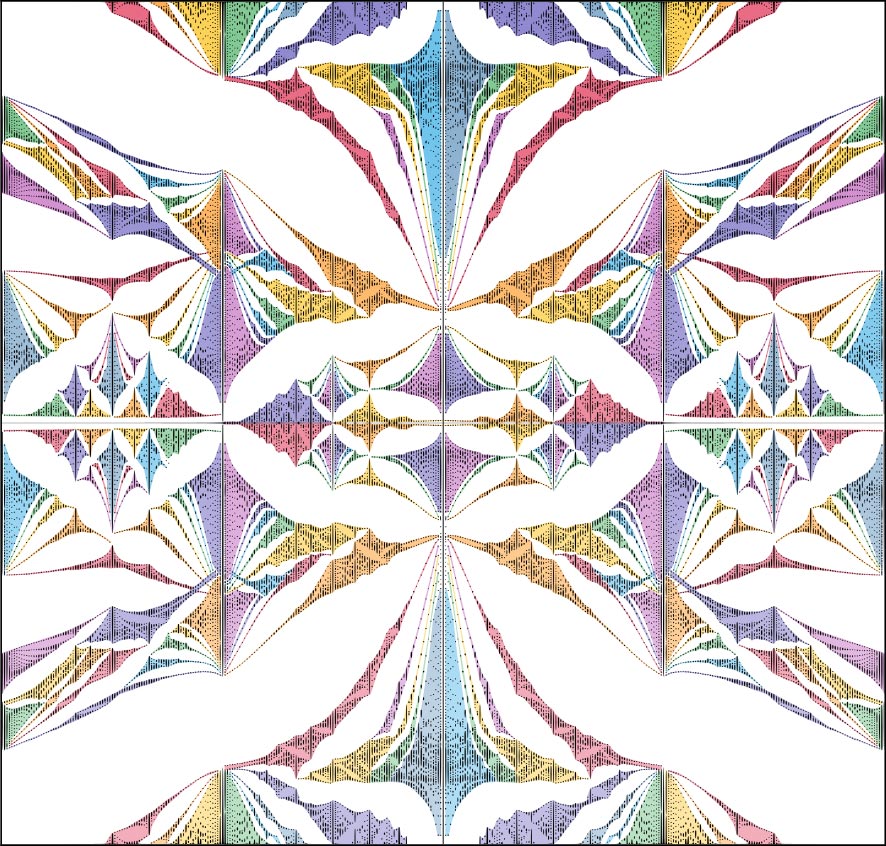
Hofstadter’s Butterfly: A Quantum Fractal
Hofstadter’s butterfly represents the principal finding of a seminal 1976 paper by Douglas Hofstadter. In this work, he predicted that the energy levels of electrons confined within two-dimensional crystals under the influence of a strong magnetic field would display a characteristic fractal energy spectrum. The “butterfly” moniker is used because the emerging pattern, when plotted against energy and magnetic field, evinces an elegant and intricate configuration that resembles a butterfly’s wings.
Importantly, this butterfly pattern is a fractal, meaning it is a self-repeating pattern that is produced over different scales, again and again. While there are many examples of fractals in nature—such as coastlines and snowflakes—few are found in the quantum realm.
“Hofstadter’s butterfly is also a rare example of a problem that is solved exactly in quantum mechanics, without any approximations,” said Kevin Nuckolls, the co-lead author of the paper that details the team’s findings that appear in a recent issue of Nature.
“Since Hofstadter’s original work, there have been many experiments and wonderful papers on the subject but, before our work, no one had ever actually visualized this beautiful energy spectrum,” added Nuckolls.
A Stunning Discovery by Accident
Actually, the researchers did not originally set out to visualize this elaborate phenomenon.
“Our discovery was basically an accident,” Nuckolls conceded. “We didn’t set out to find this.”
Instead, the researchers were conducting an experiment to investigate superconductivity in twisted bilayer graphene, said Dillon Wong, a postdoctoral research associate and co-lead author of the paper. In 2018, a team at Massachusetts Institute of Technology (MIT) discovered that electrons confined to these moiré crystals superconduct— a state in which electrons flow freely without any resistance. Since that time, Yazdani’s group and many others around the world have been trying to understand the nature of superconductivity in these materials.
“We were aiming to study superconductivity,” Wong continued, “but we undershot the magic angle when we were making these samples.”
This mistake created a moiré pattern with a periodicity that was longer than the experimentalists intended to create, but the results turned out to be just what was needed to observe the Hofstadter spectrum.
“The spectrum has a particular magnetic field dependence that can only be verified under conditions that can be achieved in the laboratory when electrons move in a perfect periodic potential with a long periodicity, which was achieved in these accidently made samples,” said Yazdani.
Scanning Tunneling Microscopy: A Closer Look
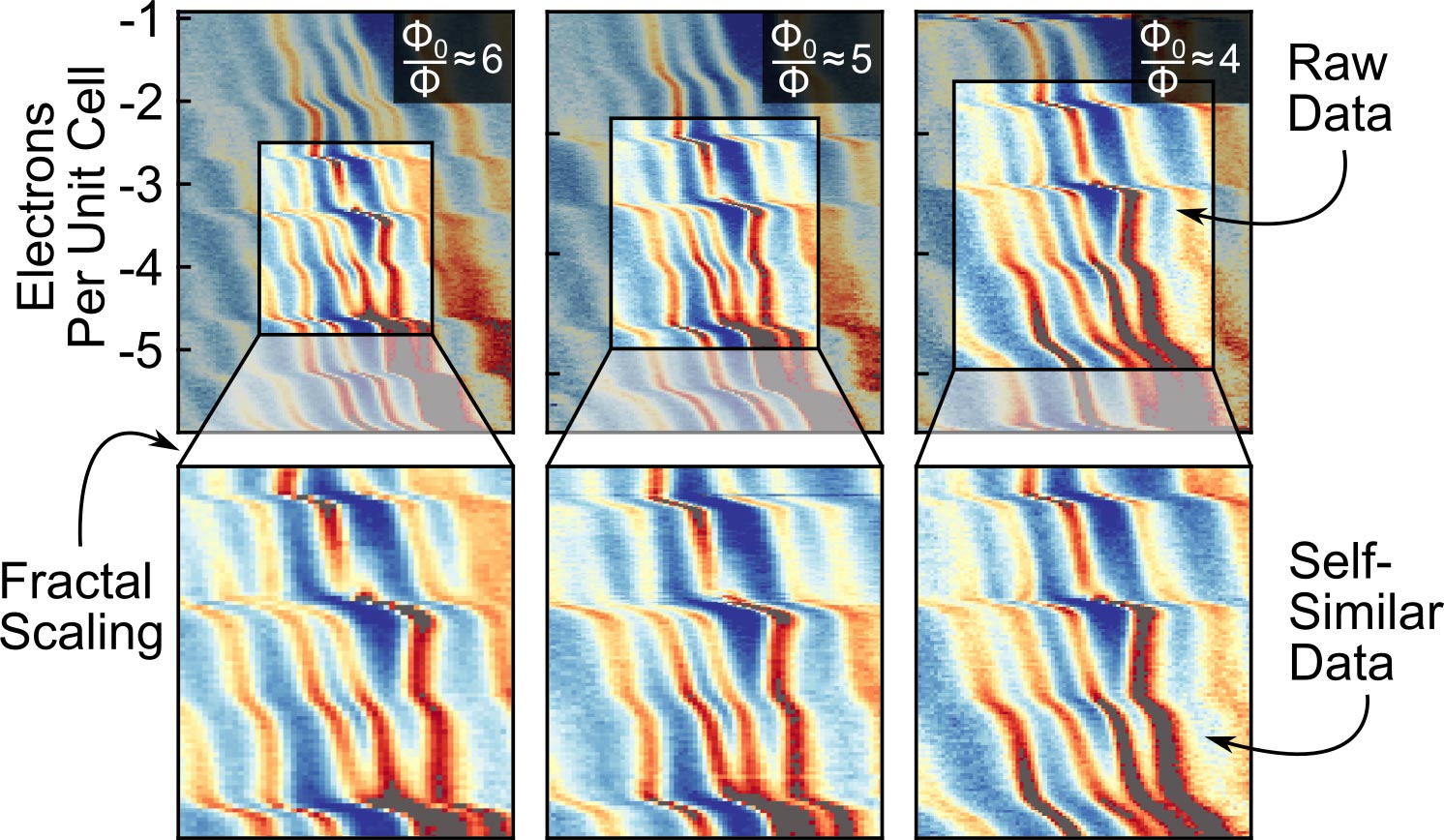
The team used a scanning tunneling microscope to image moiré crystals at atomic resolution and examine their electron energy levels. The microscope works by bringing a sharp metallic tip less than a nanometer from the surface to allow quantum “tunneling” of electrons from the tip to the sample. When using the STM to study their sample, the resulting electron behavior indicated a pattern that the researchers recognized, not initially as Hofstadter’s butterfly, but as unique. Soon however, as they analyzed the pattern in greater detail, they realized that they were gazing at the pattern Hofstadter had hypothesized nearly fifty years ago.
“Sometimes nature is kind to you,” observed Nuckolls. “Sometimes nature gives you extraordinary things to look at if you stop to observe it.”
The STM was especially crucial to this experiment, because the tool is particularly sensitive to the energy of electrons in materials. “The STM is a direct energy probe, which helps us relate back to Hofstadter’s original calculations, which were calculations of energy levels,” said Myungchul Oh, a postdoctoral research associate and co-lead author of the paper. “Previous studies on Hofstadter’s butterfly were based on electrical resistance measurements that don’t measure energy.”
New Insights into Electron Interactions
While the research may not yield any practical applications, at least not right away, the work uncovered features of Hofstadter’s spectrum that are of interest to fundamental physics research. The researchers found that theoretical modeling of the spectrum improved if they included phenomena that are related to electrons interacting with each other, an important feature that was left out of Hofstadter’s original calculations. Including the impact of such interactions is difficult, and experiments become particularly valuable in understanding the many-electron version of this problem. The experimental team worked in close collaboration with a theoretical team led by Prof. Biao Lian of the physics department and his students, who are also co-authors of the paper.
“The Hofstadter regime is a rich and vibrant spectrum of topological states, and I think being able to image these states could be a very powerful way to understand their quantum properties,” said Michael Scheer, a graduate student in physics at Princeton and one of the paper’s co-lead authors.
Reference: “Spectroscopy of the fractal Hofstadter energy spectrum” by Kevin P. Nuckolls, Michael G. Scheer, Dillon Wong, Myungchul Oh, Ryan L. Lee, Jonah Herzog-Arbeitman, Kenji Watanabe, Takashi Taniguchi, Biao Lian and Ali Yazdani, 26 February 2025, Nature.
DOI: 10.1038/s41586-024-08550-2
Never miss a breakthrough: Join the SciTechDaily newsletter.
Follow us on Google and Google News.
5 Comments
This butterfly pattern is a fractal, meaning it is a self-repeating pattern that is produced over different scales, again and again. “The Hofstadter regime is a rich and vibrant spectrum of topological states, and I think being able to image these states could be a very powerful way to understand their quantum properties,” said Michael Scheer, a graduate student in physics at Princeton and one of the paper’s co-lead authors.
VERY GOOD!
If researchers use topological vortices instead of a cat to understand quantum, it will benefit researchers even more.
Scientific research guided by correct theories can enable researchers to think more. Can you get an Interpretation of Quantum Theory within the Framework of Topological Vortex Theory (TVT)? (https://scitechdaily.com/microscope-spacecrafts-most-precise-test-of-key-component-of-the-theory-of-general-relativity/#comment-875168). Can you get an Interpretation of Einstein’s Relativity within the Framework of Topological Vortex Theory (TVT)? (https://scitechdaily.com/microscope-spacecrafts-most-precise-test-of-key-component-of-the-theory-of-general-relativity/#comment-875170).
Topological Vortex Theory (TVT) resolve the ontological divide between relativistic geometry and quantum uncertainty by geometrizing entanglement through shared vortex weaving. This framework offers falsifiable predictions for quantum gravitational phenomena, including Planck-scale defect signatures and modified Hubble flow dynamics.
The Hofstadter regime is a rich and vibrant spectrum of topological states, and one researcher thinks being able to image these states could be a very powerful way to understand their quantum properties.
Ask the researchers:
1. Do you really understand the topological states?
2. What is the relationship between quantum and topological states?
According to the Topological Vortex Theory (TVT), space is not only a backdrop but also a protagonist in the cosmic narrative. The topological phase transition based on the ideal fluid characteristics of space has always dominated the formation and evolution of all things in the universe.
Finally, Leonard discovers something!
Sheldon shouldn’t be the only one with a Nobel Prize
Bangers, mate.