
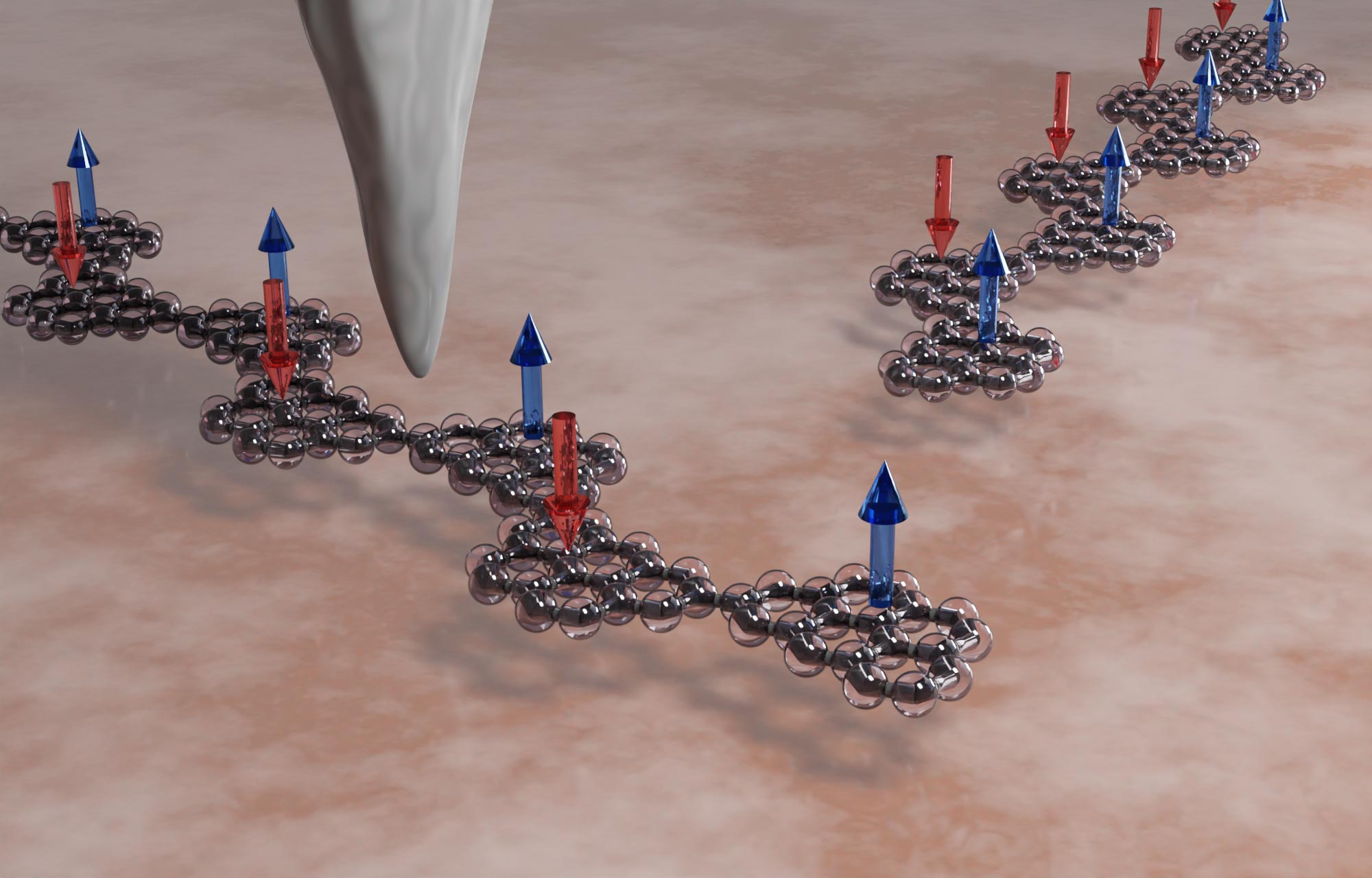
Quantum physics just took a leap from theory to reality! Empa researchers have, for the first time, successfully built a long-theorized one-dimensional alternating Heisenberg model using synthetic nanographenes.
By precisely shaping these tiny carbon structures, they’ve unlocked new ways to manipulate quantum states, confirming century-old predictions. This breakthrough could be a stepping stone toward real-world quantum technologies, from ultra-fast computing to unbreakable encryption.
Recreating a Century-Old Quantum Model
In 2024, researchers at Empa, along with their partners, achieved a major milestone in quantum physics by successfully creating a one-dimensional alternating Heisenberg model using a synthetic material. This theoretical model, first proposed nearly a century ago, describes a linear chain of spins – fundamental to understanding quantum magnetism. Now, led by Roman Fasel, head of Empa’s nanotech@surfaces laboratory, the team has gone a step further, constructing a related spin chain model for the first time in a laboratory setting.
A Subtle Shift with Big Consequences
The key difference between these models lies in how the spins are connected. In the alternating Heisenberg model, spins interact through a repeating pattern of strong and weak couplings. In the new version, however, the spins are evenly connected. This small adjustment leads to strikingly different behaviors: The homogeneous chain exhibits strong quantum entanglement and long-range correlations, with no energy gap between its ground and excited states. In contrast, the alternating model develops an energy gap, where spins tend to form tightly bound pairs, causing correlations to drop off rapidly.
By constructing these nanographene spin chains, the researchers were able to confirm theoretical predictions with high precision, marking a significant step in experimental quantum physics. Their groundbreaking findings were published on March 14 in Nature Materials.
Both models were realized with nanographenes, tiny fragments of the two-dimensional carbon material graphene. By precisely controlling the shape of these fragments, the researchers can manipulate their (quantum) physical properties. The goal is to develop a material platform, a kind of “quantum LEGO,” that allows various quantum models and effects to be experimentally studied.
Moving Quantum Technologies a (Tiny) Step Closer to Practical Applications
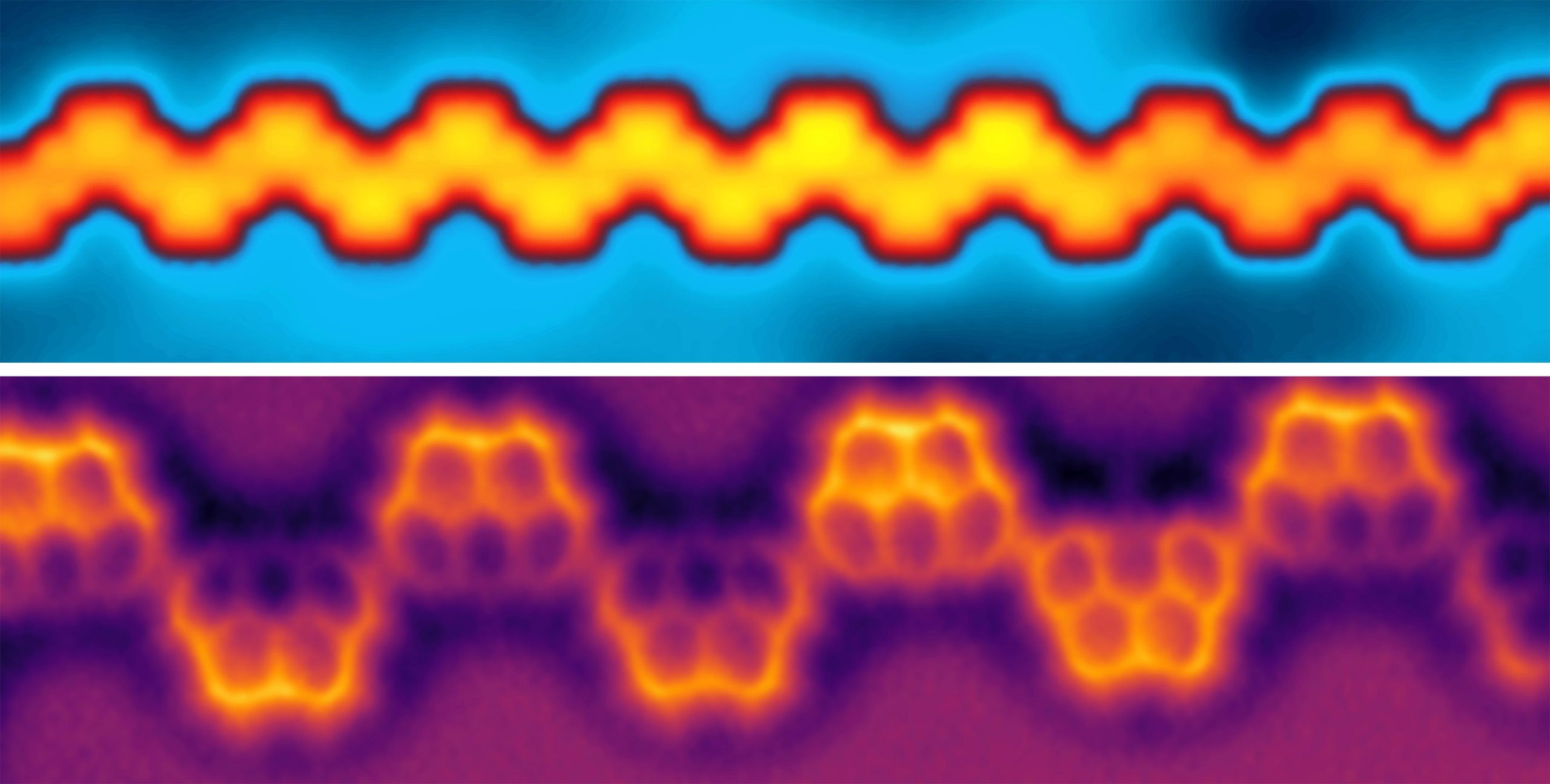
The two Heisenberg experiments highlight this approach. For the alternating spin chain model, the researchers used so-called Clar’s goblets as their starting material, hourglass-shaped nanographene molecules consisting of eleven carbon rings. For the homogeneous Heisenberg chain, they used a different nanographene: Olympicene, which consists of five rings and owes its name to its resemblance to the Olympic rings.
“We have now demonstrated for the second time that theoretical models of quantum physics can be realized with nanographenes, making their predictions experimentally testable,” says Fasel. Next, the researchers plan to use their nanographenes to create and investigate ferrimagnetic spin chains. In these chains, the magnetic moments align in an antiparallel manner but do not completely cancel out. Also of great interest are two-dimensional spin lattices, which exhibit a much greater variety of phases than spin chains, including topological states, quantum spin liquids, and exotic critical phenomena. This makes them particularly interesting, both for fundamental research and for practical applications.
Bridging Theory and Real-World Quantum Tech
After all, recreating models from quantum physics textbooks is not just an academic exercise, it serves a practical purpose as well. Quantum technologies promise breakthroughs in communication, computing power, measurement technology, and much more. However, quantum states are fragile, and their effects are difficult to grasp, making research into real-world applications particularly challenging. With their nanographene “quantum Lego,” Empa researchers hope to gain a deeper understanding of quantum effects and thus pave the way for usable quantum technologies.
Reference: “Spin excitations in nanographene-based antiferromagnetic spin-1/2 Heisenberg chains” by Chenxiao Zhao, Lin Yang, João C. G. Henriques, Mar Ferri-Cortés, Gonçalo Catarina, Carlo A. Pignedoli, Ji Ma, Xinliang Feng, Pascal Ruffieux, Joaquín Fernández-Rossier and Roman Fasel, 14 March 2025, Nature Materials.
DOI: 10.1038/s41563-025-02166-1
Never miss a breakthrough: Join the SciTechDaily newsletter.
Follow us on Google and Google News.
1 Comment
Quantum Physics breakthroughs are coming at BREAKNECK speed across ALL domains. a priori to the empirical stage are apparently developing weekly. Hold on to your hats! 🤵