
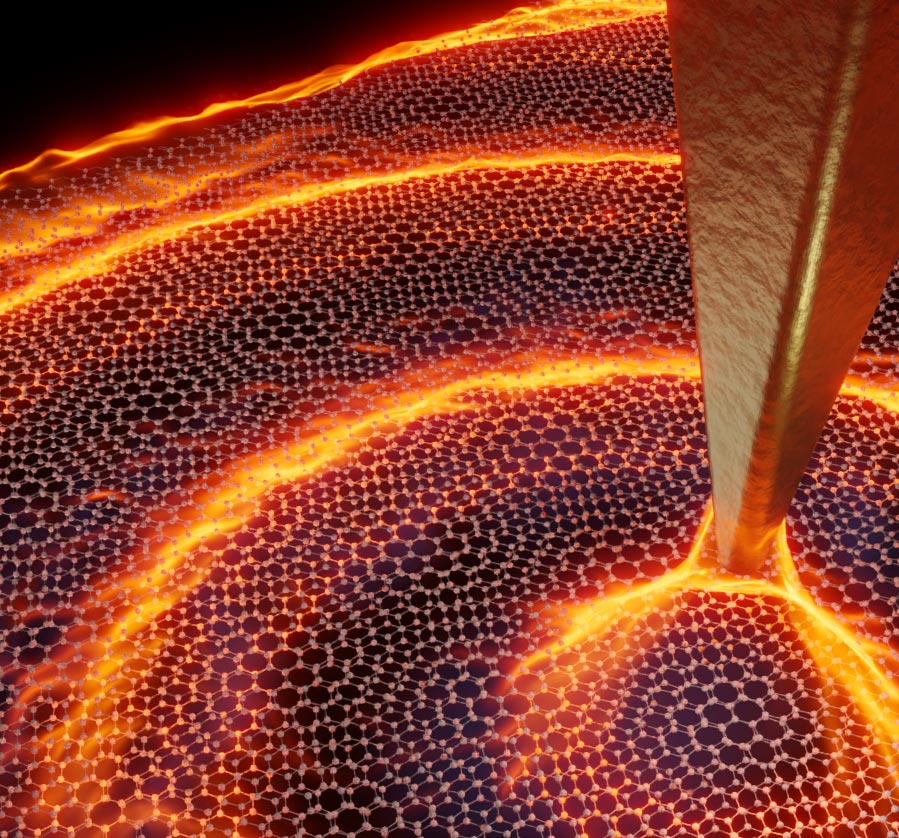
An international team of researchers reports in Nature Physics on how light and electrons move in concert in the material when illuminated with infrared light.
When two layers of graphene are placed one on top of the other, and twisted among them by a very small angle, a “moiré pattern” is formed and the physical properties of the system have proven to change dramatically. In particular, near the ‘magic’ angle of 1 degree, the electrons slow down dramatically, favoring interactions between the electrons. Such interactions give rise to a new type of superconductivity and insulating phases in twisted bilayer graphene.
Along with many other fascinating properties discovered in the past three years, this material has proven to display extremely rich physical phenomena, but most importantly, it has shown to be an easily controllable quantum material. Now, even though this carbon made material has exhibited this amazingly diverse states, the interaction between twisted bilayer graphene and light was shown to have fascinating outcomes on a theoretically level, but no experiment has so far been able to clearly show how this interaction works.
In a recent work published in Nature Physics, ICFO researchers Niels Hesp, Iacopo Torre, David Barcons-Ruiz and Hanan Herzig Sheinfux, let by ICREA Prof. at ICFO Frank Koppens, in collaboration with the research groups of Prof. Pablo Jarillo-Herrero (MIT), Prof. Marco Polini (University of Pisa), Prof. Efthimios Kaxiras (Harvard), Prof. Dmitri Efetov (ICFO) and NIMS (Japan), have found that twisted bilayer graphene can be used to guide and control light at the nanometer scale. This is possible thanks to the interaction between light and the collective movement of the electrons in the material.
Plasmons: Electrons and Light as One
By exploiting the properties of plasmons, in which electrons and light move together as one coherent wave, the scientists were able to observe that plasmons propagate in the material, while being strongly confined to the material, down to the nanoscale. Moreover, by observing the unusual collective optical phenomena occurring in the material, they were able to understand the type peculiar properties of the electrons. This observation of propagating light, confined to the nanoscale, can be used as a platform for optical sensing of gases and bio-molecules.
To obtain the results of this discovery, the team used a near-field microscope, which allows probing the optical properties with a spatial resolution of 20 nanometers, a resolution that goes beyond the diffraction limit. In brief, the scientists took two layers of graphene, put them one on top of the other, while twisting them close to the magic angle, and then, at room temperature, illuminated the material with infrared light on a nano-sized spot. They saw that the plasmons behaved very differently from the usual plasmons, for example in metals or graphene, and this deviation is linked to the peculiar motion of the electrons within the moiré superlattice of the bilayer graphene.
A Platform for Future Nano-Optics
This work lays the first stone on nano-optical studies on the exotic phases of twisted bilayer graphene at low temperatures. In particular, it demonstrates that twisted bilayer graphene is a remarkable nanophotonic material, especially since it serves as an intrinsic (no external voltage is required) host of collective excitations.
Reference: “Observation of interband collective excitations in twisted bilayer graphene” by Niels C. H. Hesp, Iacopo Torre, Daniel Rodan-Legrain, Pietro Novelli, Yuan Cao, Stephen Carr, Shiang Fang, Petr Stepanov, David Barcons-Ruiz, Hanan Herzig Sheinfux, Kenji Watanabe, Takashi Taniguchi, Dmitri K. Efetov, Efthimios Kaxiras, Pablo Jarillo-Herrero, Marco Polini and Frank H. L. Koppens, 27 September 2021, Nature Physics.
DOI: 10.1038/s41567-021-01327-8
This research has been partially supported by the European Research Council, the European Graphene Flagship, the Government of Catalonia, Fundació Cellex and the Severo Ochoa Excellence program of the Government of Spain.
Never miss a breakthrough: Join the SciTechDaily newsletter.
Follow us on Google and Google News.