
Close Menu
    Facebook X (Twitter) Instagram
    SciTechDaily
    • Biology
    • Chemistry
    • Earth
    • Health
    • Physics
    • Science
    • Space
    • Technology
    Facebook X (Twitter) Pinterest YouTube RSS
    SciTechDaily
    Home»Space»NASA’s Juno Spacecraft is Halfway to Jupiter
    Space

    NASA’s Juno Spacecraft is Halfway to Jupiter

    By DC Agle, Jet Propulsion LaboratoryAugust 14, 2013No Comments3 Mins Read
    Facebook Twitter Pinterest Telegram LinkedIn WhatsApp Email Reddit
    Share
    Facebook Twitter LinkedIn Pinterest Telegram Email Reddit
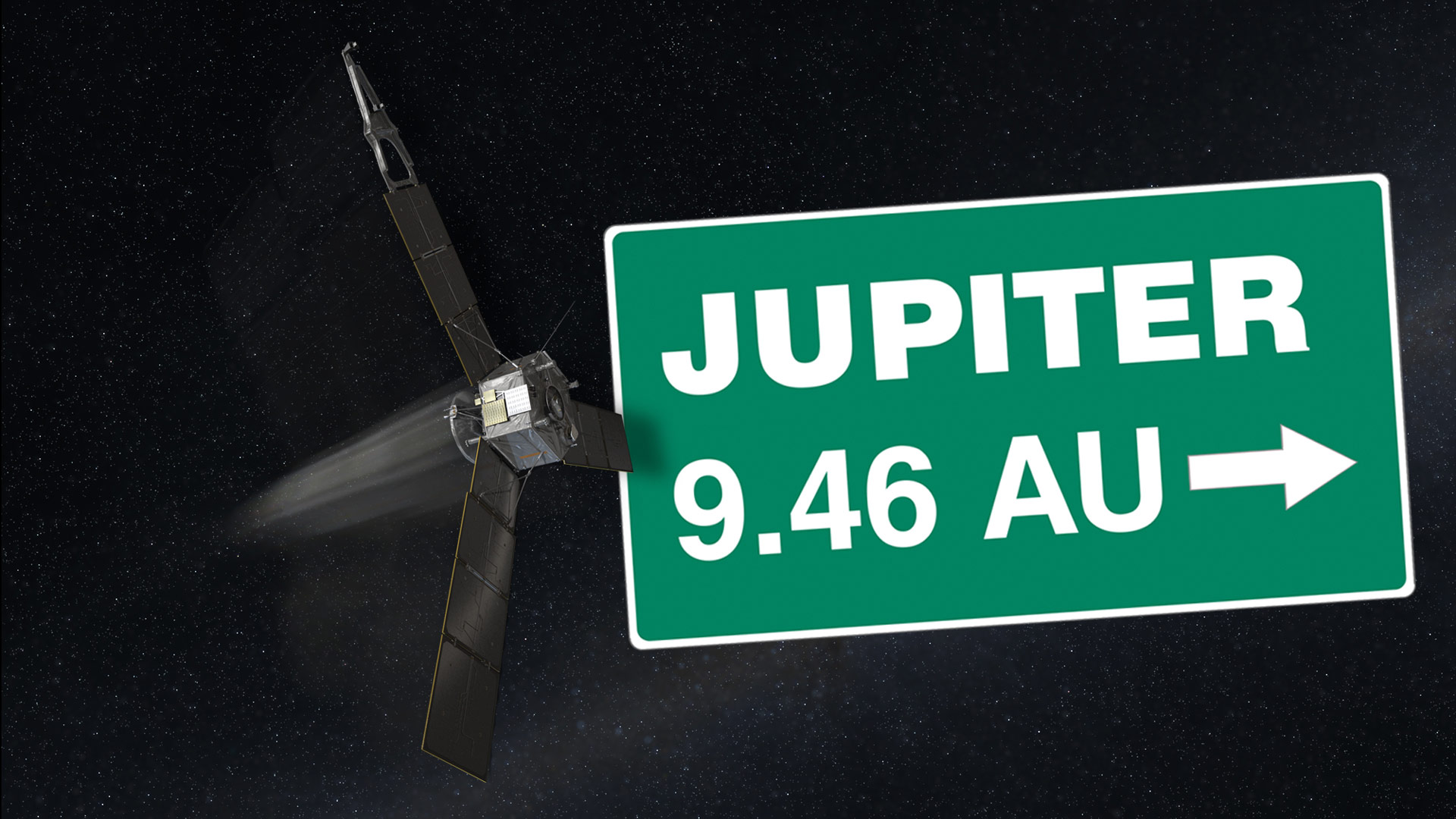
    Juno Spacecraft is Halfway to Jupiter
    A computer-generated image depicts NASA’s Juno spacecraft. Credit: NASA/JPL-Caltech

    Bound for Jupiter, NASA’s Juno spacecraft reached the halfway point on August 12, 2013 and should arrive at Jupiter on July 4, 2016. Once there, it will circle the planet 33 times collecting data.

    NASA’s Juno spacecraft is halfway to Jupiter. The Jovian-system-bound spacecraft reached the milestone today (8/12/13) at 5:25 a.m. PDT (8:25 a.m. EDT/12:25 UTC).

    “Juno’s odometer just clicked over to 9.464 astronomical units,” said Juno Principal Investigator Scott Bolton, of the Southwest Research Institute in San Antonio. “The team is looking forward, preparing for the day we enter orbit around the most massive planet in our solar system.”

    For those astronomical-unitly challenged, an astronomical unit (AU) is a unit of measure used by space engineers and scientists when discussing the massive distances involved in the exploration of our solar system – and beyond. An AU is based on the distance between Earth and the sun and is 92,955,807.273 miles (149,597,870.7 kilometers) long. The 9.464 astronomical units Juno has already traveled (or still has left to go) is equivalent to 879,733,760 miles (or 1,415,794,248 kilometers). Juno was 34.46 million miles (55.46 million kilometers) from Earth when the milestone was reached. The next milestone in the nearly five-year journey to Jupiter will occur this October, when the spacecraft flies past Earth in search of a little extra speed.

    “On October 9, Juno will come within 347 miles (559 kilometers) of Earth,” said the mission’s Project Manager Rick Nybakken of NASA’s Jet Propulsion Laboratory in Pasadena, California. “The Earth flyby will give Juno a kick in the pants, boosting its velocity by 16,330 mph (about 7.3 kilometers per second). From there, it’s next stop Jupiter.”

    Juno will arrive at Jupiter on July 4, 2016, at 7:29 p.m. PDT (10:29 p.m. EDT).

    Juno was launched on August 5, 2011. Once in orbit around Jupiter, the spacecraft will circle the planet 33 times, from pole to pole, and use its collection of eight science instruments to probe beneath the gas giant’s obscuring cloud cover. Juno’s science team will learn about Jupiter’s origins, structure, atmosphere and magnetosphere, and look for a potential solid planetary core.

    Juno’s name comes from Greek and Roman mythology. The god Jupiter drew a veil of clouds around himself to hide his mischief, and his wife, the goddess Juno, was able to peer through the clouds and reveal Jupiter’s true nature.

    NASA’s Jet Propulsion Laboratory, Pasadena, California, manages the Juno mission for the principal investigator, Scott Bolton, of Southwest Research Institute in San Antonio. The Juno mission is part of the New Frontiers Program managed at NASA’s Marshall Space Flight Center in Huntsville, Alabama. Lockheed Martin Space Systems, Denver, built the spacecraft. JPL is a division of the California Institute of Technology in Pasadena.

    Never miss a breakthrough: Join the SciTechDaily newsletter.
    Follow us on Google and Google News.

    Astronomy JPL Jupiter NASA Planetary Science
    Share. Facebook Twitter Pinterest LinkedIn Email Reddit

    Related Articles

    Juno Mission Prepares for Jupiter Flyby

    Cassini Data Reveals Jupiter’s “Hot Spots” Are Created by a Rossby Wave

    Jupiter’s Atmosphere Experiencing Large Scale Changes

    NASA’s Juno Spacecraft Completes First Deep-Space Maneuver

    Curiosity Sends Back Radioed Words and New Telephoto View of Mars

    NASA’s Curiosity Readies for First Drive on Mars

    Color HiRISE Image of Curiosity Rover on Mars

    First 360-Degree Color Panorama From NASA’s Curiosity Mars Rover

    Study Finds a Mixture of Both Deep and Shallow Heating on Io

    Leave A Reply Cancel Reply

    • Facebook
    • Twitter
    • Pinterest
    • YouTube

    Don't Miss a Discovery

    Subscribe for the Latest in Science & Tech!

    Trending News

    Scientists Break 50-Year-Old Bottleneck To Supercharge Cancer Drug Production

    Popular Weight-Loss Drug Wegovy Linked to Sudden Vision Loss

    Extraordinary Fossil Reveals Fatal Duel Between Ocean Titans 80 Million Years Ago

    “Super Bizarre” – Neuroscientists Discover That Adult Brain Is Filled With Millions of “Silent Synapses”

    Simple Brain Training Cuts Dementia Risk Decades Later, Study Finds

    A Simple Injection Could Help the Heart Heal Itself After a Heart Attack

    Scientists Just Discovered a Hidden Freshwater World Beneath the Great Salt Lake

    Why Your Daily Shower Could Be Worsening the Water Crisis

    Follow SciTechDaily
    • Facebook
    • Twitter
    • YouTube
    • Pinterest
    • Newsletter
    • RSS
    SciTech News
    • Biology News
    • Chemistry News
    • Earth News
    • Health News
    • Physics News
    • Science News
    • Space News
    • Technology News
    Recent Posts
    • This Spice Combo Could Slash Inflammation Hundreds of Times More Effectively
    • This Surprising Daily Habit Could Cut Dementia Risk by 35%
    • Just 10 Minutes a Day: Scientists Say This Ancient Chinese Practice Shows Powerful Blood Pressure Benefits
    • This Alga Rewrites the Rules of Photosynthesis To Survive in the Dark
    • Are Humans Naturally Violent? Scientists Challenge Long-Held Assumptions
    Copyright © 1998 - 2026 SciTechDaily. All Rights Reserved.
    • Science News
    • About
    • Contact
    • Editorial Board
    • Privacy Policy
    • Terms of Use

    Type above and press Enter to search. Press Esc to cancel.