
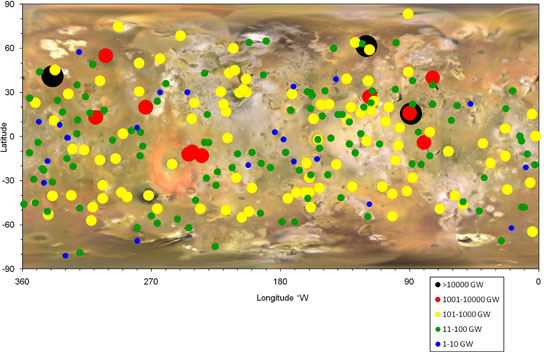
By examining data from NASA’s Voyager and Galileo missions and incorporating infrared data obtained from telescopes on Earth, astronomers discovered that the heat pouring out of Io’s hundreds of erupting volcanoes indicates a mixture of both deep and shallow heating.
A new study finds that the pattern of heat coming from volcanoes on Io’s surface disposes of the generally-accepted model of internal heating. The heat pouring out of Io’s hundreds of erupting volcanoes indicates a complex, multi-layer source. These results come from data collected by NASA spacecraft and ground-based telescopes and appear in the June issue of the journal Icarus.
A map of hot spots, classified by the amount of heat being emitted, shows the global distribution and wide range of volcanic activity on Io. Most of Io’s eruptions dwarf their contemporaries on Earth.
“This is the most comprehensive study of Io’s volcanic thermal emission to date,” said Glenn Veeder of the Bear Fight Institute, Winthrop, Wash., who led the work of a multi-faceted team that included Ashley Davies, Torrence Johnson, and Dennis Matson of NASA’s Jet Propulsion Laboratory, Pasadena, California, Jani Radebaugh of Brigham Young University, in Provo, Utah, and David Williams of Arizona State University, Tempe, Arizona. The team examined data primarily from NASA’s Voyager and Galileo missions, but also incorporated infrared data obtained from telescopes on Earth.
“The fascinating thing about the distribution of the heat flow is that it is not in keeping with the current preferred model of tidal heating of Io at relatively shallow depths,” said Davies. “Instead, the main thermal emission occurs about 40 degrees eastward of its expected positions.”
“The pattern that emerges points to a complex heating process within Io,” said Matson. “What we see indicates a mixture of both deep and shallow heating.”
A mystery has also emerged. The team found that active volcanoes accounted for only about 60 percent of Io’s heat. This component mostly emanates from flat-floored volcanic craters called paterae, a common feature on Io. But where is the “missing” 40 percent? “We are investigating the possibility that there are many smaller volcanoes that are hard, but not impossible, to detect,” said Veeder. “We are now puzzling over the observed pattern of heat flow.”
Understanding this will help identify the tidal heating mechanisms not only within Io, but also may apply to neighboring Europa, a high-priority target for NASA in its search for life beyond Earth.
Reference: “Io: Volcanic thermal sources and global heat flow” by Glenn J. Veeder, Ashley Gerard Davies, Dennis L. Matson, Torrence V. Johnson, David A. Williams and Jani Radebaugh, 13 April 2012, Icarus.
DOI: 10.1016/j.icarus.2012.04.004
The Galileo mission was managed by NASA’s Jet Propulsion Laboratory in Pasadena, California, for the agency’s Science Mission Directorate. The mission was launched by the space shuttle Atlantis in 1989 to Jupiter, produced numerous discoveries and provided scientists decades worth of data to analyze. Galileo was the first spacecraft to directly measure Jupiter’s atmosphere with a probe and conduct long-term observations of the Jovian system. NASA extended the mission three times to take advantage of Galileo’s unique science capabilities, and the spacecraft was put on a collision course into Jupiter’s atmosphere in September 2003 to eliminate any chance of impacting Europa.
JPL is a division of the California Institute of Technology in Pasadena.
Never miss a breakthrough: Join the SciTechDaily newsletter.
Follow us on Google and Google News.