
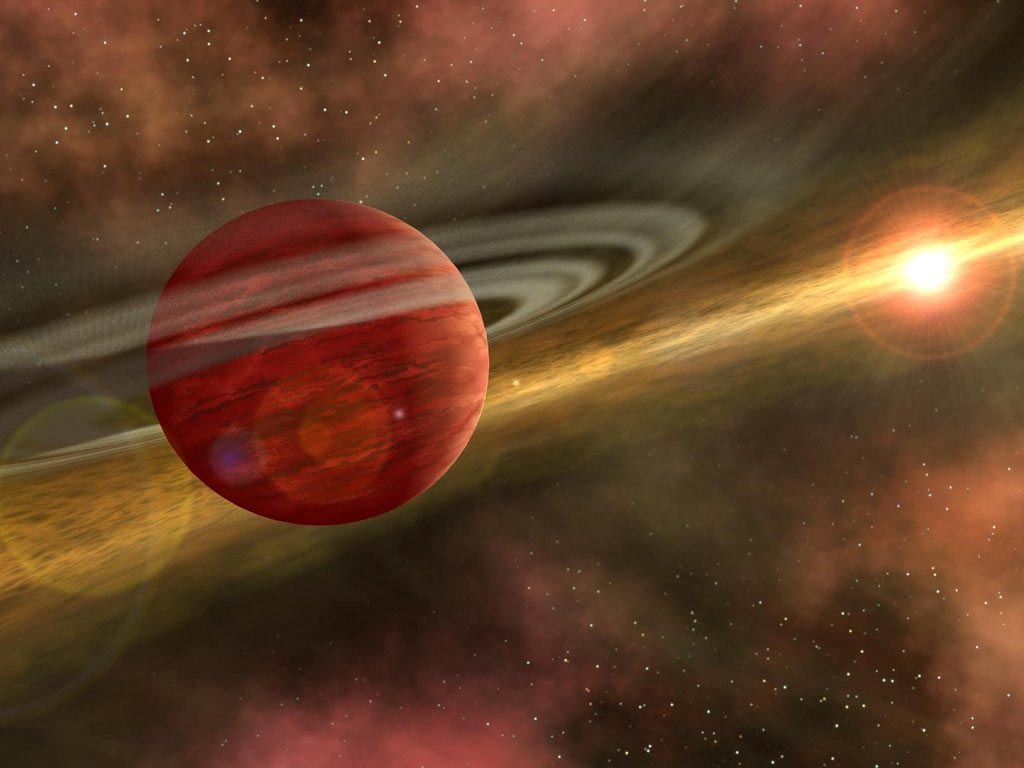
New research reveals that Jupiter-like planets quickly move to orbits close around their baby stars, helping astronomers better understand how planetary systems like our own solar system form and evolve into maturity.
Hot Jupiters, giant Jupiter-like exoplanets that orbit 20 times closer to their host stars than the Earth does to the Sun, can form and migrate towards their infant stars in as little as a few million years, researchers at the University of St Andrews have discovered.
An international research team, led by French astronomer Dr. Jean-François Donati, and including the University of St Andrews, has secured preliminary evidence that Jupiter-like planets, although probably formed far away, quickly move to orbits close around their baby stars.
Dr. Scott Gregory, STFC Ernest Rutherford Fellow in the School of Physics and Astronomy at St Andrews, and co-author of the study said: “These infant stars are the equivalent of one-week-old, if their expected 10-billion-year lifetime is scaled down to the span of a human life.”
In our solar system, rocky planets like Earth, or Mars, are found near the Sun whereas giant planets like Jupiter and Saturn orbit much further out.
In 1995 a giant planet was discovered sitting very close to its host star. Since then, astronomers have demonstrated that such planets must form in the outer regions of the protoplanetary disc – the matrix from which both the central star and surrounding planets are born – then migrate inwards and yet avoid falling into their host star.
This could happen either very early in their lives, when still embedded within their primordial disc, or much later, once multiple planets are formed and mutually interact in a rather unstable choreography – with some being pushed inwards at the immediate vicinity of their stars.
The research team has now discovered preliminary evidence that the first of these two scenarios is occurring.
Professor Moira Jardine, Professor of Astronomy at the University of St Andrews, and co-author, said: “Although more data are required for a definite validation, this first result is quite promising and clearly demonstrates that the technique our team has devised is powerful enough to solve the puzzling question of how hot Jupiters form, and end up close to their host stars.”
The discovery was observed through the Canada-France-Hawaii Telescope (CFHT) on Mauna Kea, a dormant volcano on the island of Hawaii. Looking at newly-born stars in the Taurus stellar nursery about 450 light-years away from us, the team showed that the latest baby star they scrutinized, nicknamed V830 Tau, exhibits signatures that closely resemble those caused by a 1.4 Jupiter mass planet orbiting 15 times closer to its host star than the Earth does to the Sun.
Although potentially very informative about planet formation, young stars are extremely challenging to observe.
To address this issue, the team initiated a survey aimed at mapping baby stars’ surfaces and looking for the potential presence of hot Jupiters, which, although first detected 20 years ago, are still enigmatic bodies.
In the case of V830 Tau, the authors had to accurately model the magnetic field and spots in order to clean out their polluting effect and discover the much weaker signal from the putative giant planet.
Reference: “Magnetic activity and hot Jupiters of young Suns: the weak-line T Tauri stars V819 Tau and V830 Tau” by JF Donati, E Hébrard, G Hussain, C Moutou, L Malo, K Grankin, AA Vidotto, SHP Alencar, SG Gregory, MM Jardine, G Herczeg, J Morin, R Fares, F Ménard, J Bouvier, X Delfosse, R Doyon, M Takami, P Figueira, P Petit, I Boisse and the MaTYSSE collaboration, 9 September 2015, Monthly Notices of the Royal Astronomical Society.
DOI: 10.1093/mnras/stv1837
Never miss a breakthrough: Join the SciTechDaily newsletter.
Follow us on Google and Google News.