
Close Menu
    Facebook X (Twitter) Instagram
    SciTechDaily
    • Biology
    • Chemistry
    • Earth
    • Health
    • Physics
    • Science
    • Space
    • Technology
    Facebook X (Twitter) Pinterest YouTube RSS
    SciTechDaily
    Home»Earth»NASA: 2021 Arctic Sea Ice Maximum Extent Ranks Seventh-Lowest on Record
    Earth

    NASA: 2021 Arctic Sea Ice Maximum Extent Ranks Seventh-Lowest on Record

    By Roberto Molar Candanosa, NASA’s Goddard Space Flight CenterJune 7, 2021No Comments2 Mins Read
    Facebook Twitter Pinterest Telegram LinkedIn WhatsApp Email Reddit
    Share
    Facebook Twitter LinkedIn Pinterest Telegram Email Reddit
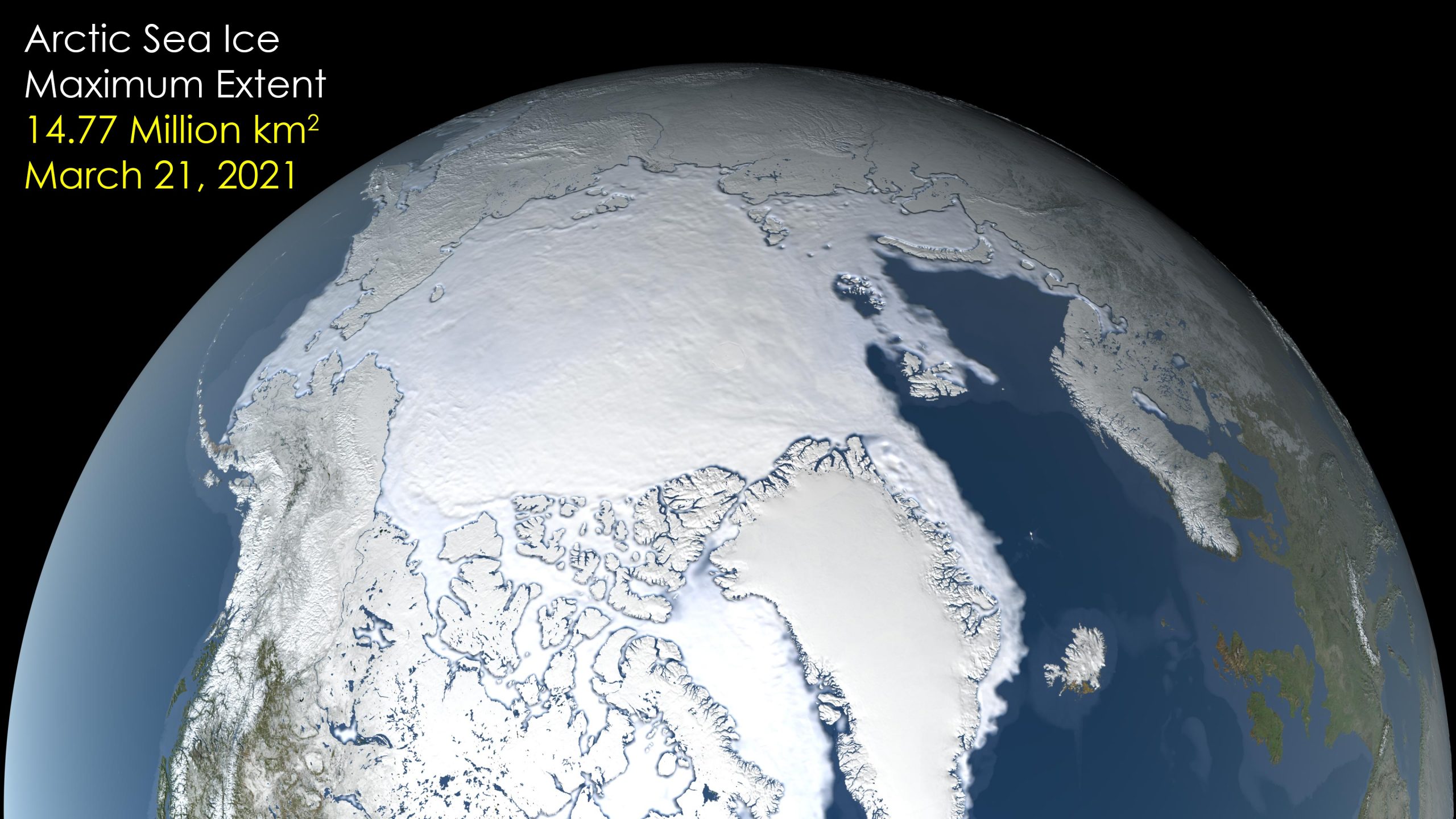
    Arctic Sea Ice Maximum Extent 2021
    After growing through the fall and winter, sea ice in the Arctic appears to have reached its annual maximum extent. The data visualization shows the ice extent – defined as the total area in which the ice concentration is at least 15% – at its 2021 maximum, which occurred on March 21. On this day the extent of the Arctic sea ice cover peaked at 14.77 million square kilometers (5.70 million square miles), making it the seventh-lowest on record, tied with 2007. Credit: NASA’s Scientific Visualization Studio

    In 2021, Arctic sea ice tied for the seventh-lowest winter maximum, missing an area larger than Texas and Florida combined.

    Sea ice in the Arctic appears to have hit its annual maximum extent after growing through the fall and winter. The 2021 wintertime extent reached on March 21 ties with 2007’s as the seventh-smallest extent of winter sea ice in the satellite record, according to scientists at the NASA-supported National Snow and Ice Data Center and NASA.

    This year’s maximum extent peaked at 5.70 million square miles (14.77 million square kilometers) and is 340,000 square miles (880,000 square kilometers) below the 1981 to 2010 average maximum – equivalent to missing an area of ice larger than the state of Texas and Florida combined.    

    This image, created at NASA’s Goddard Space Flight Center in Greenbelt, Maryland, was created using data provided by the Japan Aerospace Exploration Agency (JAXA), acquired by the Advanced Microwave Scanning Radiometer 2 (AMSR2) instrument aboard the Global Change Observation Mission 1st-Water “SHIZUKU” (GCOM-W1) satellite.


    On March 21, 2021, Arctic sea ice reached its maximum extent for winter 2020-2021, tying with 2007 for the seventh-lowest maximum on record.

    Never miss a breakthrough: Join the SciTechDaily newsletter.
    Follow us on Google and Google News.

    Arctic Climate Change Climate Science NASA NASA Goddard Space Flight Center
    Share. Facebook Twitter Pinterest LinkedIn Email Reddit

    Related Articles

    Arctic Ice Crumbles to Record Low at Winter’s Peak, NASA Warns

    Unraveling the Arctic’s Surprising Rain Surge

    NASA Finds 2022 Arctic Winter Sea Ice Maximum Extent 10th-Lowest on Record

    Scientists Tracked Arctic Animals’ Movement Patterns for Three Decades – This Is What They Found

    New ScienceCast Video: The Cloudy Future of Arctic Sea Ice

    NASA to Launch Spacecraft to Keep Track of Global Carbon Dioxide

    Arctic Melt Season Is Lengthening by Several Days Each Decade

    Increased Methane Gas Levels Found Over Cracks in Arctic Sea Ice

    NASA Study Reveals Multi-Year Ice Declining Faster than Perennial Ice that Surrounds It

    Leave A Reply Cancel Reply

    • Facebook
    • Twitter
    • Pinterest
    • YouTube

    Don't Miss a Discovery

    Subscribe for the Latest in Science & Tech!

    Trending News

    Your Blood Pressure Reading Could Be Wrong Because of One Simple Mistake

    Astronomers Stunned by Ancient Galaxy With No Spin

    Physicists May Be on the Verge of Discovering “New Physics” at CERN

    Scientists Solve 320-Million-Year Mystery of Reptile Skin Armor

    Scientists Say This Daily Walking Habit May Be the Secret to Keeping Weight Off After Dieting

    New Therapy Rewires the Brain To Restore Joy in Depression Patients

    Giant Squid Detected off Western Australia in Stunning Deep-Sea Discovery

    Popular Sugar-Free Sweetener Linked to Liver Disease, Study Warns

    Follow SciTechDaily
    • Facebook
    • Twitter
    • YouTube
    • Pinterest
    • Newsletter
    • RSS
    SciTech News
    • Biology News
    • Chemistry News
    • Earth News
    • Health News
    • Physics News
    • Science News
    • Space News
    • Technology News
    Recent Posts
    • Scientists Discover “Hidden” Materials That Could Transform Clean Energy and Batteries
    • Scientists Just Measured an Energy Pulse Smaller Than a Trillionth of a Billionth of a Joule
    • 540-Million-Year-Old Fossils Reveal a Huge Surprise About Early Life on Earth
    • Scientists Create “Living” Materials That Crawl, Walk, and Dig on Their Own
    • Dante’s Inferno May Secretly Be About a Planet-Destroying Asteroid Strike
    Copyright © 1998 - 2026 SciTechDaily. All Rights Reserved.
    • Science News
    • About
    • Contact
    • Editorial Board
    • Privacy Policy
    • Terms of Use

    Type above and press Enter to search. Press Esc to cancel.