
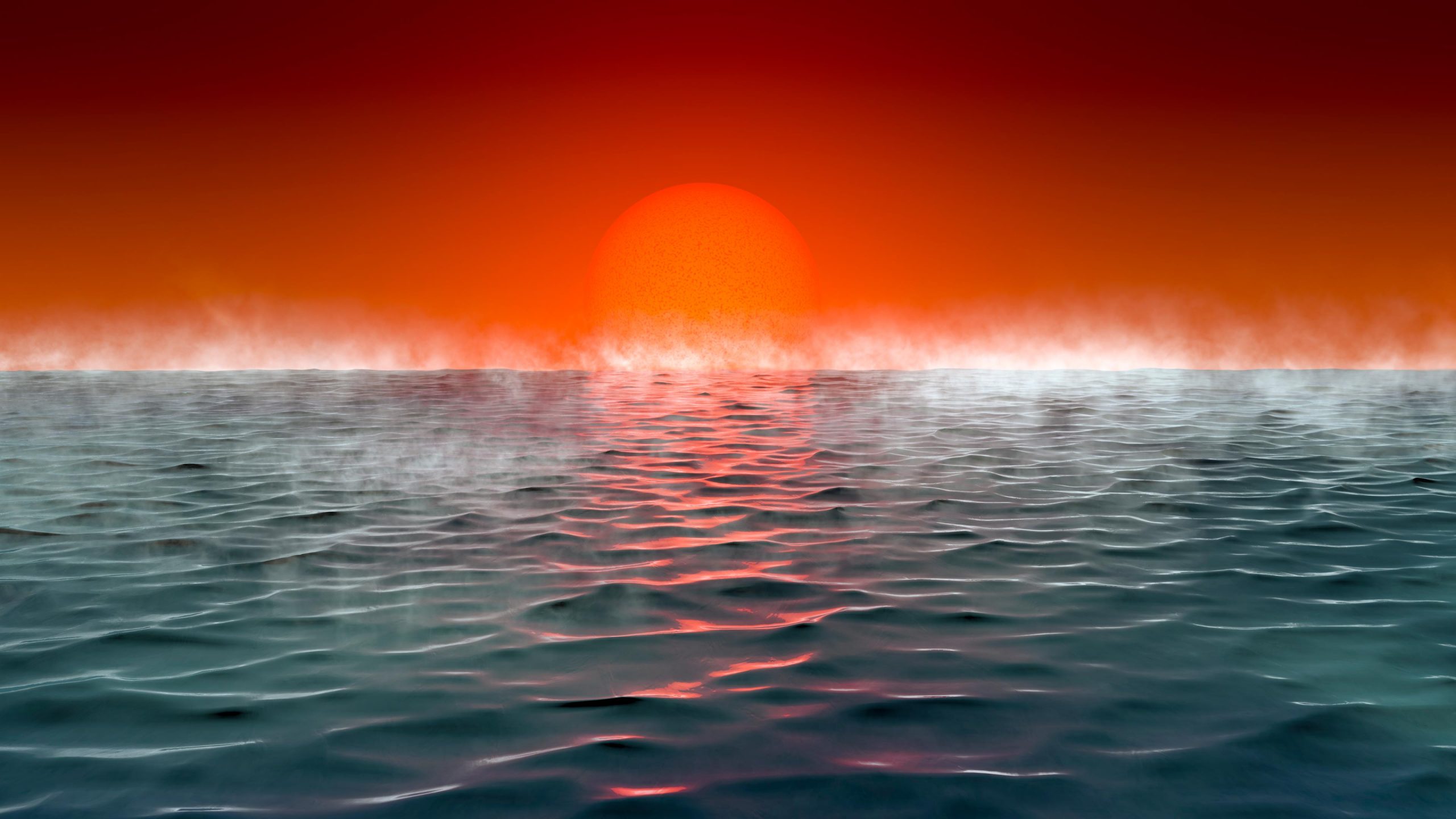
New “Hycean” planets may hold life and are easier to study than Earth-like worlds.
A new class of exoplanet very different to our own, but which could support life, has been identified by astronomers, which could greatly accelerate the search for life outside our Solar System.
In the search for life elsewhere, astronomers have mostly looked for planets of a similar size, mass, temperature, and atmospheric composition to Earth. However, astronomers from the University of Cambridge believe there are more promising possibilities out there.
The researchers have identified a new class of habitable planets, dubbed ‘Hycean’ planets – hot, ocean-covered planets with hydrogen-rich atmospheres – which are more numerous and observable than Earth-like planets.
The researchers say the results, reported in The Astrophysical Journal, could mean that finding biosignatures of life outside our Solar System within the next two or three years is a real possibility.
“Hycean planets open a whole new avenue in our search for life elsewhere,” said Dr. Nikku Madhusudhan from Cambridge’s Institute of Astronomy, who led the research.
Expanding the Goldilocks Zone
Many of the prime Hycean candidates identified by the researchers are bigger and hotter than Earth, but still have the characteristics to host large oceans that could support microbial life similar to that found in some of Earth’s most extreme aquatic environments.
These planets also allow for a far wider habitable zone, or ‘Goldilocks zone’, compared to Earth-like planets. This means that they could still support life even though they lie outside the range where a planet similar to Earth would need to be in order to be habitable.
Thousands of planets outside our Solar System have been discovered since the first exoplanet was identified nearly 30 years ago. The vast majority are planets between the sizes of Earth and Neptune and are often referred to as ‘super-Earths’ or ‘mini-Neptunes’: they can be predominantly rocky or ice giants with hydrogen-rich atmospheres, or something in between.
Most mini-Neptunes are over 1.6 times the size of Earth: smaller than Neptune but too big to have rocky interiors like Earth. Earlier studies of such planets have found that the pressure and temperature beneath their hydrogen-rich atmospheres would be too high to support life.
However, a recent study on the mini-Neptune K2-18b by Madhusudhan’s team found that in certain conditions these planets could support life. The result led to a detailed investigation into the full range of planetary and stellar properties for which these conditions are possible, which known exoplanets may satisfy those conditions, and whether their biosignatures may be observable.
Hycean Planet
The investigation led the researchers to identify a new class of planets, Hycean planets, with massive planet-wide oceans beneath hydrogen-rich atmospheres. Hycean planets can be up to 2.6 times larger than Earth and have atmospheric temperatures up to nearly 200 degrees Celsius, but their oceanic conditions could be similar to those conducive for microbial life in Earth’s oceans. Such planets also include tidally locked ‘dark’ Hycean worlds that may have habitable conditions only on their permanent night sides, and ‘cold’ Hycean worlds that receive little radiation from their stars.
Planets of this size dominate the known exoplanet population, although they have not been studied in nearly as much detail as super-Earths. Hycean worlds are likely quite common, meaning that the most promising places to look for life elsewhere in the Galaxy may have been hiding in plain sight.
However, size alone is not enough to confirm whether a planet is Hycean: other aspects such as mass, temperature, and atmospheric properties are required for confirmation.
Biosignatures Beyond Earth Analogs
When trying to determine what the conditions are like on a planet many light-years away, astronomers first need to determine whether the planet lies in the habitable zone of its star, and then look for molecular signatures to infer the planet’s atmospheric and internal structure, which govern the surface conditions, presence of oceans and potential for life.
Astronomers also look for certain biosignatures which could indicate the possibility of life. Most often, these are oxygen, ozone, methane, and nitrous oxide, which are all present on Earth. There are also a number of other biomarkers, such as methyl chloride and dimethyl sulfide, that are less abundant on Earth but can be promising indicators of life on planets with hydrogen-rich atmospheres where oxygen or ozone may not be as abundant.
“Essentially, when we’ve been looking for these various molecular signatures, we have been focusing on planets similar to Earth, which is a reasonable place to start,” said Madhusudhan. “But we think Hycean planets offer a better chance of finding several trace biosignatures.”
“It’s exciting that habitable conditions could exist on planets so different from Earth,” said co-author Anjali Piette, also from Cambridge.
A Better Target for Biosignature Detection
Madhusudhan and his team found that a number of trace terrestrial biomarkers expected to be present in Hycean atmospheres would be readily detectable with spectroscopic observations in the near future. The larger sizes, higher temperatures, and hydrogen-rich atmospheres of Hycean planets make their atmospheric signatures much more detectable than Earth-like planets.
The Cambridge team identified a sizeable sample of potential Hycean worlds which are prime candidates for detailed study with next-generation telescopes, such as the James Webb Space Telescope (JWST), which is due to be launched later this year. These planets all orbit red dwarf stars between 35-150 light-years away: close by astronomical standards. Planned JWST observations of the most promising candidate, K2-18b, could lead to the detection of one or more biosignature molecules.
“A biosignature detection would transform our understanding of life in the universe,” said Madhusudhan. “We need to be open about where we expect to find life and what form that life could take, as nature continues to surprise us in often unimaginable ways.”
Reference: “Habitability and Biosignatures of Hycean Worlds” by Nikku Madhusudhan, Anjali A. A. Piette and Savvas Constantinou, 25 August 2021, The Astrophysical Journal.
DOI: 10.3847/1538-4357/abfd9c
Never miss a breakthrough: Join the SciTechDaily newsletter.
Follow us on Google and Google News.
2 Comments
One question: What’s the origin of the term “Hycean?”
Wikipedia says, “’Hycean planet’ was coined in 2021 by a team of exoplanet researchers at the University of Cambridge, as a portmanteau of “hydrogen” and “ocean”, used to describe planets that are thought to have large oceans and hydrogen-rich atmospheres.”
You’re right, the story should have explained that.