
Close Menu
    Facebook X (Twitter) Instagram
    SciTechDaily
    • Biology
    • Chemistry
    • Earth
    • Health
    • Physics
    • Science
    • Space
    • Technology
    Facebook X (Twitter) Pinterest YouTube RSS
    SciTechDaily
    Home»Technology»Innovative Technology for Building Ultralow-Loss Integrated Photonic Circuits
    Technology

    Innovative Technology for Building Ultralow-Loss Integrated Photonic Circuits

    By EPFLApril 16, 2021No Comments3 Mins Read
    Facebook Twitter Pinterest Telegram LinkedIn WhatsApp Email Reddit
    Share
    Facebook Twitter LinkedIn Pinterest Telegram Email Reddit
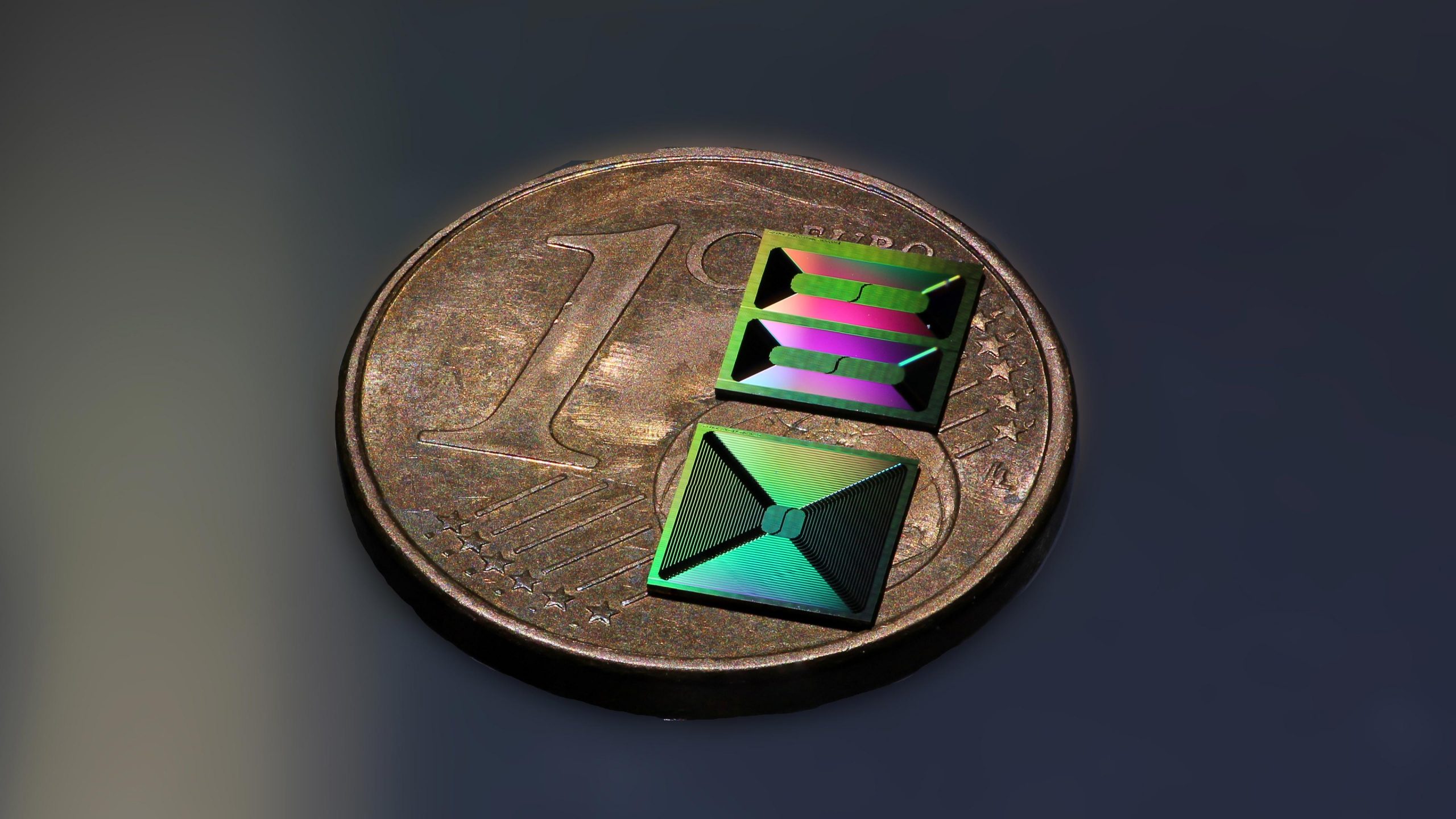
    Integrated Silicon Nitride Photonic Chips
    Integrated silicon nitride photonic chips with meter-long spiral waveguides. Credit: Jijun He, Junqiu Liu (EPFL)

    A new silicon nitride chip from EPFL achieves record-low optical loss, enhancing performance in photonic devices like microcombs and LiDAR.

    Encoding information into light, and transmitting it through optical fibers lies at the core of optical communications. With an incredibly low loss of 0.2 dB/km, optical fibers made from silica have laid the foundations of today’s global telecommunication networks and our information society.

    Such ultralow optical loss is equally essential for integrated photonics, which enables the synthesis, processing, and detection of optical signals using on-chip waveguides. Today, a number of innovative technologies are based on integrated photonics, including semiconductor lasers, modulators, and photodetectors, and are used extensively in data centers, communications, sensing, and computing.

    Integrated photonic chips are usually made from silicon that is abundant and has good optical properties. But silicon can’t do everything we need in integrated photonics, so new material platforms have emerged. One of these is silicon nitride (Si3N4), whose exceptionally low optical loss (orders of magnitude lower than that of silicon), has made it the material of choice for applications for which low loss is critical, such as narrow-linewidth lasers, photonic delay lines, and nonlinear photonics.

    A Breakthrough in Low-Loss Photonic Circuits

    Now, scientists in the group of Professor Tobias J. Kippenberg at EPFL’s School of Basic Sciences have developed a new technology for building silicon nitride integrated photonic circuits with record low optical losses and small footprints. The work is published in Nature Communications.

    Combining nanofabrication and material science, the technology is based on the photonic Damascene process developed at EPFL. Using this process, the team made integrated circuits of optical losses of only 1 dB/m, a record value for any nonlinear integrated photonic material. Such low loss significantly reduces the power budget for building chip-scale optical frequency combs (“microcombs”), used in applications like coherent optical transceivers, low-noise microwave synthesizers, LiDAR, neuromorphic computing, and even optical atomic clocks. The team used the new technology to develop meter-long waveguides on 5×5 mm2 chips and high-quality-factor microresonators. They also report high fabrication yield, which is essential for scaling up to industrial production.

    “These chip devices have already been used for parametric optical amplifiers, narrow-linewidth lasers, and chip-scale frequency combs,” says Dr. Junqiu Liu who led the fabrication at EPFL’s Center of MicroNanoTechnology (CMi). “We are also looking forward to seeing our technology being used for emerging applications such as coherent LiDAR, photonic neural networks, and quantum computing.”

    Reference: “High-yield, wafer-scale fabrication of ultralow-loss, dispersion-engineered silicon nitride photonic circuits” by Junqiu Liu, Guanhao Huang, Rui Ning Wang, Jijun He, Arslan S. Raja, Tianyi Liu, Nils J. Engelsen and Tobias J. Kippenberg, 16 April 2021, Nature Communications.
    DOI: 10.1038/s41467-021-21973-z

    Never miss a breakthrough: Join the SciTechDaily newsletter.
    Follow us on Google and Google News.

    Electrical Engineering Electromagnetics EPFL Nanotechnology Photonics Telecommunications
    Share. Facebook Twitter Pinterest LinkedIn Email Reddit

    Related Articles

    Photorealistic Painting With Light: Nanopillars Precisely Control the Color and Intensity of Transmitted Light

    Using Air to Amplify Light in Hollow-Core Optical Fibers

    Scaling Up the Quantum Chip: MIT Engineers Connect Photonics With “Artificial Atoms”

    Light, Fantastic: The Path Ahead for Faster, Nanoscale Photonic Computer Processors

    U.S. Navy Researchers Create Electronic Diodes Beyond 5G Performance

    Temporal Supersymmetry Breakthrough Paves Way to Omnidirectional Invisible Materials

    Breaking the Size and Speed Limit of Modulators for Next Generation Internet and Communication Networks

    Revolutionary Light-Emitting Silicon – “Holy Grail” Breakthrough After 50 Years of Work

    Nanoscale Device Generates High-Power THz Waves That Can See Through Walls

    Leave A Reply Cancel Reply

    • Facebook
    • Twitter
    • Pinterest
    • YouTube

    Don't Miss a Discovery

    Subscribe for the Latest in Science & Tech!

    Trending News

    Scientists Discover How Coffee Impacts Memory, Mood, and Gut Health

    Why Did the Neanderthals Disappear? Scientists Reveal Humans Had a Hidden Advantage

    Physicists Propose Strange Experiment Where Time Goes Quantum

    Magnesium Magic: New Drug Melts Fat Even on a High-Fat, High-Sugar Diet

    Weight-Loss Drugs Like Ozempic May Come With an Unexpected Cost

    Mezcal “Worm” in a Bottle Mystery: DNA Testing Reveals a Surprise

    New Research Reveals That Your Morning Coffee Activates an Ancient Longevity Switch

    This Is What Makes You Irresistible to Mosquitoes

    Follow SciTechDaily
    • Facebook
    • Twitter
    • YouTube
    • Pinterest
    • Newsletter
    • RSS
    SciTech News
    • Biology News
    • Chemistry News
    • Earth News
    • Health News
    • Physics News
    • Science News
    • Space News
    • Technology News
    Recent Posts
    • Harvard Scientists Reveal Secret Structure Behind How You Smell
    • Scientists Just Discovered the Hidden Trick That Keeps Your Cells Alive
    • This Simple Movement Could Be Secretly Cleaning Your Brain
    • Male Birth Control Breakthrough: Scientists Find Way To Turn Sperm Production Off and Back On
    • A Common Vitamin Could Hold the Key to Treating Fatty Liver Disease
    Copyright © 1998 - 2026 SciTechDaily. All Rights Reserved.
    • Science News
    • About
    • Contact
    • Editorial Board
    • Privacy Policy
    • Terms of Use

    Type above and press Enter to search. Press Esc to cancel.