
Close Menu
    Facebook X (Twitter) Instagram
    SciTechDaily
    • Biology
    • Chemistry
    • Earth
    • Health
    • Physics
    • Science
    • Space
    • Technology
    Facebook X (Twitter) Pinterest YouTube RSS
    SciTechDaily
    Home»Space»NASA’s Lucy Spacecraft Stretches Its Wings in Successful Solar Panel Deployment Test
    Space

    NASA’s Lucy Spacecraft Stretches Its Wings in Successful Solar Panel Deployment Test

    By Katherine Kretke, Southwest Research InstituteApril 10, 20211 Comment4 Mins Read
    Facebook Twitter Pinterest Telegram LinkedIn WhatsApp Email Reddit
    Share
    Facebook Twitter LinkedIn Pinterest Telegram Email Reddit
    Lucy Solar Panel Deployment Tests
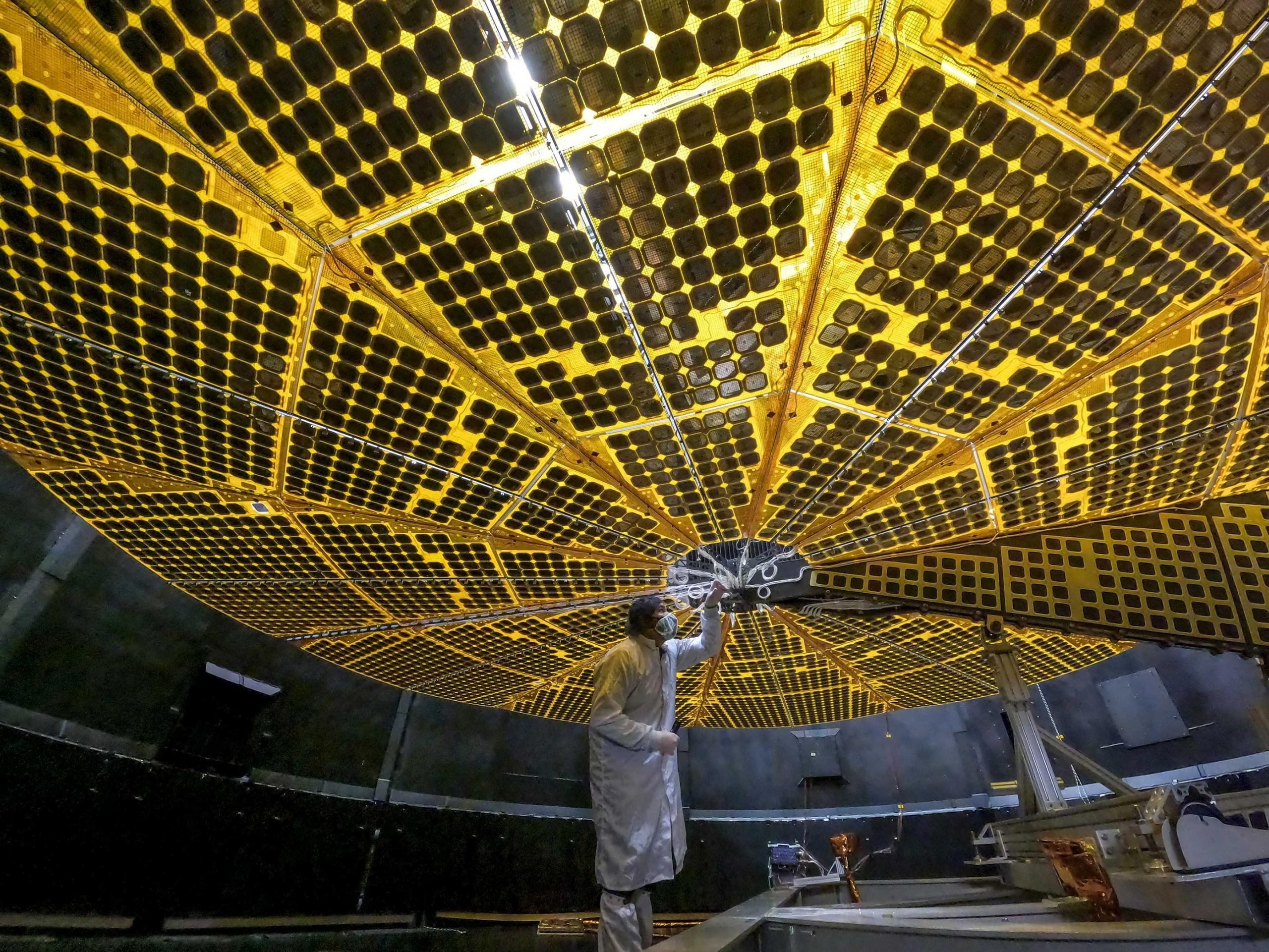
    At 24 feet (7.3 meters) across each, Lucy’s two solar panels underwent initial deployment tests in January 2021. In this photo, a technician at Lockheed Martin Space in Denver, Colorado, inspects one of Lucy’s arrays during its first deployment. These massive solar arrays will power the Lucy spacecraft throughout its entire 4-billion-mile, 12-year journey through space as it heads out to explore Jupiter’s elusive Trojan asteroids. Credit: Lockheed Martin

    NASA’s Lucy spacecraft successfully completes final solar panel tests, readying for its groundbreaking mission to Jupiter’s Trojans.

    NASA’s Lucy spacecraft has successfully completed thermal vacuum testing of both solar panels, the final step in checking out these critical spacecraft components in preparation for launch this fall. Once the Lucy spacecraft’s solar panels are attached and fully extended, they could cover a five-story building.

    Lucy, the 13th mission in NASA’s Discovery Program, requires these large solar panels as it will operate farther from the Sun than any previous solar-powered space mission. During its 12-year tour of the Trojan asteroids, the Lucy spacecraft will operate a record-breaking 530 million miles (853 million km) from the Sun, beyond the orbit of Jupiter.

    Lucy Spacecraft Solar Arrays
    Seen here partially unfurled, the Lucy spacecraft’s massive solar arrays completed their first deployment tests in January 2021 inside the thermal vacuum chamber at Lockheed Martin Space in Denver, Colorado. To ensure no extra strain was placed on the solar arrays during testing in Earth’s gravity environment, the team designed a special mesh wire harness to support the arrays during deployment. Credit: Lockheed Martin

    “The success of Lucy’s final solar array deployment test marked the end of a long road of development. With dedication and excellent attention to detail, the team overcame every obstacle to ready these solar panels,” said Matt Cox, Lockheed Martin’s Lucy program manager, in Littleton, Colorado. “Lucy will travel farther from the Sun than any previous solar-powered Discovery-class mission, and one reason we can do that is the technology in these solar arrays.”

    The solar arrays, manufactured by Northrop Grumman in Goleta, California, will be supplying power to the spacecraft and its instruments throughout the 12-year mission. The solar panels need to supply around 500 watts, about equivalent to the energy needed to run a washing machine. Despite this relatively modest need, the solar panels must be large as they need to operate so far from the Sun.

    “At about one hour after the spacecraft launches, the solar panels will need to deploy flawlessly in order to assure that we have enough energy to power the spacecraft throughout the mission,” said Principal Investigator Hal Levison of the Southwest Institute in Boulder, Colorado. “These 20 minutes will determine if the rest of the 12-year mission will be a success. Mars landers have their seven minutes of terror, we have this.”

    Precision Engineering Behind Lucy’s Solar Arrays

    Solar array deployment tests occurred between December 2020 and February 2021 in the 29-foot-by-65-foot (8.8-meter-by-19.8-meter) thermal vacuum chamber at Lockheed Martin Space, where the spacecraft is currently undergoing assembly, launch, and testing operations.

    Though when folded up the solar panels are a mere 4 inches (10 cm) thick, once expanded each solar panel has a diameter of nearly 24 feet (7.3 meters). What is more, the solar arrays can’t support their own weight of 170 pounds (77kg) each in Earth gravity, so a special precision weight offload device is employed inside the chamber for additional support.  

    “In spite of their complexity and size, the mechanical deployment of the arrays executed flawlessly, said Donya Douglas-Bradshaw, Lucy project manager from NASA’s Goddard Space Flight Center in Greenbelt, Maryland. “The ingenuity and innovation of the team is truly remarkable!”

    These key tests bring the spacecraft one step closer to launch readiness. The Lucy spacecraft will be shipped to NASA’s Kennedy Space Center in Florida this summer to ready it for launch when its window opens in the pre-dawn hours of October 16, 2021.  

    Southwest Research Institute’s Hal Levison and Cathy Olkin are the principal investigator and deputy principal investigator of the Lucy mission. Goddard provides overall mission management, systems engineering and safety and mission assurance. Lockheed Martin Space is building the spacecraft. Lucy is the 13th  mission in NASA’s Discovery Program. NASA’s Marshall Space Flight Center in Huntsville, Alabama, manages the Discovery Program for the agency’s Science Mission Directorate in Washington, D.C.

    Never miss a breakthrough: Join the SciTechDaily newsletter.
    Follow us on Google and Google News.

    Lucy Mission NASA NASA Goddard Space Flight Center Southwest Research Institute
    Share. Facebook Twitter Pinterest LinkedIn Email Reddit

    Related Articles

    NASA’s Lucy Captures Ice Cream Cone–Shaped Asteroid That Defies Expectations

    Introducing “Dinkinesh” – First Asteroid Target for NASA’s Lucy Mission Gets a Name

    NASA’s Record-Breaking Lucy Spacecraft Has a New Asteroid Target

    Never Tell Me the Odds: NASA’s Lucy To Fly Past Thousands of Objects for Earth Gravity Assist

    NASA’s Lucy Spacecraft About To Sling-Shot Past Earth

    Moon Discovered Around Asteroid Polymele by NASA’s Lucy Team

    NASA’s Lucy Trojan Asteroid Mission Invites You to Build Your Own Time Capsule

    NASA Lucy Mission’s Message – Not for Unknown Aliens – But for the Future

    The Fascinating Story of How the Trojan Asteroids – Target of NASA’s Lucy Mission – Were Discovered and Named

    1 Comment

    1. Jeffrey on April 11, 2021 3:49 pm

      You mean Lucifers spacecraft. Give me a break. Those awake know what Lucy means…

      Reply
    Leave A Reply Cancel Reply

    • Facebook
    • Twitter
    • Pinterest
    • YouTube

    Don't Miss a Discovery

    Subscribe for the Latest in Science & Tech!

    Trending News

    Popular Sugar-Free Sweetener Linked to Liver Disease, Study Warns

    What Is Hantavirus? The Deadly Disease Raising Alarm Worldwide

    Scientists Just Discovered How the Universe Builds Monster Black Holes

    Scientists Unveil New Treatment Strategy That Could Outsmart Cancer

    A Simple Vitamin May Hold the Key to Treating Rare Genetic Diseases

    Scientists Think the Real Fountain of Youth May Be Hiding in Your Gut

    Ravens Don’t Follow Wolves, They Predict Them

    This Common Knee Surgery May Be Doing More Harm Than Good

    Follow SciTechDaily
    • Facebook
    • Twitter
    • YouTube
    • Pinterest
    • Newsletter
    • RSS
    SciTech News
    • Biology News
    • Chemistry News
    • Earth News
    • Health News
    • Physics News
    • Science News
    • Space News
    • Technology News
    Recent Posts
    • This Dazzling Green Snake Was Hiding in Plain Sight for Decades
    • Scientists Discover That a Single Dose of Psilocybin Changes the Human Brain
    • “Totally Unexpected” – Scientists Discover Pancreatic Cancer’s Fatal Addiction
    • A Strange Quantum Effect May Explain One of Biology’s Greatest Mysteries
    • NASA’s Psyche Spacecraft Is About To Fly Shockingly Close to Mars
    Copyright © 1998 - 2026 SciTechDaily. All Rights Reserved.
    • Science News
    • About
    • Contact
    • Editorial Board
    • Privacy Policy
    • Terms of Use

    Type above and press Enter to search. Press Esc to cancel.