
Astrophysicists Explain the Origin of Unusually Heavy Neutron Star Binaries
Simulations of supernova explosions of massive stars paired with neutron stars can explain puzzling results from gravitational wave observatories.
A new study showing how the explosion of a stripped massive star in a supernova can lead to the formation of a heavy neutron star or a light black hole resolves one of the most challenging puzzles to emerge from the detection of neutron star mergers by the gravitational wave observatories LIGO and Virgo.
The first detection of gravitational waves by the Advanced Laser Interferometer Gravitational-Wave Observatory (LIGO) in 2017 was a neutron star merger that mostly conformed to the expectations of astrophysicists. But the second detection, in 2019, was a merger of two neutron stars whose combined mass was unexpectedly large.
“It was so shocking that we had to start thinking about how to create a heavy neutron star without making it a pulsar,” said Enrico Ramirez-Ruiz, professor of astronomy and astrophysics at UC Santa Cruz.
Compact astrophysical objects like neutron stars and black holes are challenging to study because when they are stable they tend to be invisible, emitting no detectable radiation. “That means we are biased in what we can observe,” Ramirez-Ruiz explained. “We have detected neutron star binaries in our galaxy when one of them is a pulsar, and the masses of those pulsars are almost all identical—we don’t see any heavy neutron stars.”
LIGO’s detection of a heavy neutron star merger at a rate similar to the lighter binary system implies that heavy neutron star pairs should be relatively common. So why don’t they show up in the pulsar population?
In the new study, Ramirez-Ruiz and his colleagues focused on the supernovae of stripped stars in binary systems that can form “double compact objects” consisting of either two neutron stars or a neutron star and a black hole. A stripped star, also called a helium star, is a star that has had its hydrogen envelope removed by its interactions with a companion star.
The study, published on October 8, 2021, in Astrophysical Journal Letters, was led by Alejandro Vigna-Gomez, an astrophysicist at the University of Copenhagen’s Niels Bohr Institute, where Ramirez-Ruiz holds a Niels Bohr Professorship.
“We used detailed stellar models to follow the evolution of a stripped star until the moment it explodes in a supernova,” Vigna-Gomez said. “Once we reach the time of the supernova, we do a hydrodynamical study, where we are interested in following the evolution of the exploding gas.”
Supernova Energy Determines the Remnant
The stripped star, in a binary system with a neutron star companion, starts out ten times more massive than our sun, but so dense it is smaller than the sun in diameter. The final stage in its evolution is a core-collapse supernova, which leaves behind either a neutron star or a black hole, depending on the final mass of the core.
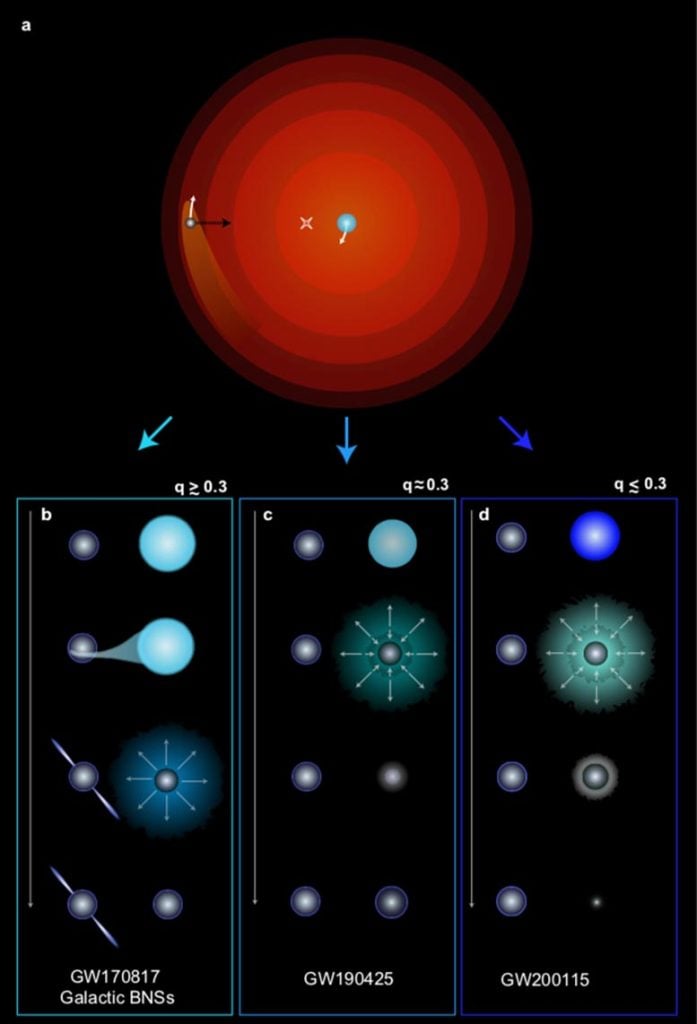
The team’s results showed that when the massive stripped star explodes, some of its outer layers are rapidly ejected from the binary system. Some of the inner layers, however, are not ejected and eventually fall back onto the newly formed compact object.
“The amount of material accreted depends on the explosion energy—the higher the energy, the less mass you can keep,” Vigna-Gomez said. “For our ten-solar-mass stripped star, if the explosion energy is low, it will form a black hole; if the energy is large, it will keep less mass and form a neutron star.”
These results not only explain the formation of heavy neutron star binary systems, such as the one revealed by the gravitational wave event GW190425, but also predict the formation of neutron star and light black hole binaries, such as the one that merged in the 2020 gravitational wave event GW200115.
Helium Core Mass and Pulsar Formation
Another important finding is that the mass of the helium core of the stripped star is essential in determining the nature of its interactions with its neutron star companion and the ultimate fate of the binary system. A sufficiently massive helium star can avoid transferring mass onto the neutron star. With a less massive helium star, however, the mass transfer process can transform the neutron star into a rapidly spinning pulsar.
“When the helium core is small, it expands, and then mass transfer spins up the neutron star to create a pulsar,” Ramirez-Ruiz explained. “Massive helium cores, however, are more gravitationally bound and don’t expand, so there is no mass transfer. And if they don’t spin up into a pulsar, we don’t see them.”
In other words, there may well be a large undetected population of heavy neutron star binaries in our galaxy.
“Transferring mass onto a neutron star is an effective mechanism to create rapidly spinning (millisecond) pulsars,” Vigna-Gomez said. “Avoiding this mass transfer episode as we suggest hints that there is a radio-quiet population of such systems in the Milky Way.”
Reference: “Fallback Supernova Assembly of Heavy Binary Neutron Stars and Light Black Hole–Neutron Star Pairs and the Common Stellar Ancestry of GW190425 and GW200115” by Alejandro Vigna-Gómez, Sophie L. Schrøder, Enrico Ramirez-Ruiz, David R. Aguilera-Dena, Aldo Batta, Norbert Langer and Reinhold Willcox, 8 October 2021, The Astrophysical Journal Letters.
DOI: 10.3847/2041-8213/ac2903
In addition to Vigna-Gomez and Ramirez-Ruiz, the coauthors of the paper include Sophie Schroder at the Niels Bohr Institute; David Aguilera-Dena at the University of Crete; Aldo Batta at the National Institute of Astrophysics in Mexico; Norbert Langer at the University of Bonn, Germany; and Reinhold Willcox at Monash University, Australia. This work was supported by the Heising-Simons Foundation, the Danish National Research Foundation, and the U.S. National Science Foundation.
Never miss a breakthrough: Join the SciTechDaily newsletter.
Follow us on Google and Google News.
1 Comment
The space-time is also a dependent factor for evolution of pulsar at particular position in the background of surrounding stars group.