
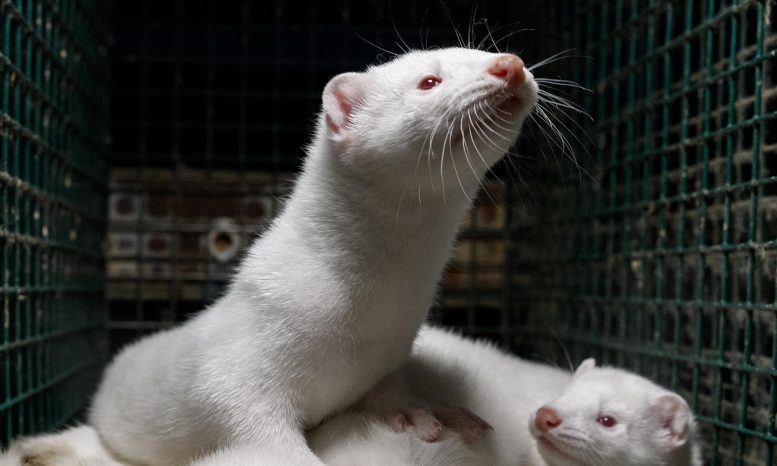
Carnivorous animals lack key genes needed to detect and respond to infection by pathogens, a study has found.
Farming large numbers of carnivores, like mink, could allow the formation of undetected ‘disease reservoirs,’ in which a pathogen could spread to many animals and mutate to become a risk to human health.
Research led by the University of Cambridge has discovered that carnivores have a defective immune system, which makes them likely to be asymptomatic carriers of disease-causing pathogens.
“We’ve found that a whole cohort of inflammatory genes is missing in carnivores.” Clare Bryant
Three key genes in carnivores that are critical for gut health were found to have lost their function. If these genes were working, they would produce protein complexes called inflammasomes to activate inflammatory responses and fight off pathogens. The study was published recently in the journal Cell Reports.
The researchers say that the carnivorous diet, which is high in protein, is thought to have antimicrobial properties that could compensate for the loss of these immune pathways in carnivores – any gut infection is expelled by the production of diarrhea. But the immune deficiency means that other pathogens can reside undetected elsewhere in these animals.
“We’ve found that a whole cohort of inflammatory genes is missing in carnivores — we didn’t expect this at all,” said Professor Clare Bryant in the University of Cambridge’s Department of Veterinary Medicine, senior author of the paper.
She added: “We think that the lack of these functioning genes contributes to the ability of pathogens to hide undetected in carnivores, to potentially mutate and be transmitted becoming a human health risk.”
Zoonotic pathogens are those that live in animal hosts before jumping to infect humans. The COVID-19 pandemic, thought to originate in a wild animal, has shown the enormous damage that can be wrought by a novel human disease. Carnivores include mink, dogs, and cats, and are the biggest carriers of zoonotic pathogens.
Genes Turned to Pseudogenes and Mutated Caspases
Three genes appear to be in the process of being lost entirely in carnivores: the DNA is still present but it is not expressed, meaning they have become ‘pseudogenes’ and are not functioning. A third gene important for gut health has developed a unique mutation, causing two proteins called caspases to be fused together to change their function so they can no longer respond to some pathogens in the animal’s body.
“When you have a large population of farmed carnivorous animals, like mink, they can harbor a pathogen — like SARS-CoV-2 and others — and it can mutate because the immune system of the mink isn’t being activated. This could potentially spread into humans,” said Bryant.
The researchers say that the results are not a reason to be concerned about COVID-19 being spread by dogs and cats. There is no evidence that these domestic pets carry or transmit COVID-19. It is when large numbers of carnivores are kept together in close proximity that a large reservoir of the pathogen can build up amongst them, and potentially mutate.
Reference: “Evolutionary loss of inflammasomes in the Carnivora and implications for the carriage of zoonotic infections” by Zsofia Digby, Panagiotis Tourlomousis, James Rooney, Joseph P. Boyle, Betsaida Bibo-Verdugo, Robert J. Pickering, Steven J. Webster, Thomas P. Monie, Lee J. Hopkins, Nobuhiko Kayagaki, Guy S. Salvesen, Soren Warming, Lucy Weinert and Clare E. Bryant, 24 August 2021, Cell Reports.
DOI: 10.1016/j.celrep.2021.109614
This research was funded by Wellcome.
Never miss a breakthrough: Join the SciTechDaily newsletter.
Follow us on Google and Google News.
5 Comments
“There is no evidence that these domestic pets carry or transmit COVID-19. … It is when large numbers of carnivores are kept together in close proximity that a large reservoir of the pathogen can build up amongst them, and potentially mutate.”
Until fairly recently, it was common to keep packs of hunting dogs, and encourage large numbers of cats around farms, and yet there is little evidence that these domesticated predators have been problematic throughout history. Perhaps these researchers have missed something?
The Pope was wrong when he ordered all black cats killed to stop the plague, but by some sick twist of fate, they’re now the preferred vehicle to bring disease home. A woman in WY got the plague last month from her cat, probably after it played with something in the wild.
Inasmuch as the disease is actually carried by fleas, just walking in an area with abundant rodents can be dangerous. I remember once being in Lava Beds National Monument and seeing signs warning not to enter the lava tubes because the ground squirrels were infected.
If cats keep the deer mouse population down and out of the house, then they are providing a net-positive service, despite being some risk to their owners. It would be prudent to put a flea collar on the cat.
Dogs are omnivores
I believe when large numbers of humans are kept in close proximity the same diseases or infections can occurr. This article really should be called “Humanotic” given that humans can transmit more pathogens then all the animals combined. We truly are Parasites.