
Close Menu
    Facebook X (Twitter) Instagram
    SciTechDaily
    • Biology
    • Chemistry
    • Earth
    • Health
    • Physics
    • Science
    • Space
    • Technology
    Facebook X (Twitter) Pinterest YouTube RSS
    SciTechDaily
    Home»Space»This Tiny World in the Outer Solar System Should Be Airless, but It Has an Atmosphere
    Space

    This Tiny World in the Outer Solar System Should Be Airless, but It Has an Atmosphere

    By National Institutes of Natural SciencesMay 7, 2026No Comments3 Mins Read
    Facebook Twitter Pinterest Telegram LinkedIn WhatsApp Email Reddit
    Share
    Facebook Twitter LinkedIn Pinterest Telegram Email Reddit
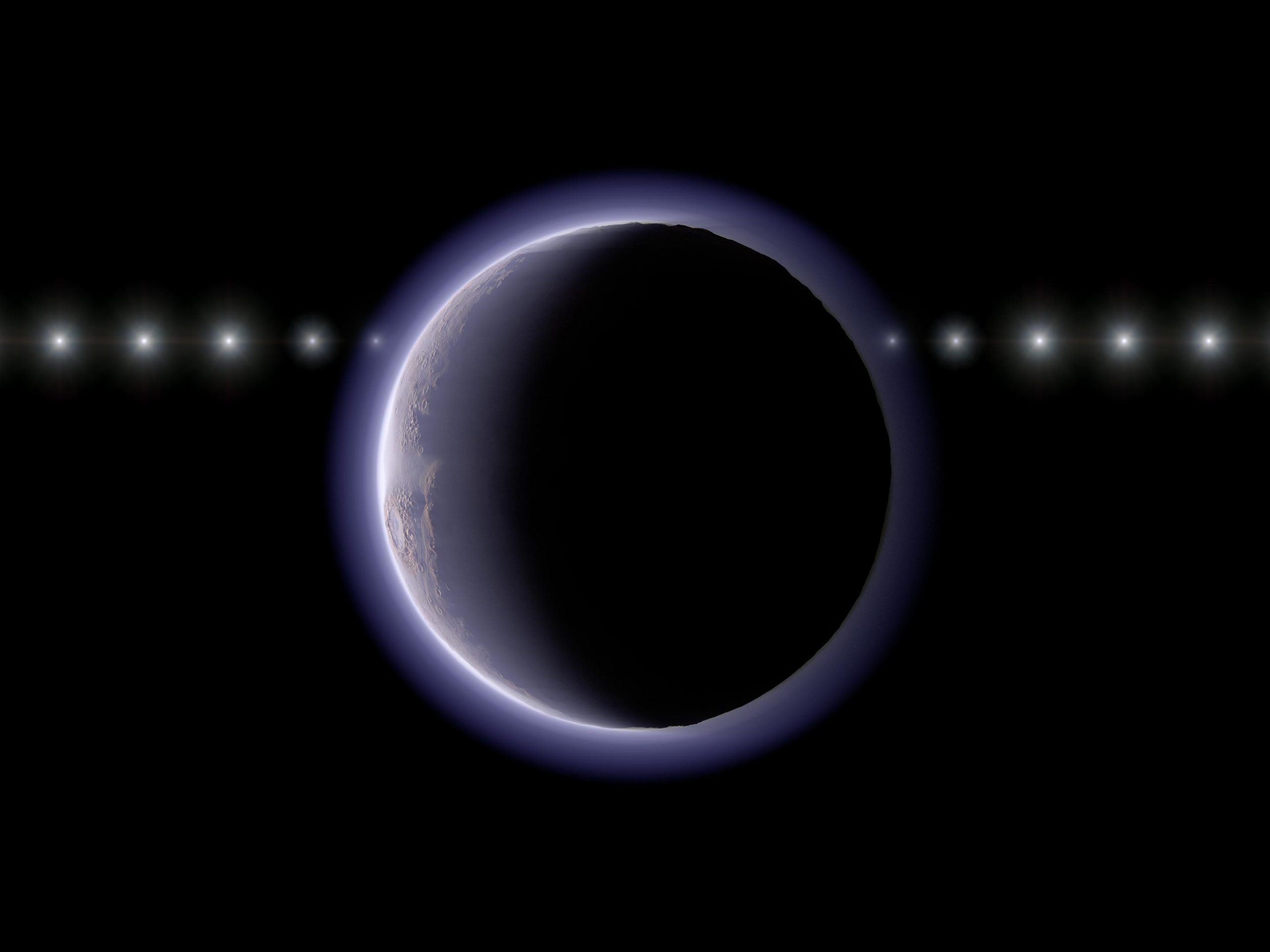
    Star Passes Behind TNO With Atmosphere
    Artist’s conception of this research showing an imagined time sequence as a star passes behind a TNO with an atmosphere. Credit: NAOJ

    A tiny world in our Solar System has an atmosphere it shouldn’t—hinting something dramatic happened there recently.

    A group of Japanese astronomers, including both professionals and amateur observers, has found signs of a thin atmosphere surrounding a small object far beyond Neptune. The discovery is surprising because the object is so small that it should not be able to hold onto gas for long. This raises new questions about when the atmosphere formed and what is keeping it there. Additional observations will be needed to better understand this unusual finding.

    Why Most Trans-Neptunian Objects Are Airless

    The outer Solar System is filled with icy bodies known as trans-Neptunian objects (TNOs), which orbit the Sun beyond Neptune. Pluto is the best-known example and is one of the few confirmed to have a thin atmosphere. For most TNOs, however, conditions make atmospheres unlikely. These objects are extremely cold, and their weak gravity allows gases to escape easily, leaving their surfaces exposed to space.

    Conceptual video showing how the light from a star changes when it passes behind an object with an atmosphere. Credit: NAOJ

    A Rare Stellar Alignment Provides a Clue

    To investigate further, astronomers took advantage of a fortunate “natural experiment” involving a TNO called (612533) 2002 XV93. This object, often shortened to 2002 XV93, is about 500 km in diameter, much smaller than Pluto, which measures 2,377 km across.

    On January 10, 2024, 2002 XV93 passed directly in front of a distant star as seen from Japan. Events like this allow scientists to study distant objects in detail. If the object has no atmosphere, the star’s light should vanish instantly. If gas surrounds it, the light dims gradually as it passes through the atmosphere before disappearing.

    Observations Reveal Signs of a Thin Atmosphere

    A team led by Ko Arimatsu at NAOJ Ishigakijima Astronomical Observatory monitored this event from several locations across Japan. Their measurements showed a pattern of fading starlight consistent with the presence of a thin atmosphere. This suggests that 2002 XV93 is not completely bare, as previously expected.

    A Short-Lived Atmosphere With an Unknown Source

    Further analysis indicates that this atmosphere cannot last long. Calculations suggest it would dissipate in less than 1000 years unless new material is continually added. This means the atmosphere must have formed or been refreshed in the recent past.

    Observations from the James Webb Space Telescope add to the mystery. They show no clear evidence of surface ice that could slowly turn into gas and maintain the atmosphere. Scientists are now considering other explanations. One idea is that material from inside the object reached the surface and released gas. Another possibility is that a comet impact supplied or triggered the release of gas, creating a temporary atmosphere.

    More data will be needed to determine which explanation is correct and to understand how such a small object can briefly support an atmosphere at all.

    Reference: “Detection of an atmosphere on a trans-Neptunian object beyond Pluto” by Ko Arimatsu, Fumi Yoshida, Tsutomu Hayamizu, Satoshi Takita, Katsumasa Hosoi, Takafumi Ootsubo and Jun-ichi Watanabe, 4 May 2026, Nature Astronomy.
    DOI: 10.1038/s41550-026-02846-1

    Never miss a breakthrough: Join the SciTechDaily newsletter.
    Follow us on Google and Google News.

    Astronomy Atmosphere National Institutes of Natural Sciences
    Share. Facebook Twitter Pinterest LinkedIn Email Reddit

    Related Articles

    Venus’ Evil Twin or Earth’s Long-Lost Sibling? The Intriguing Case of Gliese 12 b

    Stellar Revelation: AI Discovers the Universe’s First Stars Weren’t Alone

    Spiral Pattern Provides New Clues Into How High-Mass Stars Form

    New Innovative System Evaluates the Habitability of Distant Planets

    Discovery of Laughing Gas in Space Could Mean Alien Life

    Astronomy & Astrophysics 101: Atmosphere

    New Supercomputer Simulations Provide Clue to Missing Planets Mystery

    Astronomers Use Artificial Intelligence to Reveal the Actual Shape of the Universe

    ALMA Peers Back 12.4 Billion Years and Discovers the Most Ancient Galaxy of Its Kind Ever Observed

    Leave A Reply Cancel Reply

    • Facebook
    • Twitter
    • Pinterest
    • YouTube

    Don't Miss a Discovery

    Subscribe for the Latest in Science & Tech!

    Trending News

    Scientists May Have Discovered How To Heal Damaged Kidneys

    Interstellar Visitor 3I/ATLAS Is Bursting With an Unexpected Chemical

    Scientists Just Found All 5 Genetic “Letters” of DNA and RNA on an Asteroid

    The 4,000-Year-Old City That Defied History’s Rules on Wealth and Power

    The World’s Biggest Population Fear Has Flipped – and It Could Change Everything

    This “Fake” Pill Improved Memory and Physical Performance in Just 3 Weeks

    Scientists Say Frequent Ejaculation May Improve Sperm Quality and Fertility

    Scientists Have Found “The Heaven Sword” After Years of Looking

    Follow SciTechDaily
    • Facebook
    • Twitter
    • YouTube
    • Pinterest
    • Newsletter
    • RSS
    SciTech News
    • Biology News
    • Chemistry News
    • Earth News
    • Health News
    • Physics News
    • Science News
    • Space News
    • Technology News
    Recent Posts
    • Scientists Uncover a Previously Unknown Lineage of Ancient Marsupials
    • Critically Endangered Monkey Defies the Odds With New Baby After Surgery
    • 17-Million-Year-Old Ape Fossil in Egypt Could Change What We Know About Human Origins
    • NASA’s Orbiting Quantum Lab Pushes Deeper Into the Unknown
    • NASA’s James Webb Discovers Bizarre Salt Clouds on the Pink Planet
    Copyright © 1998 - 2026 SciTechDaily. All Rights Reserved.
    • Science News
    • About
    • Contact
    • Editorial Board
    • Privacy Policy
    • Terms of Use

    Type above and press Enter to search. Press Esc to cancel.