
Close Menu
    Facebook X (Twitter) Instagram
    SciTechDaily
    • Biology
    • Chemistry
    • Earth
    • Health
    • Physics
    • Science
    • Space
    • Technology
    Facebook X (Twitter) Pinterest YouTube RSS
    SciTechDaily
    Home»Space»Stellar Revelation: AI Discovers the Universe’s First Stars Weren’t Alone
    Space

    Stellar Revelation: AI Discovers the Universe’s First Stars Weren’t Alone

    By National Institutes of Natural SciencesApril 10, 2023No Comments4 Mins Read
    Facebook Twitter Pinterest Telegram LinkedIn WhatsApp Email Reddit
    Share
    Facebook Twitter LinkedIn Pinterest Telegram Email Reddit
    AI Finds That First Stars Were Clustered Together
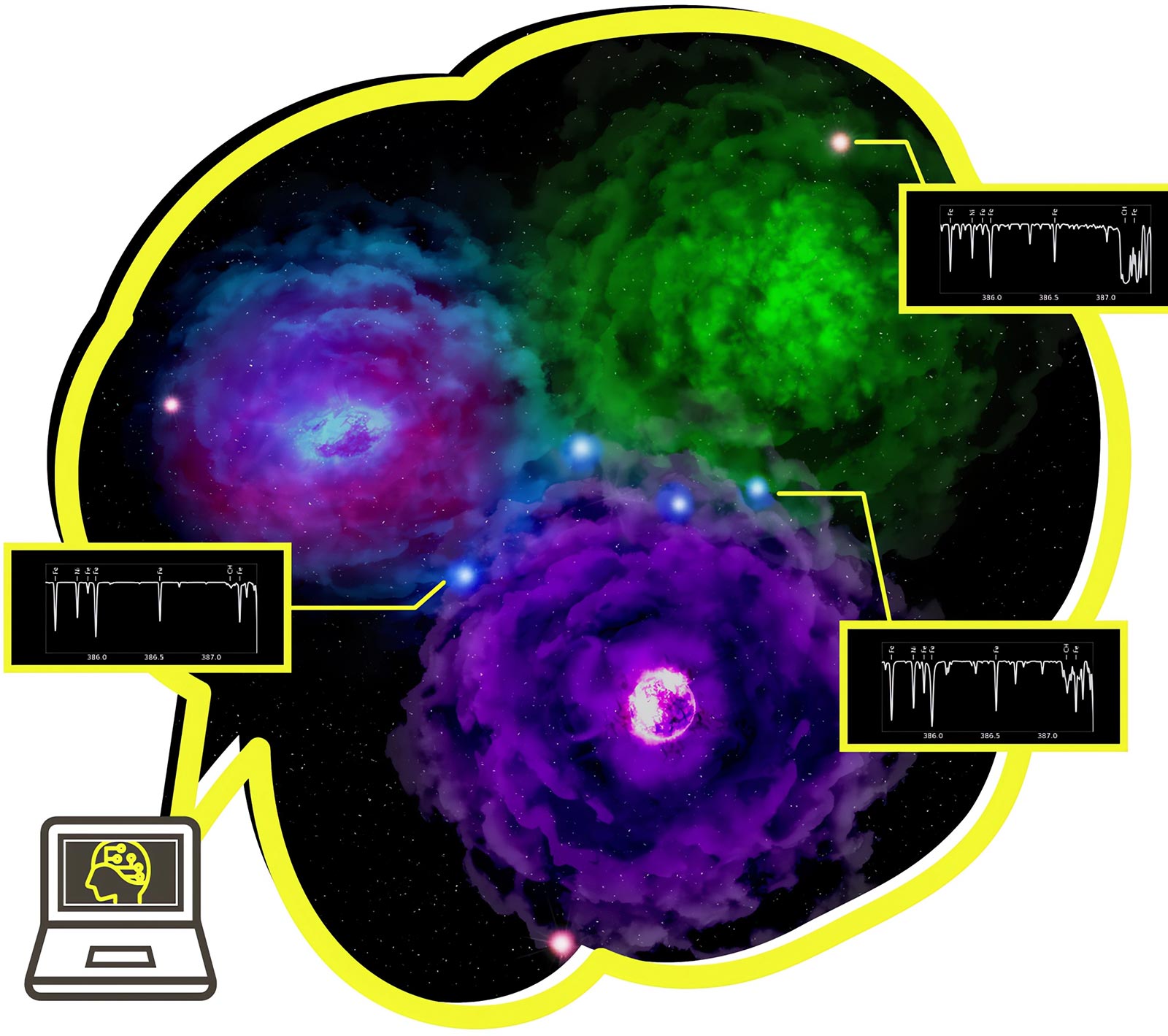
    Ejecta from the first supernovae (cyan, green, and purple objects surrounded by clouds of ejected material) enrich the primordial hydrogen and helium gas with heavy elements. If the first stars were born as multiple stellar systems, rather than as isolated single stars, elements ejected by different supernovae would be mixed together and incorporated into the next generation of stars. The characteristic chemical abundances in such a mechanism are preserved in the atmospheres of long-lived stars. The team invented a machine learning algorithm to distinguish between the observed stars (shown in red in the diagram) formed out of the ejecta of a single supernova and stars (shown in blue in the diagram) formed out of ejecta from multiple supernovae, based on measured elemental abundances from the spectra of the stars. Credit: Kavli IPMU

    Using artificial intelligence, an international team analyzed the chemical composition of extremely metal-poor stars, finding that the first stars in the Universe were likely born in groups rather than individually. This method will be applied to future observations to better understand the early Universe.

    An international team has used artificial intelligence to analyze the chemical abundances of old stars and found indications that the very first stars in the Universe were born in groups rather than as isolated single stars. Now the team hopes to apply this method to new data from on-going and planned observation surveys to better understand the early days of the Universe.

    After the Big Bang, the only elements in the Universe where hydrogen, helium, and lithium. Most of the other elements making up the world we see around us were produced by nuclear reactions in stars. Some elements are formed by nuclear fusion at the core of a star, and others form in the explosive supernova death of a star. Supernovae also play an important role in scattering the elements created by stars, so that they can be incorporated into the next generation of stars, planets, and possibly even living creatures.

    The first generation of stars, the first to produce elements heavier than lithium, are of particular interest. But first-generation stars are difficult to study because none have ever been observed directly. It is thought that they have all already exploded as supernovae. Instead, researchers try to draw inferences about first-generation stars by studying the chemical signature the first generation of supernovae imprinted on the next generation of stars. Based on their composition, extremely metal-poor stars are believed to be stars formed after the first round of supernovae. Extremely metal-poor stars are rare, but enough have been found now to be analyzed as a group.

    Evidence for Clustered Star Formation

    In this study, a team including members from the University of Tokyo/Kavli IPMU, National Astronomical Observatory of Japan, and University of Hertfordshire took a novel approach of using artificial intelligence to interpret elemental abundances in over 450 extremely metal-poor stars observed by telescopes including the Subaru Telescope. They found that 68% of the observed extremely metal-poor stars have a chemical fingerprint that is consistent with enrichment by multiple previous supernovae.

    In order for the ejecta from multiple previous supernovae to get mixed together in a single star, the supernovae must have occurred in close proximity. This means that in many cases first-generation stars must have formed together in clusters rather than as isolated stars. This offers the first quantitative constraint based on observations for the multiplicity of the first stars.

    Now the team hopes to apply this method to Big Data from current and future observing programs, such as the data expected from the Prime Focus Spectrograph on the Subaru Telescope.

    These results appeared as Hartwig et al. “Machine Learning Detects Multiplicity of the First Stars in Stellar Archaeology Data” in The Astrophysical Journal on March 22, 2023.

    For more on this research, see Artificial Intelligence Sheds New Light on the Mysterious First Stars.

    Reference: “Machine Learning Detects Multiplicity of the First Stars in Stellar Archaeology Data” by Tilman Hartwig, Miho N. Ishigaki, Chiaki Kobayashi, Nozomu Tominaga and Ken’ichi Nomoto, 22 March 2023, The Astrophysical Journal.
    DOI: 10.3847/1538-4357/acbcc6

    Funding: Ministry of Education, Culture, Sports, Science and Technology-Japan, Japan Society for the Promotion of Science, UK Science and Technology Facility Council, Leverhulme Trust

    Never miss a breakthrough: Join the SciTechDaily newsletter.
    Follow us on Google and Google News.

    Artificial Intelligence Astronomy Astrophysics Machine Learning National Institutes of Natural Sciences Supernova
    Share. Facebook Twitter Pinterest LinkedIn Email Reddit

    Related Articles

    Artificial Intelligence Reveals a Stunning, High-Definition View of M87’s Big Black Hole

    Peering Into the Abyss: Machine Learning Enhances M87 Black Hole Image

    State-of-the-Art Artificial Intelligence Sheds New Light on the Mysterious First Stars

    Astronomers Use Artificial Intelligence to Reveal the Actual Shape of the Universe

    Unknown Physics on the Cosmic Scale? 1000 Supernova Explosions Chart the Expansion History of the Universe

    AI “Magic” Just Removed One of the Biggest Roadblocks in Astrophysics

    Seeing Quadruple: Artificial Intelligence Leads to Discovery That Can Help Solve Cosmological Puzzles

    Doubling the Number of Known Gravitational Lenses Using Artificial Intelligence

    Artificial Intelligence Classifies Real Supernova Explosions With Unprecedented Accuracy

    Leave A Reply Cancel Reply

    • Facebook
    • Twitter
    • Pinterest
    • YouTube

    Don't Miss a Discovery

    Subscribe for the Latest in Science & Tech!

    Trending News

    Millions of People Have Osteopenia Without Realizing It – Here’s What You Need To Know

    Researchers Discover Boosting a Single Protein Helps the Brain Fight Alzheimer’s

    World-First Study Reveals Human Hearts Can Regenerate After a Heart Attack

    Why Your Dreams Feel So Real Sometimes and So Strange Other Times

    This Simple Home Device May Boost Brain Power in Adults Over 40

    Enormous Prehistoric Insects Puzzle Scientists

    Scientists Develop Bioengineered Chewing Gum That Could Help Fight Oral Cancer

    After 37 Years, the World’s Longest-Running Soil Warming Experiment Uncovers a Startling Climate Secret

    Follow SciTechDaily
    • Facebook
    • Twitter
    • YouTube
    • Pinterest
    • Newsletter
    • RSS
    SciTech News
    • Biology News
    • Chemistry News
    • Earth News
    • Health News
    • Physics News
    • Science News
    • Space News
    • Technology News
    Recent Posts
    • After 100 Years, Scientists Uncover Hidden Rule Governing Cosmic Rays
    • The Milky Way Has a Hidden Edge and Scientists Finally Mapped It
    • Scientists Stunned by New Organic Molecules Found on Mars
    • Scientists Discover Evolution’s 120-Million-Year-Old “Cheat Sheet”
    • This New “Sound Laser” Could Measure Gravity With Stunning Precision
    Copyright © 1998 - 2026 SciTechDaily. All Rights Reserved.
    • Science News
    • About
    • Contact
    • Editorial Board
    • Privacy Policy
    • Terms of Use

    Type above and press Enter to search. Press Esc to cancel.