
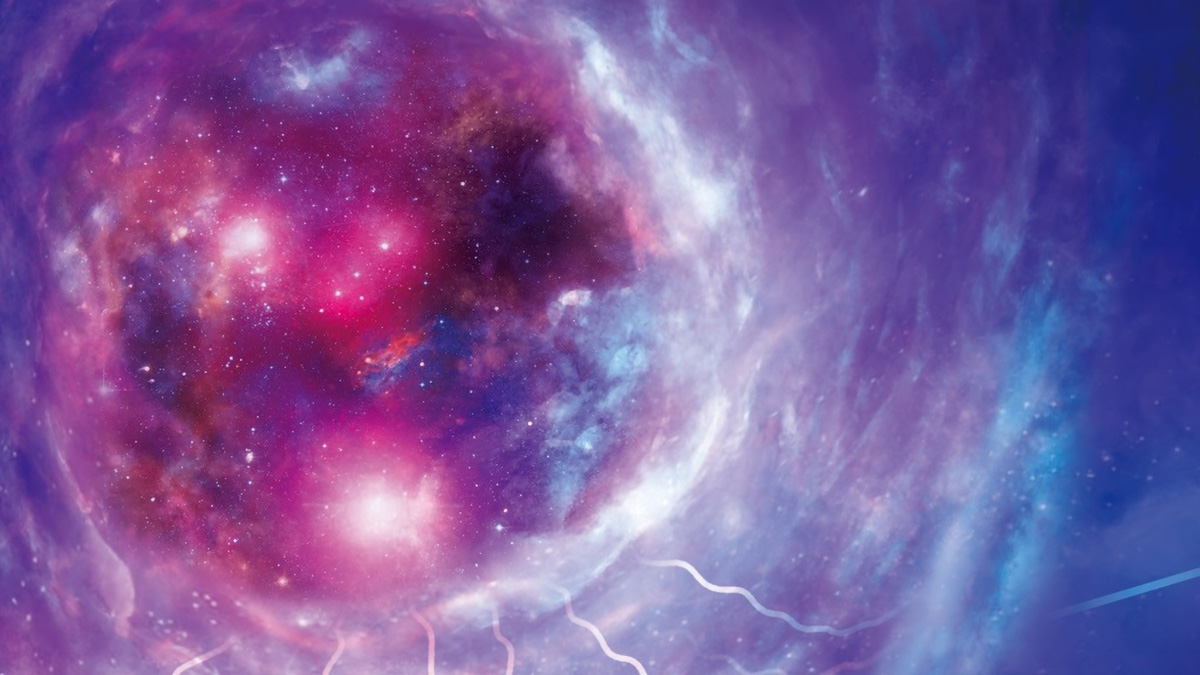
The Large High Altitude Air Shower Observatory (LHAASO) has discovered a giant ultra-high-energy gamma-ray bubble structure in the Cygnus star-forming region, which is the first time that the origin of cosmic rays with energy higher than 10 Peta-Electronvolt (PeV, 1PeV=1015eV) has been discovered.
This achievement was published in the form of a cover article in Science Bulletin on February 26.
The research was completed by the LHAASO Collaboration led by Prof. Cao Zhen as the spokesperson from the Institute of High Energy Physics of the Chinese Academy of Sciences. Dr. Gao Chuandong, Dr. Li Cong, Prof. Liu Ruoyu, and Prof. Yang Ruizhi are the co-corresponding authors of the paper.
Cosmic rays are charged particles from outer space, mainly composed of protons. The origin of cosmic rays is one of the most important frontier issues in modern astrophysics. Measurements of cosmic rays in past decades have revealed a break around 1 PeV in the energy spectrum (i.e., the distribution of cosmic ray abundance as a function of the particle energy), which is called the “knee” of the cosmic ray energy spectrum due to its shape resembling a knee joint.
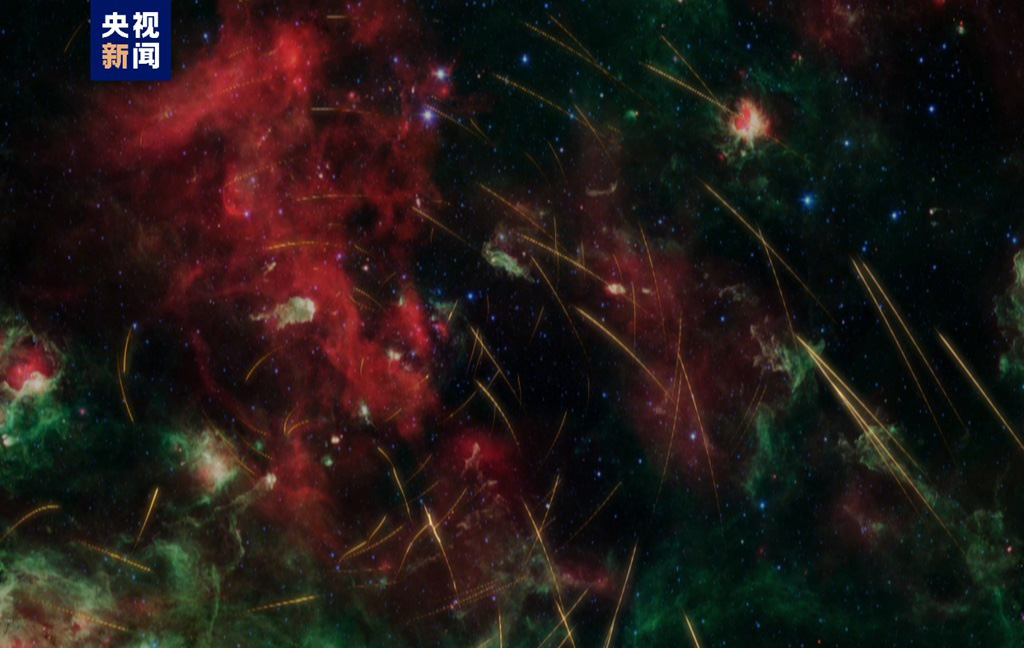
Scientists believe that cosmic rays with energy lower than the “knee” originate from astrophysical objects within the Milky Way, and the existence of the “knee” also indicates that the energy limit for accelerating protons from most of the cosmic ray sources in the Milky Way is around a few PeV. However, the origin of cosmic rays in the “knee” region is still an unsolved mystery and one of the most intriguing topics in cosmic ray research in recent years.
Discovery of a Super Cosmic Ray Accelerator
LHAASO has discovered a giant ultra-high-energy gamma-ray bubble structure in the Cygnus star-forming region, with multiple photons exceeding 1 PeV inside the structure, with the highest energy reaching 2.5 PeV, indicating the presence of a super cosmic ray accelerator inside the bubble, which continuously accelerates high-energy cosmic ray particles with energies of up to 20 PeV and injects them into interstellar space. These high-energy cosmic rays collide with interstellar gas and produce gamma rays. The intensity of these gamma-ray photons is clearly correlated with the distribution of the surrounding gas, and the massive star cluster (the OB association, Cygnus OB2) near the center of the bubble is the most promising candidate for the super cosmic ray accelerator. Cygnus OB2 is composed of many young, hot, massive stars with surface temperatures exceeding about 35,000 °C (O-type stars) and 15,000 °C (B-type stars).

The radiation luminosity of these stars is hundreds to millions of times that of the Sun, and the huge radiation pressure blows away the surface material of the stars, forming dynamic stellar winds with speeds up to thousands of kilometers per second. The collision of stellar winds with the surrounding interstellar medium and the violent collision between stellar winds have created ideal sites for efficient particle acceleration. This is the first super cosmic ray accelerator identified as of now. With increasing observation time, LHAASO is expected to detect more super cosmic ray accelerators, and hopefully solve the mystery of the origin of cosmic rays in the Milky Way.
LHAASO’s observation has also indicated that the super cosmic ray accelerator inside the bubble significantly increases the cosmic ray density in the surrounding interstellar space, far exceeding the average level of cosmic rays in the Milky Way. The spatial extension of the density excess even exceeds the observed range of bubbles, providing a possible explanation for the excess of diffuse gamma-ray emission from the Galactic Plane previously detected by LHAASO.
Prof. Elena Amato, a renowned astrophysicist from the Italian National Institute for Astrophysical (INAF), highlighted the impact of the discovery on the origin of Cosmic Rays in general. She also commented that these results “not only impacts our understanding of diffuse emission, but has also very relevant consequences on our description of cosmic ray (CR) transport in the Galaxy.”
Reference: “An ultrahigh-energy γ-ray bubble powered by a super PeVatron” by LHAASO Collaboration, 23 December 2023, Science Bulletin.
DOI: 10.1016/j.scib.2023.12.040
Never miss a breakthrough: Join the SciTechDaily newsletter.
Follow us on Google and Google News.
1 Comment
So, this line draw my attention, “Cygnus OB2 is composed of many young, hot, massive stars with surface temperatures exceeding about 35,000 °C (O-type stars) and 15,000 °C (B-type stars).” BUT HIP 105186, 68 Cyg, O8(V), 16,800 x Sun (at 7.5264 au if seen wit Appp. diameter of 1dec8min45.4sec)
16 x Radius(of Sun) Radius in meters(11.3 x 10^9m) Surface temp 35,800 K, nearest out to 2,473.0 light years
e = .04300728431 in ((givenLum) / (4pi x sig x (given radius in meter)^2 x (given temp in kelvins)^4))